All species › Passerines › Chats and flycatchers › Red-Rumped Wheatear
Red-Rumped Wheatear | Oenanthe moesta
Roodstuittapuit | Collalba culirroja
The Red-rumped Wheatear is a bulky wheatear with a big head and a rusty rump, a resident of the semi-deserts along the northern edge of the Sahara and of the desert steppe of the Levant and Mesopotamia. It is almost confined to the region.

Voice
The song is short and untidy, with rattling, buzzing and whistled notes and some mimicry; in Cyrenaica and the Levant more melodious, like twee-churr-urr-urr. Male and female sing in duet, sometimes in a short song flight. The call is a hard chak and a whirring chrrr.
Recording: Stanislas Wroza — CC BY-NC-SA 4.0 · shortened to the first 60 s, mono · xeno-canto
Identification
15.5–16.5 cm. Sturdy, with a big head, short wings and a fairly long tail. The male has a grey-white crown and nape, a narrow white supercilium, a black face and a black throat continuing into a black, slightly scaly mantle and black wings with white fringes. Underparts off-white to buff. Rump and tail base warm rusty brown to orange, the rest of the tail blackish-brown. The female lacks black: head and cheeks rusty brown, back grey-brown, underparts creamy white, and the same rusty rump and tail base with a dark tail end. The eastern form brooksbanki is somewhat paler.
Confusion species
No other wheatear in the region combines a rusty rump with a black throat. Kurdish Wheatear (Oenanthe xanthoprymna) and Red-tailed Wheatear (Oenanthe chrysopygia) also have a rusty rump, but a tail with much white (Kurdish) or rufous (Red-tailed) at the sides and no grey crown. The female Desert Wheatear (Oenanthe deserti) has a white rump and an entirely black tail.
Habitat
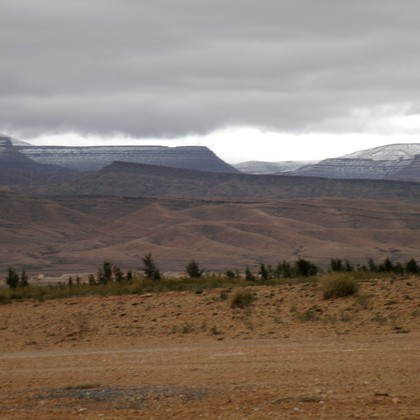
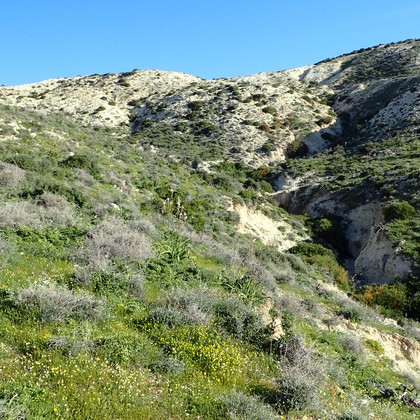
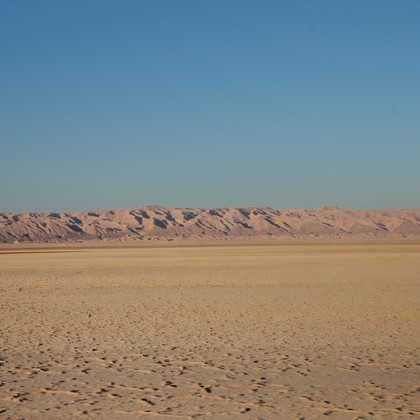
Flat, sparsely vegetated semi-desert, the edges of salt flats, chotts and sebkhas, dry river beds and low stony hills; often near ruins, wells or pits. Avoids true sand and stone desert. In Morocco on more vegetated ground than Desert Wheatear.
Where the bird is most at home, classified by the habitats of North Africa and the Middle East.
Range and movements
The form moesta breeds from Western Sahara and eastern and southern Morocco across the High Plateaux and northern Sahara of Algeria and southern Tunisia to the coastal plains of Libya (Tripolitania and Cyrenaica) and north-western Egypt, east to near Alexandria; also in the far north of Mauritania. The form brooksbanki lives in southern Syria, eastern Jordan, north-western Saudi Arabia and western and south-western Iraq. A rare wanderer to Israel and Kuwait.
- Resident
- Winter visitor (c. Apr–Sep)
- Passage (Mar–Apr, Oct–Nov)
- dark = core range, pale = thinly spread
How and when to look
In Morocco on the plains around Boumalne-Dadès, Errachidia or the Tafilalt, in Jordan in the basalt desert around Azraq. The male likes to sit on a wall or gravestone; the female with her rusty head is just as striking.
Conservation status
Not globally threatened. Locally declining through overgrazing and the spread of irrigated farming onto the steppe, but common over large parts of its range.
Scientific name
Oenanthe moesta | (Lichtenstein, 1823)
Lichtenstein described the species in 1823 as Saxicola moesta; because it was later moved to another genus, the author and year stand in brackets. The genus Oenanthe was introduced in 1816 by Vieillot. Oenanthe was used by Aristotle for a bird that can no longer be identified; the word comes from the Greek oinos, oinoē 'wine, vine' and anthos 'flower, bloom'. moesta is Latin for 'sad', after the sombre grey-black plumage of the male. The specimen the first description was based on came from Egypt.