All species › Waterfowl › Ducks, geese and swans › Ruddy Shelduck
Ruddy Shelduck | Tadorna ferruginea
Casarca | Tarro canelo
The Ruddy Shelduck is a large, orange-brown shelduck of open, dry country with salt lakes and reservoirs. In the Maghreb it is a characteristic bird of the Atlas and the high plateaus, where pairs fly honking loudly over bare slopes and small lakes.

Voice
A loud, nasal, honking aang or a-ong, often repeated and far-carrying, especially in flight; the female calls higher and hoarser. Pairs and flocks call a great deal, also at night.
Recording: Bo Shunqi 薄顺奇 — CC BY-NC-SA 4.0 · converted to mono · xeno-canto
Identification
About 64 cm, plain orange-rufous with a distinctly paler, cream to buff head. The bill and legs are black. In the breeding season the male has a narrow black neck ring; the female lacks it and has a whiter face. In flight the white wing coverts, black primaries and green-glossed secondaries contrast strongly; the tail is black. Juveniles are duller and greyer brown.
Confusion species
The Egyptian Goose (Alopochen aegyptiaca) shows the same white wing panel but is grey-brown with a chestnut eye patch and a pink bill and legs. Feral birds or escaped shelducks from waterfowl collections, such as the South African Shelduck, can cause confusion; the male of that species has a grey head.
Habitat
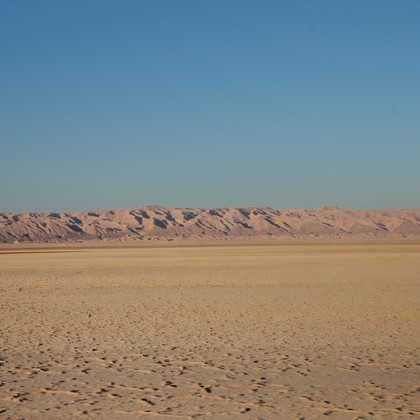
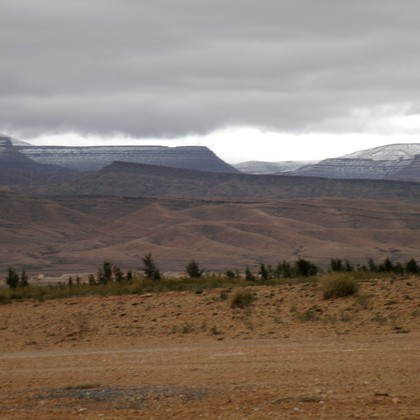
Salt lakes, chotts, riverbeds, reservoirs and mountain lakes in open, dry and often bare country, up to high in the mountains. It grazes on shores, fields and steppe. It nests in rock crevices, holes in steep banks and walls, tree holes or old buildings, sometimes far from water.
Where the bird is most at home, classified by the habitats of North Africa and the Middle East.

Range and movements
In Morocco resident in the Middle and High Atlas, on the eastern high plateaus and at the reservoirs south of the Atlas, such as El Mansour Eddahbi near Ouarzazate, where flocks of hundreds gather after the breeding season; in Algeria on the high plateaus and at the chotts; scarce in Tunisia. In the Middle East mainly a winter visitor to Iraq, Syria, Israel and Jordan, scarce on the Persian Gulf and elsewhere in Arabia, and rare in Egypt. Beyond the region from Turkey and south-east Europe east through the Central Asian steppes to Mongolia and China, with an isolated population in the Ethiopian highlands.
- Resident
- Summer visitor (c. Apr–Sep)
- Winter visitor (c. Oct–Mar)
- Passage (Mar–Apr, Oct–Nov)
- dark = core range, pale = thinly spread
How and when to look
In autumn drive along the reservoirs near Ouarzazate or the small lakes around Ifrane in the Middle Atlas. The birds are heard before they are seen: the honking calls carry for kilometres over open country.
Conservation status
Not threatened and stable or increasing over much of its range. In North Africa the population is smaller than formerly owing to the drying out of wetlands, but it benefits locally from new reservoirs. Sensitive to hunting and disturbance at breeding sites.
Scientific name
Tadorna ferruginea | (Pallas, 1764)
Pallas described the species in 1764 as Anas ferruginea; because it was later moved to another genus, the author and year stand in brackets. The genus Tadorna was introduced in 1822 by Boie. Tadorna comes through French tadorne from an older, probably Celtic name for a pied waterfowl. ferruginea is Latin for 'rust-coloured', from ferrugo 'iron rust', after the orange-brown plumage. The specimen the first description was based on came from Central Asia.