All species › Waders, gulls and terns › Sandpipers and snipes › Sanderling
Sanderling | Calidris alba
Drieteenstrandloper | Correlimos tridáctilo
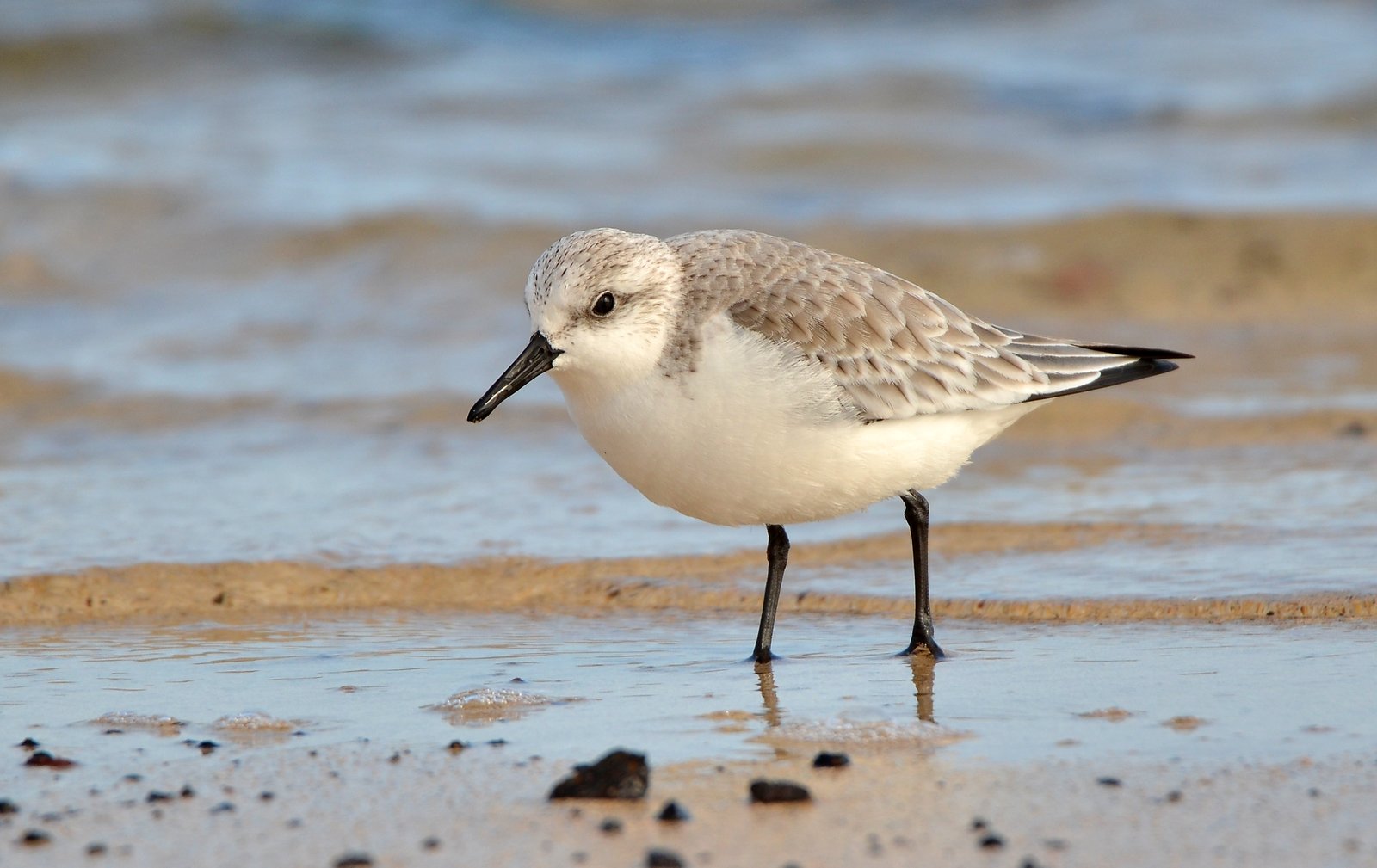
The pale, running sandpiper of the surf line, scurrying like a clockwork toy after every retreating wave. In the region it is a common winter visitor to sandy beaches, from Morocco's Atlantic coast to the Arabian Sea off Oman.
Voice
A short, clear twick or plit, often in flight; flocks give a soft twittering. Clearer and less rasping than the call of Dunlin.
Recording: Daan van der Hoeven — CC BY-NC-SA 4.0 · converted to mono · xeno-canto
Identification
Slightly larger and sturdier than Dunlin, with a short, straight black bill and black legs lacking a hind toe. In winter plumage strikingly white: pale grey upperparts, snow-white underparts and a black carpal patch on the leading edge of the wing, often visible as a dark shoulder mark. In breeding plumage (April–May, sometimes seen on passage) head, breast and back are rufous with black spotting. Juveniles have a black-and-white chequered back. In flight a broad, crisp white wing bar.
Confusion species
Dunlin (Calidris alpina) is darker and greyer, longer-billed with a slightly drooping tip, and lacks the black carpal patch. Little Stint (Calidris minuta) is much smaller and browner. A breeding-plumaged Sanderling can recall Red-necked Stint (Calidris ruficollis), which is barely recorded in the region and is much smaller. Running along the tideline is the best feature at a distance.
Habitat
Broad sandy beaches with surf, where it picks small bivalves, crustaceans and worms along the tideline; also tidal flats, sandbanks and coastal lagoons. At high tide it roosts in compact flocks on the beach or on sandbars. Rare inland, on passage occasionally at salt pans and lakes.
Where the bird is most at home, classified by the habitats of North Africa and the Middle East.

Range and movements
Along almost all sandy coasts of the region. In Morocco common on the Atlantic coast, from Larache and Merja Zerga via Sidi Moussa and Oualidia to Khnifiss and Dakhla Bay in Western Sahara. Along the Mediterranean in smaller numbers on the beaches of Algeria, Tunisia (Gulf of Gabès), Libya, the Nile Delta and northern Sinai (Bardawil) and the coast of Israel. Along the Red Sea from the Gulf of Suez and Eilat to Yemen, and in the Gulf from Kuwait and Bahrain to the Emirates. The largest numbers winter on the Arabian Sea: Barr al Hikman and Masirah in Oman hold thousands; also on Socotra. Beyond the region it breeds on the high-Arctic tundra and winters on beaches worldwide.
- Resident
- Summer visitor (c. Oct–Mar)
- Winter visitor (c. Apr–Sep)
- Passage (Mar–Apr, Oct–Nov)
- dark = core range, pale = thinly spread
How and when to look
Walk a sandy beach at low tide in winter: the small flocks keep to the surf and are quick and easy to see. The beaches at Oualidia and Dakhla Bay in Morocco and the coasts of Masirah and Barr al Hikman in Oman are good sites. In April–May birds moulting into rufous breeding plumage can be seen at Eilat and in the Gulf.
Conservation status
Not globally threatened, with a very large population. In the region it suffers from beach disturbance by tourism, coastal development and driving on beaches, and from pollution along the Gulf coast. Well-protected intertidal areas such as Barr al Hikman and Dakhla Bay are important for wintering birds.
Scientific name
Calidris alba | (Pallas, 1764)
Pallas described the species in 1764 as Trynga alba; because it was later moved to another genus, the author and year stand in brackets. The genus Calidris was introduced in 1804 by Merrem. Calidris goes back to Ancient Greek kalidris or skalidris, a name Aristotle used for an unidentified grey waterside bird. alba is Latin for 'white', after the pale winter plumage. The specimen the first description was based on came from the North Sea coast.