All species › Passerines › Chats and flycatchers › Siberian Stonechat
Siberian Stonechat | Saxicola maurus
Aziatische roodborsttapuit | Tarabilla siberiana
The Siberian Stonechat is the eastern counterpart of the European Stonechat, breeding from eastern Turkey and the Caucasus to Siberia and Japan. In the region it is a passage migrant and scarce winter visitor in the east, involving several forms that can partly be separated in the field: armenicus from eastern Turkey and Iran, variegatus from the Caspian steppes and the northern maurus.

Voice
The call is a hard chak or tek-tek, often combined with a whistled weet. The song is a short, scratchy phrase, slightly thinner and faster than that of European Stonechat; in the region mainly heard in spring.
Recording: Oscar Campbell — CC BY-NC-SA 4.0 · converted to mono · xeno-canto
Identification
12–13 cm. Slightly paler and more contrasting than European Stonechat. The spring male has a black head, a broad white neck patch, a dark mantle with pale fringes and an orange breast patch confined to the upper breast; the rest of the underparts are clean white. The best feature is the large, unstreaked white to pale orange rump. In variegatus and armenicus the tail base is also white, giving a wheatear-like tail pattern. In autumn and winter both sexes are pale sandy brown with a pale supercilium, dark underwing (black axillaries) and a plain pale orange-pink rump.
Confusion species
European Stonechat (Saxicola rubicola) is darker, with more orange on breast and flanks, a smaller, streaked white rump patch and pale axillaries; females and autumn birds are warm brown and less pale. Whinchat (Saxicola rubetra) has a striking pale supercilium, a streaked rump and white patches at the tail base. Males with a white tail base may suggest a small wheatear but perch like a stonechat on stems and bushes.
Habitat
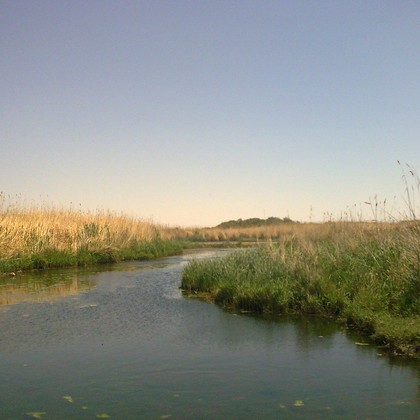
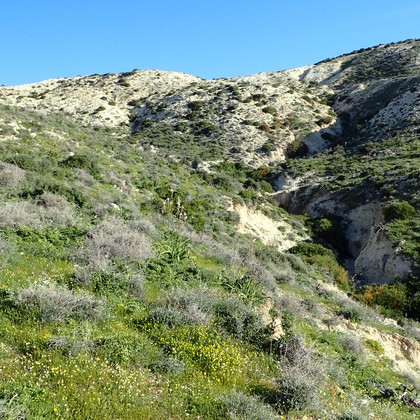
Open country with low vegetation and perches: field edges and irrigated land, reed fringes and tamarisk scrub along water, rough grassland and scrub at the edge of semi-desert. In winter often in the same habitat as European Stonechat.
Where the bird is most at home, classified by the habitats of North Africa and the Middle East.

Range and movements
Passage migrant in Iraq, Kuwait, eastern Saudi Arabia, Bahrain, Qatar, the Emirates and Oman, and scarcer in Jordan, Israel, Syria and Egypt; in the Emirates it is an uncommon migrant involving at least two forms, less numerous than European Stonechat. A few winter in Iraq, on the Gulf and in Oman; in Israel and Jordan it is a scarce migrant in March – April and October – November. The form armenicus breeds in the mountains of eastern Turkey and western Iran and possibly in Iraqi Kurdistan. In North Africa west of Egypt it is a vagrant. Beyond the region the species breeds from eastern Turkey and the Caucasus through Central Asia and Siberia to Japan and the Himalaya, wintering from north-east Africa and Arabia to South-East Asia.
- Resident
- Summer visitor (c. Oct–Mar)
- Winter visitor (c. Apr–Sep)
- Passage (Mar–Apr, Oct–Nov)
- dark = core range, pale = thinly spread
How and when to look
In spring and autumn, search the farmland of the Emirates and Oman, such as the fields around Al Ain or Sun Farms in Sohar, for stonechats with a large pale rump. A bird in flight showing black axillaries, or a male with a white tail base, makes identification easier.
Conservation status
Not globally threatened. The limits of the forms and the status of migrants in the region are still poorly known; many wintering stonechats are not identified to species in the field.
Scientific name
Saxicola maurus | (Pallas, 1773)
Pallas described the species in 1773 as Muscicapa maura; because it was later moved to another genus, the author and year stand in brackets. The genus Saxicola was introduced in 1802 by Bechstein. Saxicola is Latin, from saxum 'stone, rock' and -cola 'dweller', from colere 'to inhabit': 'rock dweller', after the open stony ground these birds keep to. maurus is Latin for 'Moorish' or 'African', and by extension 'dark' or 'black'. The specimen the first description was based on came from Karassum, Siberia.