All species › Passerines › Finches › Syrian Serin
Syrian Serin | Serinus syriacus
Syrische kanarie | Serín sirio
One of the few true endemics of the Levant: a pale, silvery-yellow serin of the mountain slopes of Lebanon, Syria, Mount Hermon and the Edom mountains of Jordan. It is Vulnerable and declining.

Voice
The song is a soft, high, sweet twittering with rolling trills, more musical and less shrill than that of European Serin, from a juniper or in a slow song flight. The call is a light, rolling tree-rilit, softer than that of European Serin, and in winter the best way to pick up flocks.
Recording: Paul Coiffard — CC BY-NC-SA 4.0 · converted to mono · xeno-canto
Identification
A small, pale finch with a long tail for its size and a washed-out, silvery appearance. Head and underparts are greyish-white with a yellow forehead, a yellow eye-ring and a yellow wash across face and breast; the back is grey with faint streaks, the rump greenish-yellow. Wing and tail have yellow edges, which catch the eye on a fluttering bird. The female is paler and browner with less yellow; juveniles are sandy brown and finely streaked.
Confusion species
European Serin (Serinus serinus) is smaller and shorter-tailed, with a thicker bill, heavily streaked flanks, a bright yellow rump and no yellow in the tail. Adult Red-fronted Serin (Serinus pusillus) has a black head with red; juveniles are a warmer cinnamon-brown. Eurasian Siskin (Spinus spinus) is greener and heavily streaked, with black and yellow wing-bars.
Habitat
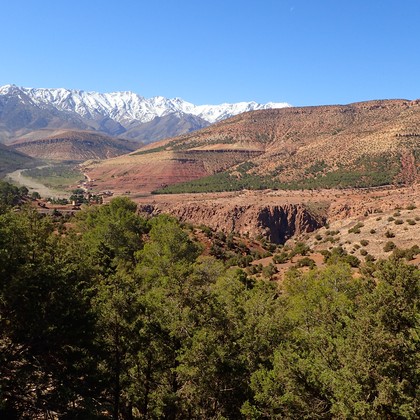
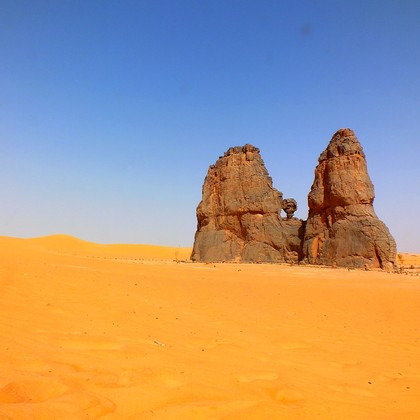
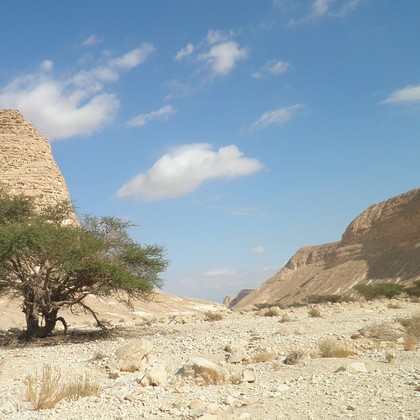
In the breeding season open, dry mountain slopes with scattered junipers, cedars, oaks and shrubs, often on limestone, between about 900 and 1900 m. Feeds on herb seeds on the ground. In winter in small flocks in wadis, on dry slopes with acacias and in scrub on the desert edge.
Where the bird is most at home, classified by the habitats of North Africa and the Middle East.
Range and movements
Breeds in Lebanon in the Lebanon and Anti-Lebanon ranges (including the Chouf cedar reserve and Horsh Ehden), in south-west Syria, on Mount Hermon in Israel (about 100–150 pairs) and in south-west Jordan in the Edom mountains, especially Dana reserve (440–490 pairs in 2022). In winter dispersing to lower areas: Judea, Samaria, the Negev, the Arava and the Eilat mountains, southern Sinai around St Catherine's, and north-west Saudi Arabia to about 27.6° N; scarce in Iraq. Beyond the region only a few wintering birds in southern Turkey.
- Resident
- Summer visitor (c. Oct–Mar)
- Winter visitor (c. Apr–Sep)
- Passage (Mar–Apr, Oct–Nov)
- dark = core range, pale = thinly spread
How and when to look
In Jordan, Dana reserve is the best place in spring and summer; listen for the soft, sweet song over the juniper slopes. In winter flocks can be found in the mountains around Eilat and in the Negev highlands, often mixed with other serins.
Conservation status
Vulnerable (VU): the world population is estimated at 7000–9999 mature birds and is declining. Overgrazing by goats and sheep, drought and tree dieback, recreation, road building and mining plans threaten the breeding areas; at Dana the population has fallen by about a quarter since 1996. Illegal trapping may also play a part.
Scientific name
Serinus syriacus | Bonaparte, 1850
Bonaparte described the species in 1850 and placed it straight away in the genus where it still stands. The genus Serinus was introduced in 1816 by Koch. Serinus is Neo-Latin for 'canary-yellow'. syriacus is Latin for 'Syrian', after the Levant, where the species breeds. The specimen the first description was based on came from Bsharri, Lebanon.