All species › Waterfowl › Ducks, geese and swans › Tundra Bean-Goose
Tundra Bean-Goose | Anser serrirostris
Toendrarietgans | Ánsar campestre de la tundra
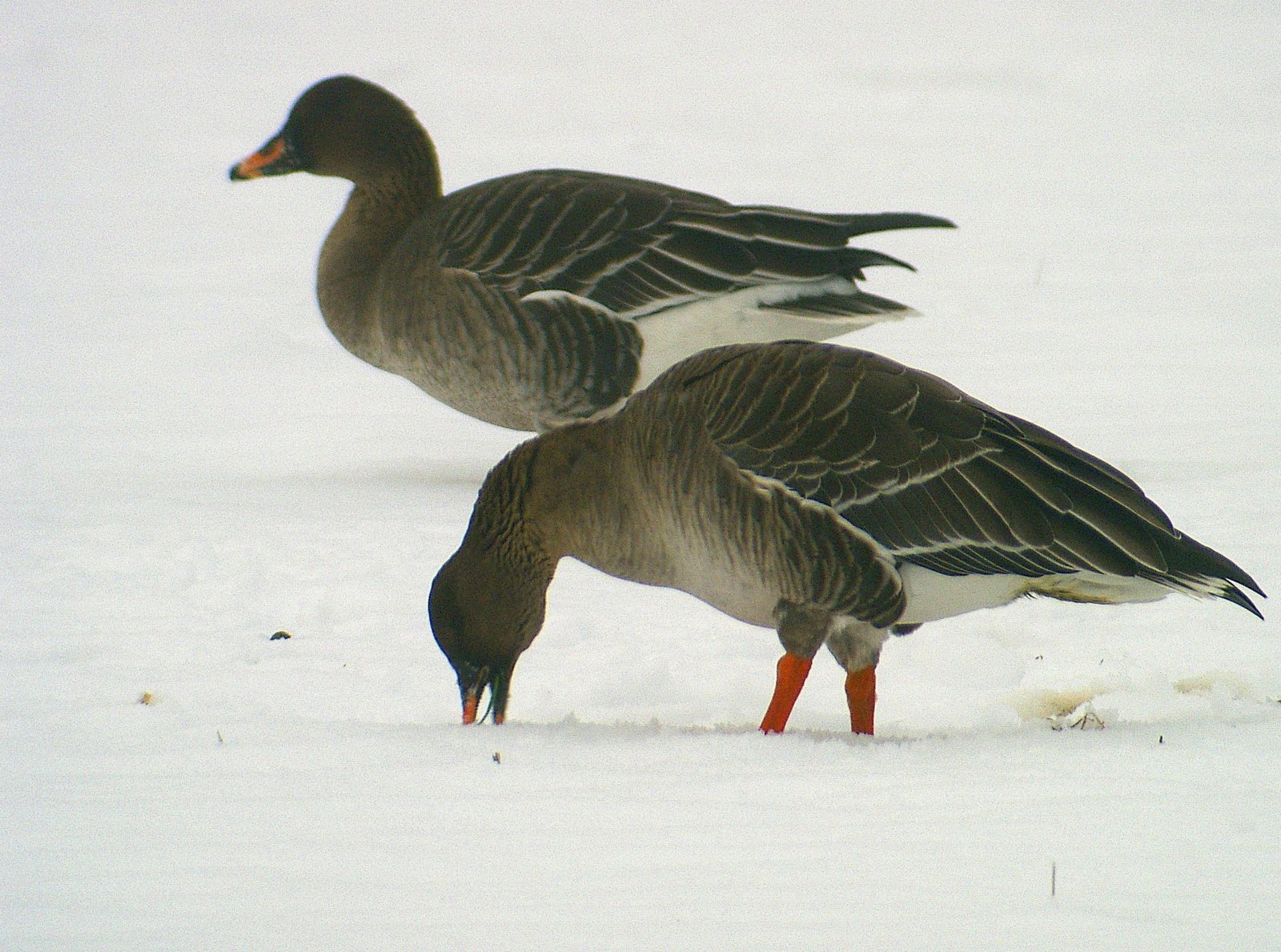
A dark brown goose with a dark head and a black bill with a narrow orange band. Tundra Bean-Goose winters in central and eastern Europe and eastern Asia and occurs in the region only as a very rare vagrant; older bean goose records are mostly not identified to species.
Voice
A low, nasal, somewhat hoarse ung-ank, deeper than Greater White-fronted Goose; in flocks a continuous murmur.
Recording: Stanislas Wroza — CC BY-NC-SA 4.0 · shortened to the first 60 s, mono · xeno-canto
Identification
Medium-sized and compact, with a short, thick neck and a rounded head. Head and neck are distinctly darker chocolate brown than the body; the upperparts are brown with pale fringes, the flanks dark-scalloped, the rear white. The bill is short and deep at the base, black with a narrow orange band just behind the tip. The legs are orange. Juveniles are duller and less crisply marked.
Confusion species
Taiga Bean-Goose (Anser fabalis) is larger, with a longer, slimmer neck, a flatter head and a long, wedge-shaped bill with more orange. Greater White-fronted Goose (Anser albifrons) has a white blaze, black belly bars and an all-pink bill. Pink-footed Goose (Anser brachyrhynchus) is paler grey on the back and has pink instead of orange on bill and legs.
Habitat
Winters on fields of winter cereals, sugar beet and maize stubble and on short grassland, roosting on large lakes or reservoirs. Breeds on the Arctic tundra of northern Russia and Siberia.
Where the bird is most at home, classified by the habitats of North Africa and the Middle East.


Range and movements
A few records in the region, among them in Israel, where the country's first bean goose was seen at Eilat in March 2007, and in Egypt (Sinai, October 1982); with older records it was often not established which of the two bean geese was involved, but Tundra Bean-Goose is the more likely. Breeds from northern Russia to eastern Siberia and winters in western and central Europe, around the Black Sea and in eastern Asia.
How and when to look
A matter of luck: in winter, especially after hard frost in eastern Europe, check flocks of Greylag and Greater White-Fronted Geese for a goose with a dark head and a black-and-orange bill. Photograph the bill side-on and the profile of head and neck to clinch the species.
Conservation status
Very rare vagrant, with a handful of records in Israel and Egypt; not established with certainty elsewhere in the region. Not globally threatened.
Scientific name
Anser serrirostris | Gould, 1852
Gould described the species in 1852 and placed it straight away in the genus where it still stands. The genus Anser was introduced in 1760 by Brisson. Anser is the Latin word for 'goose'. serrirostris is Latin, from serra 'saw' and rostrum 'bill', after the saw-like cutting edges of the bill. The specimen the first description was based on came from Shanghai, China.