All species › Passerines › Nuthatches › Western Rock Nuthatch
Western Rock Nuthatch | Sitta neumayer
Rotsklever | Trepador rupestre
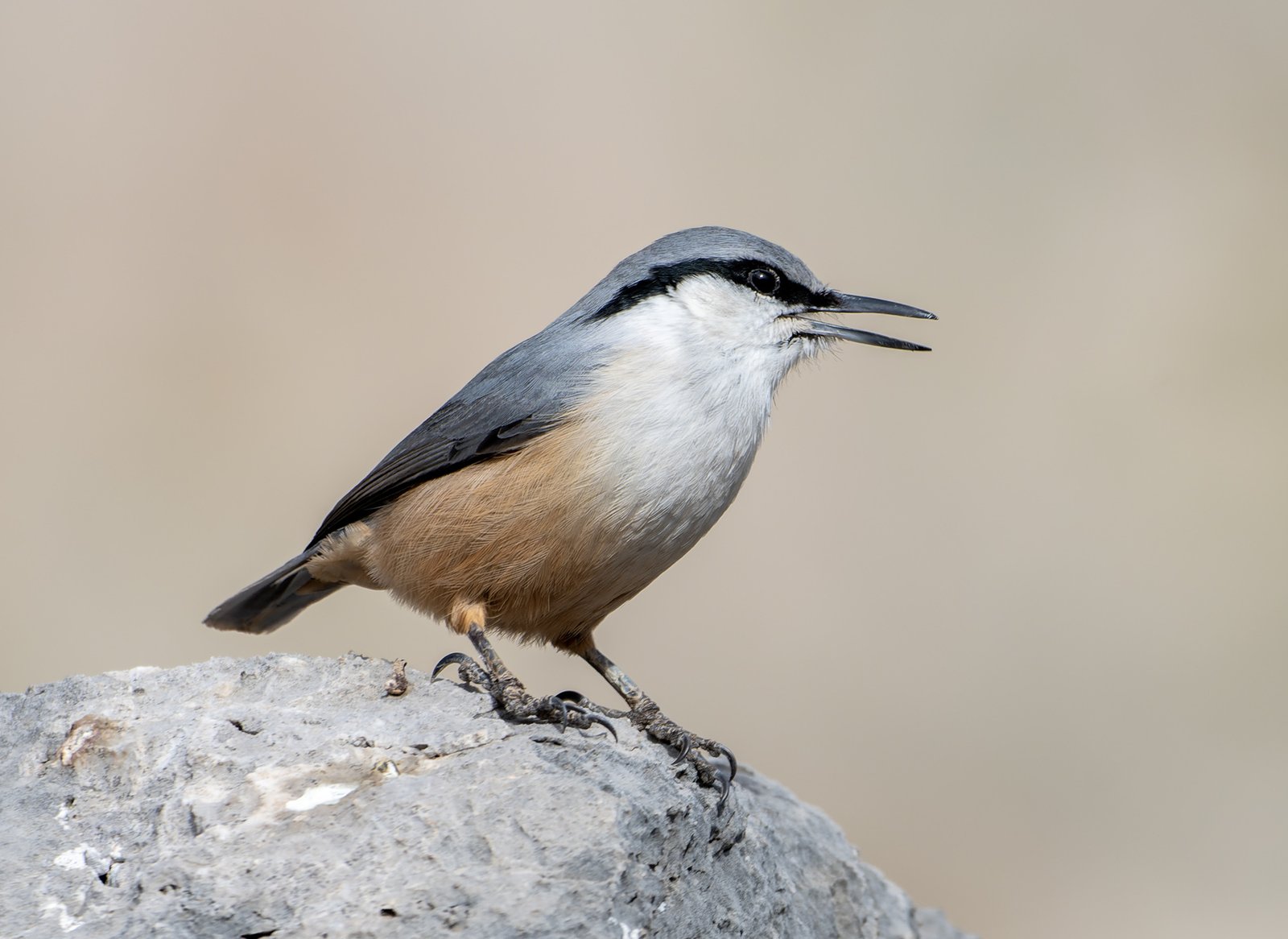
The Western Rock Nuthatch is a nuthatch that has swapped trees for bare limestone: it runs and hops over slopes and cliffs and plasters a flask-shaped mud nest against a rock face. In the region it is a bird of the Levant: the mountains of Lebanon, western Syria, northern Israel and Kurdistan in northern Iraq. Noisy, and therefore often heard before it is seen.
Voice
Exceptionally loud for its size; in a gorge the sound echoes between the walls. The call is a sharp, hard chik, in rapid series when excited. The song is a clear, piercing, accelerating trill, twee-twee-twee-twee, almost becoming a rattle at the end and audible over hundreds of metres.
Recording: Stanislas Wroza — CC BY-NC-SA 4.0 · shortened to the first 60 s, mono · xeno-canto
Identification
13.5–15 cm, slightly larger and paler than Eurasian Nuthatch. Upperparts plain pale grey, underparts white on throat and breast, becoming warm cream to rusty buff towards belly and undertail-coverts. A black eyestripe runs from the bill onto the side of the neck, with no white supercilium above it. Tail plain grey, without white spots. Bill long and strong. Moves jerkily over boulders, often with tail slightly raised.
Confusion species
Eastern Rock Nuthatch (Sitta tephronota), in the region only in northern Iraq, is larger, with a heavier bill and a broader, longer eyestripe; where both occur, Western is smaller with a narrower eyestripe, so size, bill and eyestripe together decide. Eurasian Nuthatch (Sitta europaea) is darker blue-grey, has rufous flanks and white tail spots and lives in trees. Wallcreeper (Tichodroma muraria) also lives on rock faces but is grey with crimson wing panels, has a long decurved bill and flutters like a butterfly.
Habitat
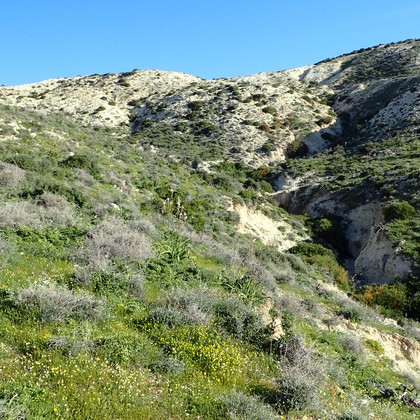
Rocky slopes, limestone cliffs, gorges and scree with scattered bushes, from middle altitudes high into the mountains (on Mount Hermon to well over 2,000 m); also ruins, old stone walls and terraces. Searches rock crevices for insects, spiders and snails and also eats seeds in winter. The nest is a flask-shaped mud structure with a tubular entrance, against an overhanging rock face.
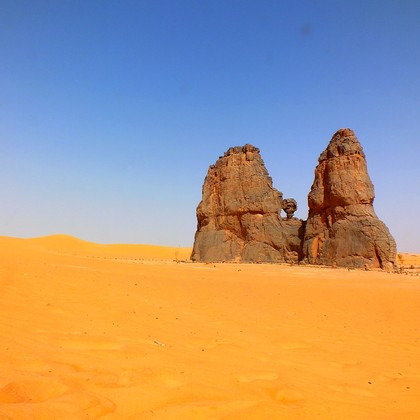
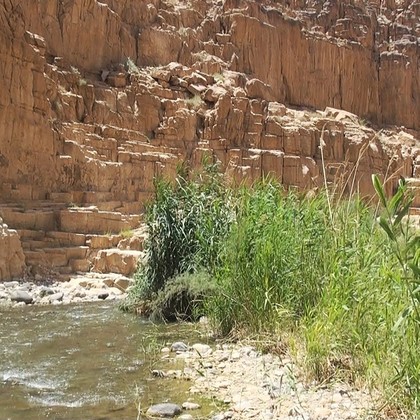
Where the bird is most at home, classified by the habitats of North Africa and the Middle East.
Range and movements
In the region only in the north-east: in the mountains of Lebanon (Mount Lebanon and Anti-Lebanon ranges), in western and northern Syria, on Mount Hermon, the Golan Heights and in Upper Galilee in northern Israel, and in Kurdistan in northern Iraq, where it shares the area with Eastern Rock Nuthatch. Levantine birds are sometimes separated as the form syriaca. Southwards the species quickly becomes scarcer; from Jordan there are at most a few reports from the north-western highlands. Beyond the region it breeds from Croatia through the Balkans, Greece and Turkey to western Iran.
- Resident
- Summer visitor (c. Oct–Mar)
- Winter visitor (c. Apr–Sep)
- Passage (Mar–Apr, Oct–Nov)
- dark = core range, pale = thinly spread
How and when to look
On Mount Hermon and in the Golan, Western Rock Nuthatches are easy to find in spring and summer along roads with rocky slopes and old stone walls; in Lebanon in the gorges of Mount Lebanon, for example around the cedar forests. Follow the loud trill, and scan the cliff for the mud flask nest.
Conservation status
Not globally threatened. Locally fairly common in the region, but with a small range; in Israel it is listed as Near Threatened on the national Red List, with densities declining since 1990. Few specific threats, although quarries, building on mountain slopes and disturbance can cost nest sites locally.
Scientific name
Sitta neumayer | Michahelles, 1830
Michahelles described the species in 1830 and placed it straight away in the genus where it still stands. The genus Sitta was introduced in 1758 by Linnaeus. Sitta is the Ancient Greek name sittē for the nuthatch. neumayer honours Franz Neumayer (1791–1842), an Austrian naturalist and natural history dealer who lived at Ragusa, present-day Dubrovnik, and is called an active naturalist there in the original description. The specimen the first description was based on came from Dubrovnik, Croatia.