All species › Bats › Vesper bats › Alcathoe Myotis
Alcathoe Myotis | Myotis alcathoe
Myotis alcathoe | Murciélago Ratonero Bigotudo Pequeño
The Alcathoe Myotis is one of the smallest Myotis species in Europe, with a forearm of 29.7 to 34.6 mm and a weight of 3.5 to 5.5 grams. Otto von Helversen and Klaus-Gerhard Heller described it in 2001 from a stream near Kleistos in central Greece, after examining bats from Greece and Hungary whose high-pitched calls and DNA differed from those of the Whiskered Bat. In appearance it resembles the Whiskered Bat and Brandt's Bat, but genetically it lies outside that group: its closest relative is M. hyrcanicus from Iran. It is associated with old, moist broadleaved forest along streams.
No photograph of a living wild animal of this species with a suitable Creative Commons licence exists. Do you have one that meets the rules? Send it in.
Tracks
There are hardly any external signs. Roosts are behind loose bark and in cavities of broken and rotting wood, 15 to 22 m above ground, and are often changed after one or a few days. Maternity colonies are small, rarely up to about 80 bats. In the first half of August the bats swarm at some caves, often together with Bechstein's Bat and Brandt's Bat; trapping at swarming sites and detector recordings over streams in old forest provide most of the data.
Identification
Head-body 39 to 44 mm, tail 36 to 37 mm, ear 11.4 to 14.3 mm, forearm 29.7 to 34.6 mm. The upperparts are brown to reddish brown, the underparts paler brown; the hairs are 6 to 8 mm long, dark at the base with pale brown tips. Young bats may be entirely grey or brown. The wings are dark brown to blackish, but paler than in the Whiskered Bat. The ears are short and pale; the short tragus has a clear notch in its margin. The face is largely furred, and the bare skin is pink and much paler than in the Whiskered Bat. Feet, legs and thumb are short. The penis is narrow from base to tip; the baculum is short (about 0.5 mm) and broad. The call is one of the highest within Myotis: pulses of 2.5 to 4 milliseconds starting at 120 kHz and ending at about 46 to 32 kHz, with a characteristic frequency around 53 kHz. The call is faint and rarely picked up at more than 10 m.
Similar species
The species belongs to the 'whiskered bats' in the external sense, together with the Whiskered Bat (M. mystacinus), Brandt's Bat (M. brandtii) and, in south-eastern Europe, David's Myotis (M. davidii). Until 2001 bats of this species were identified as Whiskered Bats, and even now identification in the hand is not free of doubt. Indicative characters relative to the Whiskered Bat are the small size, the reddish-brown fur, the pale pink face, the pale ears, and the paler wings. Penis shape is used as a character within the group in the literature, but the handbook describes it as narrow in both this species and the Whiskered Bat. The measurements, however, overlap with those of the Whiskered Bat (forearm 32 to 36.5 mm), and colour varies with age. On a bat detector a high end frequency and a characteristic frequency around 53 kHz point towards this species, but according to the handbook the end frequency extends down to 32 kHz and then overlaps with the other small Myotis species. A certain identification rests on DNA. Many older records of the Whiskered Bat in forest areas may have concerned this species; old data therefore cannot simply be assigned to either.
Habitat
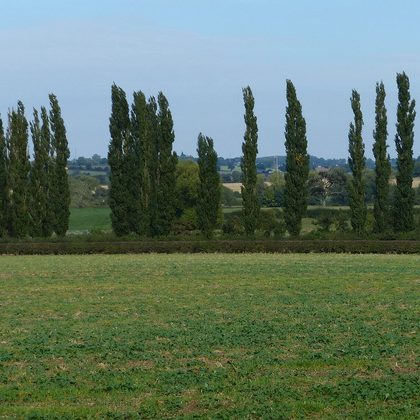
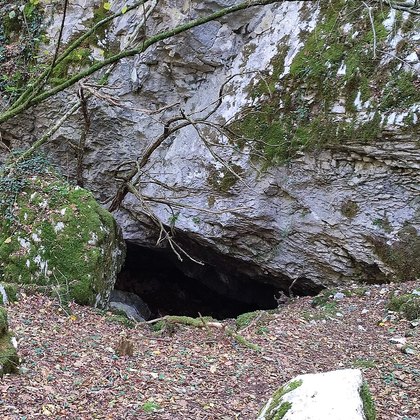
Old, moist broadleaved forest with a complex structure and much dead and rotting wood, usually along streams: forest with oak, lime, alder and birch, riparian forest and montane forest with oak, hornbeam and beech. The species appears to favour sloping ground. It often occurs in the same forests as Bechstein's Bat and Brandt's Bat. In winter it uses caves and other small cavities; hibernation roosts in trees have also been found.
Where the animal is most at home, classified with EUNIS — the European standard for habitats.



Distribution
Scattered and local across most of Europe, from northern Spain to Germany and Great Britain, and east to south-western Ukraine and Turkish Thrace. Calls attributed to this species are known from southern Sweden. The subspecies M. a. circassicus lives on the northern slopes of the Greater Caucasus in Russia and Abkhazia, possibly also in north-eastern Turkey and Azerbaijan. At the time of description the species was known only from Greece and Hungary; the known range has since been greatly extended by DNA analysis of captured bats, and its limits have not yet been established.
- Native
- dark = core range, pale = thinly spread
Way of life
The bats leave the roost 30 to 60 minutes after sunset and are active in two peaks per night. They fly to nearby streams and rivers, rarely more than 3 to 6 km from the roost, and hunt mainly in the canopy at the forest edge and over water. Prey consists of small insects such as midges, small moths, flies, ants and beetles, and also spiders; the latter indicate that prey is also gleaned from leaves. Locally the diet consists mainly of midges and gnats (Nematocera). Maternity colonies are in the canopy and hold few adult females; males usually live alone. Young are born up to mid-July. Hibernation takes place in caves and cavities.
Where and when to look
Old, moist broadleaved forest with a stream, on a slope, is the habitat where a detector gives the best chance. Record close to the water and under the canopy: the call is faint and does not carry far. A recording with a high end frequency is an indication, not an identification. Capturing and handling bats requires a licence throughout the European Union.
Conservation status
Data Deficient (DD) on the global Red List, assessed in 2016; the assessment gives the recent description as the reason. The handbook states that the species occurs at low densities and in scattered populations, and that suitable habitat is limited. The main threats are loss and fragmentation of old forest, especially through logging, and collisions with traffic. In the European Union it falls, like all bats, under Annex IV of the Habitats Directive.
Scientific name
Myotis alcathoe | von Helversen & K.-G. Heller in von Helversen, K.-G. Heller, F. Mayer, Nemeth, Volleth, & Gombkötő, 2001
Von Helversen & K.-G. Heller in von Helversen, K.-G. Heller, F. Mayer, Nemeth, Volleth, & Gombkötő described the species in 2001 and placed it straight away in the genus where it still stands. Myotis is Greek, from mys, genitive myos, 'mouse', and ous, genitive ōtos, 'ear': 'mouse-ear'. alcathoe is Alcathoe, one of the daughters of Minyas whom Dionysus turned into bats in Greek myth; it stands as a proper noun in apposition to the genus name. The specimen the first description was based on came from Greece, Evritania.