All species › Rodents › Mice and rats › Algerian Mouse
Algerian Mouse | Mus spretus
Algerijnse muis | Ratón Moruno
The Algerian Mouse is a wild mouse of the western Mediterranean. It lives in fields, olive groves and maquis in Spain, Portugal, southern France and the Maghreb and, unlike the House Mouse, does not enter buildings. In the open Mediterranean landscape of Iberia it is the commonest mouse in many districts.

Tracks
The signs are those of a Mus and cannot be distinguished from those of the House Mouse. Droppings three to eight millimetres long, spindle-shaped with pointed ends, black and glossy when fresh, scattered along the runs rather than in a latrine. Gnawing with paired grooves about a millimetre wide on seeds, grain, acorns, almonds and fruit; grain is hollowed out and the empty husks remain. Prints smaller than a centimetre, with four toes on the forefoot and five on the hind foot, and a thin drag mark of the tail, in blown sand or fine dust on a threshing floor. Characteristic of this species is a tunnel system: it makes complex systems of interconnecting tunnels through the litter layer and just below the soil surface, found as a network of hollow runs under a layer of dead grass and cistus leaves; when the litter is pushed aside, the system is exposed. It does not leave smear marks and urine pillars, the signs the House Mouse leaves indoors, because it does not enter buildings. In Iberia the species is most often recorded from Barn Owl pellets.
Identification
A mouse of nearly eight to over nine centimetres head-body length, with a short tail: five to seven centimetres, 57 to 93 per cent of the head-body length. The short tail is the main character. The back is yellowish to greyish brown, sandier than in the House Mouse, and the belly is white or pale grey and more sharply demarcated. Ears eleven to fifteen millimetres, hind foot fourteen to twenty-one. Weight seven to nineteen grams. One character separates it in the hand from all other European Mus: the upper incisors have no notch at the back, whereas the House Mouse, the Mound-building Mouse, the Balkan Short-tailed Mouse and the Cypriot Mouse all have one. This character can be checked with a hand lens.
Similar species
The House Mouse (Mus musculus) is the species most often confused with it; the distinction is clearer than between the other wild Mus species. The decisive character is the tail: in the House Mouse as long as head and body, in the Algerian Mouse distinctly shorter. In addition, the belly of the House Mouse is grey to yellowish white without a sharp boundary, while that of the Algerian Mouse is paler and more sharply demarcated, and the Algerian Mouse lacks the notch in the upper incisor. In Iberia habitat gives an indication: indoors the House Mouse, in the Mediterranean countryside the Algerian Mouse. This is not conclusive, because in summer the House Mouse also moves into cereal fields and gardens. The Wood Mouse is larger and warm russet, with much larger eyes and ears, a pure white belly, a long two-coloured tail and a bounding gait. Shrews are insectivores with a long, pointed snout and very small eyes. In North Africa the species occurs together with small gerbils, which have long hind legs and a long tail ending in a tuft.
Habitat
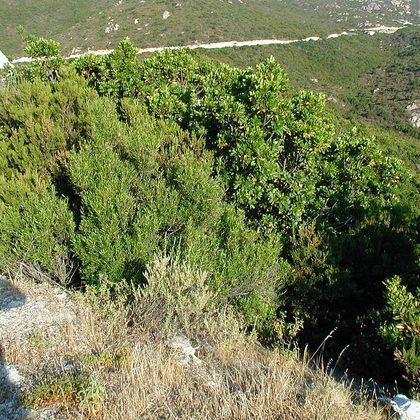
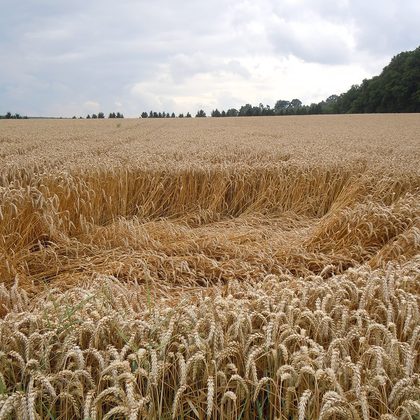
Mediterranean farmland and the scrub around it: maquis, garrigue and thorny scrub, dry grassland, arable fields and their margins, olive groves and vineyards, dehesa, hedges and bramble-covered banks, and anywhere shrubs, brambles or dead wood provide cover. In Portugal a preference has been shown for grassland with tall vegetation and sites with shrubs, brambles or dead wood. In North Africa it lives in sparsely wooded terrain with much bare ground, with the highest densities in farmland. Mature forest and very dense vegetation are avoided, and the species does not enter buildings.
Where the animal is most at home, classified with EUNIS — the European standard for habitats.




Distribution
The western Mediterranean: Portugal, the whole of Spain including the Balearics, southern France to about the Rhône and Provence, and in North Africa Morocco, northern Algeria, Tunisia and northern Libya. In Spain it occurs across the entire peninsula and in many districts is the commonest mouse of open country; it is absent from the Canary Islands. In France the range reaches Languedoc and Provence, with a northern limit roughly coinciding with that of the olive. The species is absent from the British Isles, the Low Countries, Italy and the Balkans.
- Native
- dark = core range, pale = thinly spread
Way of life
Nocturnal and crepuscular, and entirely ground-living. The diet is varied: fruit, seeds and green plant material, and also insects; in North Africa it can cause crop damage. In southern France and Spain breeding stops in winter, with two peaks, in spring and at the end of summer. Gestation lasts nineteen to twenty days, litters number two to ten young, averaging a little over five; the eyes open at twelve to fourteen days, weaning falls in the third week and adult size is reached at eight to nine weeks. It is less social than the House Mouse and less colonial than the Mound-building Mouse, but has more stable bonds between male and female. Densities are three to twelve animals per hectare and daily movements a few tens of metres to over a hundred. In Portugal males had ranges averaging 343 square metres, overlapping the ranges of at least two females but separate from those of other males; this exclusive territory is actively defended against intruders. There is no hibernation.
Where and when to look
On a warm evening in spring or late summer, go to an olive grove, a field margin or a track through maquis, for example in Andalusia, the Alentejo or Languedoc, and shine a weak lamp along the ground and the foot of the bushes. A small sandy-brown mouse with a short tail that runs rather than bounds is this species. By day, check the litter under cistus and broom: where a network of small tunnels lies under the litter, the species is present. Houses and barns are occupied by the House Mouse; establishing that separation is a simple field exercise in Iberia. Barn Owl pellets from a church tower in the dehesa often contain dozens of individuals.
Conservation status
Least Concern (LC, 2016), common and widespread throughout its range. The species benefits from the traditional Mediterranean farmed landscape with its margins, walls, brambles and fallow, and declines where that landscape is enlarged: closely cut field edges, the loss of hedges and dead wood, and the conversion of dehesa and dry arable land to intensive cultivation reduce cover. Anticoagulant control in olive and almond groves affects it, although it is not a household pest, and leaves residues in owls and small carnivores. As prey the species is of great importance: it is a staple of Barn Owl, Little Owl, genet, weasel and snakes, and of the Iberian lynx in its first years. In laboratory research it is one of the most important wild relatives of the House Mouse: crosses between Mus spretus and the laboratory mouse have produced a large part of the genetic map of mammals.
Scientific name
Mus spretus | Lataste, 1883
Lataste described the species in 1883 and placed it straight away in the genus where it still stands. Mus is the Latin word for 'mouse', cognate with Greek mys. spretus is Latin for 'despised, spurned', the past participle of spernere, 'to reject'. It is Lataste's verdict on the treatment the species had so far received from zoologists, not a character of the animal. The specimen the first description was based on came from Algeria, Oued Magra.