All species › Rodents › Voles and hamsters › Alpine Pine Vole
Alpine Pine Vole | Microtus multiplex
Fatio's woelmuis | Topillo de Fatio
The Alpine Pine Vole (Microtus multiplex) is a burrowing vole of the south-western Alps and the northern Apennines. Within the group of pine voles it is the only species with an external character that is sometimes usable: a relatively long tail. Otherwise it is, as the Swiss zoologist Victor Fatio already suspected in 1905, barely separable from related species, and identification rests largely on locality and skull characters.
No photograph of a living wild animal of this species with a suitable Creative Commons licence exists. Do you have one that meets the rules? Send it in.
Tracks
A burrower, with tunnel systems that may contain one to seven nest chambers per animal. In alpine meadows and damp mountain woodland small, low heaps of fine earth in winding lines with plugged entrances can be found; the species does not make open holes. A molehill is larger, taller, conical and built of clods, and lies above a vertical shaft; that of the water vole is coarser and has the tunnel opening visible at the side. Under the turf and moss lie cleared runways 3 to 4 cm wide. A characteristic sign is the store chamber: the species lays up underground stores of bulbs and rhizomes of crocus, gagea, grape hyacinth and buttercup; when a tunnel in a bank is opened in spring, dozens of bulbs are sometimes found together. Above ground there are bitten leaves of butterbur, monkshood and hellebore, and gnawed bark at the base of young larches. Droppings are 4 to 6 mm, cylindrical with blunt ends, and lie in latrines in the tunnels. The most reliable source of records is pellets of Barn Owl, Tawny Owl and Tengmalm's Owl.
Identification
A medium-sized burrowing vole with a rounded head, small eyes and short ears half hidden in the fur, dark brown above and grey below. The distinguishing character is the tail: at 4 to 4.4 cm it is about forty per cent of head-body length; in the other pine voles of the region it is about a third or less. Females have four nipples in two inguinal pairs. Cheek teeth and skull structure are almost identical to those of Microtus liechtensteini; the teeth alone do not settle identification here, which is exceptional in this group.
Similar species
Against Microtus liechtensteini, which inhabits the south-eastern Alps, locality is decisive: the two border each other roughly at the Adige and are morphologically inseparable, down to the enamel pattern of the cheek teeth, but they do not occur at the same sites. The name multiplex was long applied to the Dinaric animals as well; older records from Slovenia, Croatia, Bosnia and Serbia still held in databases under this name belong to liechtensteini. Against the Common Pine Vole (M. subterraneus), which shares much of the range, separation is more difficult: it is smaller and shorter-tailed, and the longer tail of the Alpine Pine Vole is then the most usable character, but measurements overlap and certainty comes only from the skull. In the Apennines Savi's Pine Vole (M. savii) also occurs, inhabiting the lowlands and hills, while the Alpine Pine Vole lives in the mountains. Separable in the field are: Common Vole and Field Vole, with larger eyes and visible ears, which move above ground along grass runways; the Bank Vole, with a red-brown back and a medium-length tail; and the Snow Vole, which lives in the same mountains but is much paler grey, has large ears and a long tail and lives among rocks rather than in the soil.
Habitat
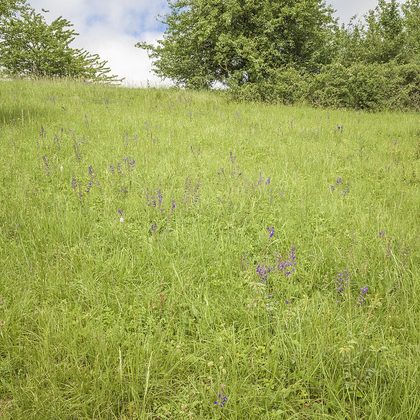
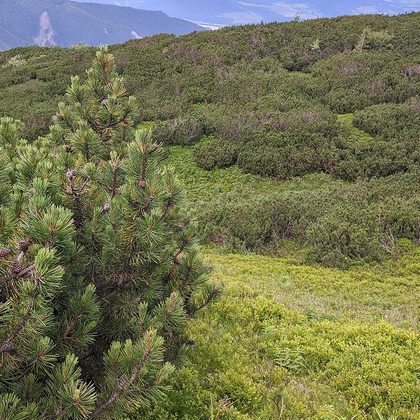
Grassland with deep, damp soil: in the lowlands and valleys hay meadow and pasture, in the mountains mainly humid woodland, woodland edges and clearings, and higher up alpine meadows with dwarf willow and the margins of raised bogs. Up to 2800 m in the Alps, in the Apennines mainly below 1300 m.
Where the animal is most at home, classified with EUNIS — the European standard for habitats.


Distribution
The western and south-western Alps and the north-western Apennines: south-eastern France (Savoie, Hautes-Alpes, Alpes-Maritimes), southern Switzerland (Ticino, Graubünden, Valais) and north-western Italy (Piedmont, Liguria, Lombardy, Trentino); the type locality is near Lugano. There are over 1500 georeferenced records, most of them from Switzerland and France; for this group the species is therefore well documented. Dinaric reports under this name derive from the older, broader species concept and belong to M. liechtensteini. The species does not occur outside the Alps and Apennines.
- Native
- dark = core range, pale = thinly spread
Way of life
Mainly diurnal, with a polyphasic rhythm of eight to sixteen short activity periods per 24 hours, which is many for a burrowing vole. Herbivorous: leaves of herbs and, underground, bulbs and rhizomes, which are stored. The species is monogamous; both sexes defend a territory, and the pair shares the tunnel system but rarely sleeps in the same nest chamber. Swiss research gives home ranges averaging 342 m² for males and 229 m² for females, which become smaller during the breeding season. Breeding in principle continues throughout the year, with interruptions; one to four young per litter, in captivity on average 2.3. There is no winter dormancy; the animals are also active under the snow.
Where and when to look
In May or June search a damp alpine meadow or woodland edge in Ticino, Valais or Savoie for lines of small earth heaps; carefully open a tunnel with a knife and measure the diameter. Because the species is often active by day, it is one of the few species of this group that can be seen with patience: sit ten metres from a tunnel system, keep still and watch for grass moving without wind. If you see the animal, look immediately at the tail, the only character usable in the field. In winter, pellets from below a roost provide the most reliable data for this group.
Conservation status
Least Concern (LC, 2024), with a continuous range and locally high densities in alpine grassland. There are no large-scale threats; the species does decline where hay meadow is converted to intensive, herb-poor grassland or built-up land, and where mountain pastures become overgrown after grazing stops. In orchards and gardens in the Alpine valleys it is locally controlled. As with almost all burrowing voles, the assessment is based on the extent of the range and not on counts, since none exist.
Scientific name
Microtus multiplex | (Fatio, 1905)
Fatio described the species in 1905 as Arvicola subterraneus multiplex; because it was later moved to another genus, the author and year stand in brackets. Microtus is Greek, from mikros, 'small', and ous, genitive ōtos, 'ear', after the small ears hidden in the fur. multiplex is Latin for 'manifold, many-folded', from multus, 'many', and the stem of plicare, 'to fold'. Fatio gives no explanation; the complicated enamel folds of the molars are the usual guess. The specimen the first description was based on came from Switzerland, Ticino.