All species › Even-toed ungulates › Bovids › Barbary sheep
Barbary sheep | Ammotragus lervia
Manenschaap | Ammotragus lervia
The Barbary sheep (Ammotragus lervia) is a wild sheep-like ungulate of the dry mountains of North Africa and the Sahara. Within the guide area it is native to the Maghreb and to Egypt and Libya. Since 1970 it has also lived in south-eastern Spain, where it was released for hunting and is now regarded as an invasive alien species.

Tracks
The track is two-toed and resembles that of a domestic goat; in the field the two cannot be separated with certainty. The droppings are dark pellets in small heaps, also indistinguishable from those of goat and ibex. Resting places lie under overhanging rocks and in small caves, with droppings and loose hair.
Identification
A heavy, sandy to reddish-brown ungulate with a head-body length of 130 to 165 cm, a shoulder height of 75 to 110 cm and a weight of 30 to 145 kg; rams are much heavier than ewes. The belly is paler, and a darker line runs along the back. The key feature is the long fringe of hair on the throat, chest and forelegs, much longer in the ram than in the ewe. Both sexes carry thick horns with a triangular cross-section that curve first outwards, then backwards and finally inwards; in old rams they reach more than 50 cm. The animal has no beard and no dark markings on head or legs. The tail is 15 to 20 cm long, longer than in sheep and goats.
Similar species
In south-eastern Spain the Barbary sheep shares its mountains with the Spanish ibex. The male ibex has a dark beard, black patches on legs and flanks and horns that rise upwards and backwards; the Barbary sheep is uniformly sandy brown, has the throat fringe and horns that sweep sideways and back in a half circle. The mouflon is smaller, reddish-brown with a pale saddle patch and a white belly, and lacks the throat fringe. Free-ranging domestic goats usually have a beard and a piebald or black coat.
Habitat
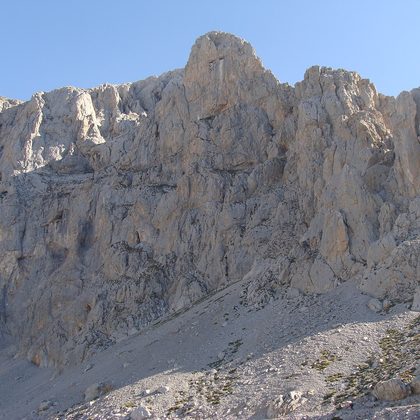
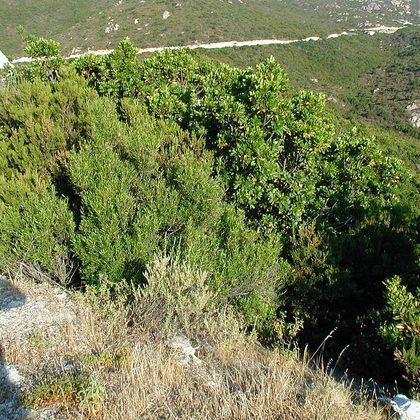
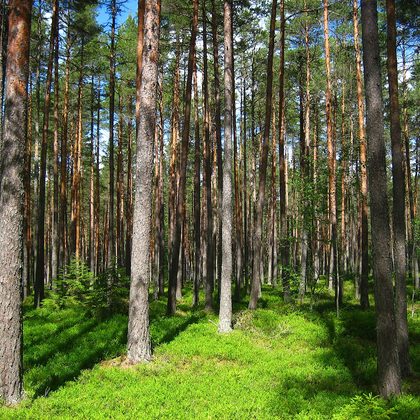
Dry, rocky mountains, gorges and steep slopes with sparse vegetation, from the Atlas to the Saharan massifs. In Spain the Barbary sheep occupies steep limestone ranges with Mediterranean scrub, garrigue and open pine woodland. It avoids flat open ground without rocks.
Where the animal is most at home, classified with EUNIS — the European standard for habitats.



Distribution
The natural range extends over Morocco, Algeria, Tunisia, Libya and Egypt and south across the Saharan massifs to Mauritania, Mali, Niger, Chad and Sudan, in scattered populations described as six subspecies. In Spain the species was released for hunting in 1970 in the Sierra Espuña (Murcia), with animals from the zoos of Casablanca and Frankfurt; in 1972 fifteen animals were released in the north of La Palma (Canary Islands). The Barbary sheep has since spread over the provinces of Murcia, Alicante, Almería, Granada and Jaén, partly from escapes out of hunting enclosures. A released population is also reported from Croatia (Mosor). Outside the guide area the species has been introduced to the United States, including Texas.
- Native
- dark = core range, pale = thinly spread
Way of life
The Barbary sheep is active mainly in the cool hours of morning and evening and rests at midday in the shade of rocks. It lives alone or in small groups and ranges widely. Its food is grass, shrubs, acacia leaves and lichens. From a standstill the animal clears an obstacle of two metres. The rut falls between September and November; after a gestation of about 160 days a single young is born between March and May, rarely two or three. The young are weaned at three to four months and sexually mature at eighteen months. Barbary sheep can live for twenty years.
Where and when to look
In Spain the Sierra Espuña is the area with the longest history of the species; at sunrise scan the cliffs and steep slopes with a telescope from the viewpoints along the forest tracks. The animals often stand motionless on a ledge and are noticed only when they move. In the Maghreb the species is scarce and shy because of hunting; better chances are offered by protected areas in the Atlas and by Chambi National Park in Tunisia.
Conservation status
Vulnerable (VU, 2021). In the natural range, legal and illegal hunting, habitat loss, feral dogs, overgrazing by livestock and drought cause the decline. In Spain the species has been listed in the Spanish catalogue of invasive alien species since Royal Decree 630/2013; the exception for the Murcia populations was annulled by the Tribunal Supremo in 2016, so that the species counts as invasive throughout Spain and its possession, transport and release are prohibited. On La Palma the Barbary sheep damages the native island flora, above all in the Caldera de Taburiente National Park. Whether the damage on the Spanish mainland exceeds that of native ungulates is a matter of scientific debate.
Scientific name
Ammotragus lervia | (Pallas, 1777)
Pallas described the species in 1777 as Antilope lervia; because it was later moved to another genus, the author and year stand in brackets. Ammotragus is Greek, from ammos, 'sand', and tragos, 'he-goat': the goat of the desert. lervia goes back to lerwee, the native name recorded by the English traveller Thomas Shaw in his account of the Barbary coast. The specimen the first description was based on came from North Africa.