All species › Rodents › Voles and hamsters › Black-bellied Hamster
Black-bellied Hamster | Cricetus cricetus
Europese hamster | Hámster Común
The Common Hamster (Cricetus cricetus), also called Black-bellied Hamster, is a large, solitary rodent of arable land on loess and loam, and the only rodent in Europe with a black belly. Around 1950 it was regarded as an agricultural pest with a bounty on it, and its skins were traded by the hundred thousand; in 2020 it was listed on the Red List as Critically Endangered, with a calculated risk of disappearing from Europe within this century. In the Netherlands the wild population had disappeared by 2002; the present animals there derive from captive-breeding programmes.

Tracks
The burrow is the main sign. An occupied burrow has two kinds of shaft. The sloping run enters the ground at an angle of 30 to 45 degrees and is the entrance by which the animal comes out and brings food in; in front of it lies a fan of excavated soil. The drop shaft runs vertically down, often visible to a metre deep, and has no soil in front of it because the hamster digs it from below; it serves as an escape route. Both shafts are 5 to 7 cm across, with a smooth, rounded rim. A burrow has two to ten entrances and reaches 1 to 2 m deep, with a nest chamber lined with finely shredded grass, one or more store chambers and a separate latrine; the nest itself is not fouled. In cereal stubble after harvest the shafts are easiest to find; on damp loam the rim is sharply visible. Other signs: cut stems, clipped obliquely just above the ground and without the ear, in small bundles at the shaft; feeding patches in lucerne and clover around an entrance; and droppings, dark, cylindrical, 8 to 12 mm long, usually in the latrine and seldom in the open. The store chamber holds on average 2 to 3 kg of grain and seed; chambers have been found with 15 kg and exceptionally 65 kg, sorted by species. In winter a shaft plugged with soil from inside indicates an animal in hibernation. Prey remains of Kestrel or Buzzard with red-brown back fur and black belly fur are in central Europe often the first evidence of hamsters in a field.
In its habitat

Head close-up

The young

Identification
Large for a rodent: head-body 20 to 27 cm, tail 4 to 7 cm, weight 220 to 460 g, about the size of a guinea pig, with a thickset, heavy build. The pattern: red-brown to golden-brown back, orange-buff flanks with three white patches, and a black belly and chest. A dark underside with a paler upperside is rare among mammals and is the best character. Large cream-white patches lie on the cheeks and behind the ears; feet and muzzle are white. The ears are short, round and furred, the eyes large and black, the tail short and sparsely haired. On either side of the mouth are large cheek pouches reaching back behind the shoulders, which when filled make the head almost triangular. Black (melanistic) animals occur regularly in eastern Europe and are wholly dark apart from the white muzzle. Sitting upright the black chest is visible from afar; when walking the animal is low and broad, with a waddling gait.
Similar species
Seen well, the species cannot be confused with any other animal in Europe. At a distance and from behind a Brown Rat may resemble a hamster, but it has a long, naked, scaly tail, a pointed muzzle and no cheek pouches. A souslik is slimmer, sandy, sits tall and upright and has no black belly. A young marmot is much larger and uniformly coloured. An escaped Golden Hamster is half the size, sandy and has a pale underside. The Romanian Hamster of the Dobruja is clearly smaller and has a black band across the chest rather than a black belly, and the Grey Hamster of south-eastern Europe is a grey rodent of less than 60 g. A large, heavy rodent with a black underside in a field or verge is a Common Hamster.
Habitat
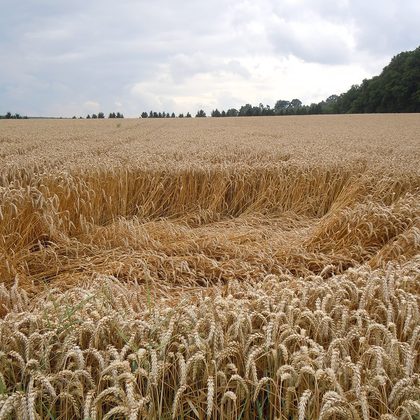
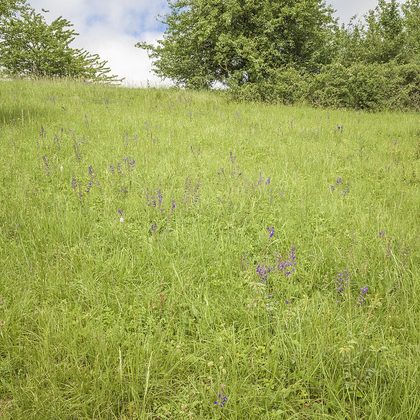
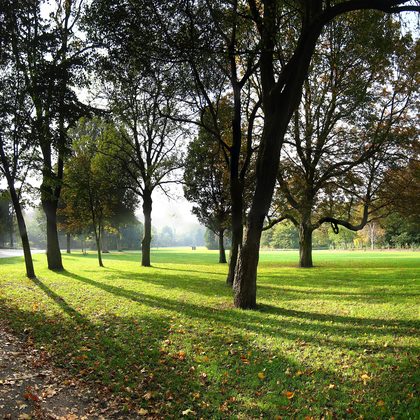
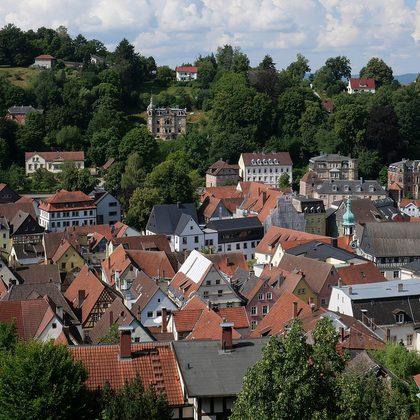
Open arable land on loess, loam or heavy clay, with a low water table and soil deep and firm enough for a two-metre burrow; the species is absent from sand and wet ground. It prefers cereals and lucerne and fields that keep cover through the summer. Also dry, herb-rich grassland, banks, field margins and fallow. In central Europe it also lives in cemeteries, parks and green verges in cities, where there is no ploughing, the grass stays short and predators are absent; Vienna therefore has one of the most easily observed hamster populations in Europe. From the lowlands up to about 600 m.
Where the animal is most at home, classified with EUNIS — the European standard for habitats.

Distribution
From north-eastern France and the Low Countries east through central and eastern Europe to Russia, northern Kazakhstan and south-western Siberia. The western limit lies at the Rhine plain, eastern France and South Limburg; the species has never occurred in Britain and Ireland or in the Iberian Peninsula. In the west the range has broken up into small fragments over the last fifty years. In France it survives in Alsace, thanks to a large recovery programme. In Belgium a few dozen burrows remain in Flemish Brabant, Haspengouw and the Voer area. In the Netherlands the hamster was formerly common in South Limburg and occurred in parts of the Achterhoek; after 1980 it declined rapidly, and in 2002 the last burrow of a wild animal was found near Maastricht. In the same year releases began with animals from a captive-breeding programme centred on GaiaZOO at Kerkrade, in the Sibbe arable reserve and later at further sites in the Limburg loess area (Amby, Heer, Puth-Schinnen). The population first grew rapidly, fluctuated strongly from 2008 and declined again between 2016 and 2020; since then animals have been added every year, and without these supplementary releases and without hamster-friendly arable management (strips of cereal harvested late or not at all, lucerne in the rotation) the species cannot maintain itself there. In Germany, Poland, Czechia, Austria and Hungary it is still locally numerous, in Austria mainly in towns. Further east, in Ukraine and Russia, it is still widespread, but declining there too.
- Native
- dark = core range, pale = thinly spread
Way of life
Mainly crepuscular and nocturnal; in quiet areas and in urban populations also by day. The species is strictly solitary: every adult has its own burrow, and encounters outside the breeding season lead to fights. The diet is mixed: cereals, seeds, roots, tubers, green plant parts, clover and lucerne, supplemented with insects, worms, snails and occasionally a mouse nest. What is not eaten at once is carried in the cheek pouches to the store chamber; an adult carries up to 100 g at a time and can bring in several kilograms in one night. From October to early April it hibernates, its body temperature falling to just above that of the burrow; every five to seven days the animal wakes to eat from the store, which explains the size of the store. The breeding season runs from April to August: two to three litters a year, after a gestation of only 17 to 19 days, with seven or eight young on average. The young are independent at three weeks and can breed in their first summer. With this reproductive rate the species formerly compensated for losses; that populations are declining nonetheless indicates the extent of the deterioration of arable land as habitat. In the wild a hamster seldom lives beyond two years.
Where and when to look
The best place to see the species is Vienna: in the cemeteries of Meidling, Simmering and Hietzing hamsters live in the grass between the graves; they are active by day and allow people to approach to within a few metres. The best period is May to August, in the early morning or the last hour before sunset. Elsewhere in central Europe: drive along loess fields after the cereal harvest and look for the shafts in the stubble; at a fresh drop shaft with a smooth rim, sit down a hundred metres away and wait for dusk. In the Netherlands and Flanders the chance of finding one on your own is small and disturbance is a real risk; join an excursion by a site-managing organisation or the Dutch Mammal Society rather than walking into the arable reserves yourself. At a burrow: never dig, do not probe the shaft with a stick and do not enter the field; a disturbed hamster abandons its burrow and loses its store.
Conservation status
Critically Endangered (CR, 2020); this assessment applies to the entire world population. The 2020 IUCN assessment for the first time named a cause besides habitat loss: reproduction has declined sharply. Where a female in the 1960s raised more than twenty young a year, the figure is now often five or six, and the animals enter hibernation later and emerge earlier. The causes given are uniform arable farming (maize and cereal monocultures without the herbs and insects a hamster needs; a maize diet leads to vitamin B3 deficiency and the eating of the female's own young), fragmentation by roads and urbanisation, light pollution, which disrupts the daily and hibernation rhythms, and climate warming, which lengthens the autumn and shortens hibernation. In addition, past control continues to have an effect: into the 1980s hamsters were poisoned in eastern Europe and their skins traded, in the Soviet Union by the million each year. Models based on these data predict extinction in Europe around the middle of this century if conditions do not change. Conservation measures are applied at dozens of sites: captive breeding and release, as in Limburg, Alsace and North Rhine-Westphalia; hamster-friendly arable management with lucerne, winter cereals, late harvest and strips left standing; and connections between the remaining fields. These measures are labour-intensive and costly and have to be repeated every year.
Scientific name
Cricetus cricetus | (Linnaeus, 1758)
Linnaeus described the species in 1758 as Mus Cricetus; because it was later moved to another genus, the author and year stand in brackets. Cricetus is the medieval Latin name for the hamster, already in Albertus Magnus; it goes back to a Slavonic word (Czech křeček, Polish skrzeczek) imitating the animal's grating call. The specific name repeats the genus name. The specimen the first description was based on came from Germany.