All species › Rodents › Voles and hamsters › Gray Hamster
Gray Hamster | Nothocricetulus migratorius
Trekhamster | Hámster migrador
The Grey Hamster is a grey, mouse-sized member of the hamster family without conspicuous markings. The species ranges from the Balkans to western China and occupies a wide range of habitats: dry steppe, rocky terrain, gardens and buildings. Until recently it was called Cricetulus migratorius; since 2018 it has been placed in a genus of its own, Nothocricetulus. Most of the literature still uses the old name.

Tracks
The species digs its own burrow systems. These reach half a metre to a metre and a half deep and have one to five entrances two to three centimetres across, usually under a stone, at the foot of a shrub or beside a wall, with a small fan of loose soil in front. At the bottom lie a nest chamber bedded with grass and plant down and one or more store chambers with seeds; stores of four to five hundred grams have been described, more than ten times the body weight of a thirty-five-gram animal. Above ground the signs are limited: narrow paths two centimetres wide along walls or rock crevices, stems cut off at an angle, and small, dark, oval droppings three to four millimetres long in small heaps at the entrance or under an overhanging stone. Where the species takes over a disused tunnel of a vole or blind mole-rat, occupation can only be recognised by the cleared entrance with seed husks in front. In buildings such as barns, stables and garden sheds the store is sometimes found behind a beam or in an empty flowerpot. Otherwise most data come from pellets of Barn Owl and Long-eared Owl, in which the species is regularly found in south-eastern Europe.
Head close-up

Identification
Small: head-body 8.7 to 13.4 cm, tail 2.2 to 3.7 cm, weight 33 to 38 g; the size of a large House Mouse, but much stockier and with a blunt head. The fur is soft and uniformly pale ash-grey to grey-brown, without dorsal stripe, saddle or black areas; belly and feet are pure white and sharply separated from the upperparts. The tail is short, thick and densely furred, about a quarter of head-body length; this is the best field character, since no true mouse has such a short, woolly tail. The ears are medium-sized, round, thinly haired and pink inside; the eyes are small and black. This species also has cheek pouches. Young animals are greyer and darker than adults. Since a colour pattern is lacking, identification rests on build: stocky body, blunt muzzle, short furred tail and a sharp boundary between grey and white.
Similar species
In this species size and tail are decisive. House Mouse and Wood Mouse have a long, thin, scaly and almost naked tail of at least three-quarters of head-body length and a pointed muzzle with large eyes. Common Vole and other voles have a shorter tail, but also a much rounder head, smaller ears and a browner, coarser coat without the sharp boundary between grey and white; their muzzle is blunter and their eyes smaller than in the Grey Hamster. The Common Hamster and Romanian Hamster are five to ten times as heavy and have black on the underside or chest. A dwarf hamster from the pet trade (Phodopus) has a dark dorsal stripe and does not occur in the wild in Europe. In case of doubt with the animal in the hand, the cheek pouches are conclusive: no true mouse or vole has them.
Habitat
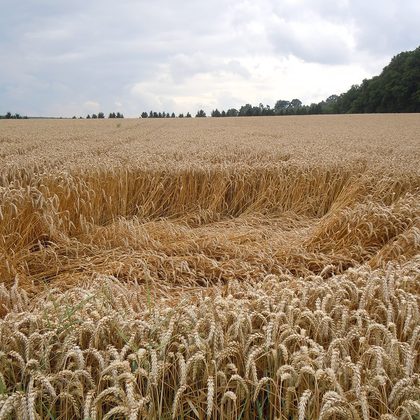
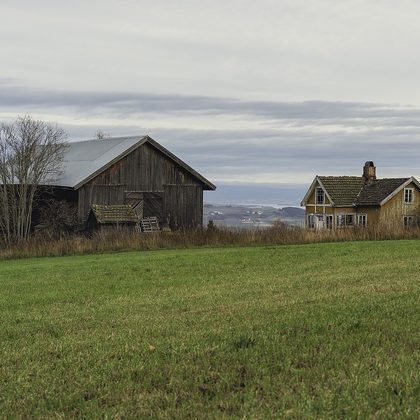
Dry, open terrain with sparse vegetation: steppe, semi-desert, dry grassland, stony and scrub-covered slopes, screes and rocky banks. Wet ground and closed woodland are avoided entirely. In large parts of its range the species is a mountain dweller, often above a thousand metres and in Central Asia above three thousand metres. It is also a pronounced follower of cultivation: field margins, cereal fields, vegetable gardens, vineyards, orchards, village edges and stone heaps, and in winter also barns, stables and houses, where it is attracted by food stores.
Where the animal is most at home, classified with EUNIS — the European standard for habitats.



Distribution
A large range from south-eastern Europe to western China. In Europe and adjacent areas the species occurs in eastern Bulgaria and eastern Romania, where it was discovered only in 1959 in south-eastern Bulgaria and later also in north-eastern Romania, further in Moldova, Ukraine, southern Russia, the Caucasus and Turkey, and in the Middle East from Syria and Lebanon to Israel, Jordan, Iraq and Iran. From Greece no records have been known since about 1970; there it is regarded as extinct or at most as a very scarce relict. Eastwards the range extends through Central Asia to Mongolia, Pakistan and north-western India.
Way of life
Nocturnal and crepuscular, most active in the first hours after dark; by day the animals stay in the burrow. There is no hibernation; in severe frost activity decreases and the animals live off the store laid up in late summer and autumn. Food consists of seeds, grain, roots, green plant parts and tubers, supplemented with insects and snails; the proportion of animal food is relatively large for a hamster. The species is solitary and aggressive towards conspecifics: outside the mating season no other animal is tolerated in the burrow. Breeding runs from March to October and in warm regions almost all year, with three litters a year after a gestation of about twenty days and one to thirteen young per litter. The animals are adult at two months. The scientific name goes back to the assumption that the species migrates: in dry years and after a population peak the animals disperse over greater distances and appear in villages and buildings where they do not normally occur. There is, however, no directed migration as in the Norway Lemming; it is dispersal.
Where and when to look
Search in summer in south-eastern Europe, Turkey or the Levant, and first look for suitable terrain: a dry, stony slope with low vegetation, an old terrace wall, a stone heap beside a field or the edge of an abandoned vineyard. Walk along the walls by day and watch for small round entrances with a fan of soil and for seed husks at crevices. Return after dark with a torch or thermal imager and move slowly along the same wall; the animal is quick but repeatedly stops for a moment. In many regions examining Barn Owl pellets from an old church tower is the most reliable way to establish the species' presence; the short, broad lower jaw with hamster molars is then the diagnostic find. Live-trapping is the standard method elsewhere, but is not suitable for casual observers.
Conservation status
Least Concern (2017). With a range from the Balkans to western China, a broad choice of habitats and the ability to live in farmland and buildings, the species as a whole is not threatened. At the western edge of the range the situation is different. In Greece it has not been recorded since about 1970 and is regarded nationally as extinct; in Bulgaria and Romania it is local and scarce, and the conversion of dry grassland to arable land and the intensification of agriculture contribute to its decline there. The use of rodenticides in and around buildings also affects the species, because it regularly enters buildings. This does not threaten the species as a whole, but the European part of the range is slowly retreating eastwards.
Scientific name
Nothocricetulus migratorius | (Pallas, 1773)
Pallas described the species in 1773 as Mus migratorius; because it was later moved to another genus, the author and year stand in brackets. Nothocricetulus joins Greek nothos, 'false, spurious', to Cricetulus: the false dwarf hamster, split off from that genus in 2018. migratorius is Latin for 'wandering, migrating', from migrare, 'to move house', after the wanderings Pallas ascribed to the animal. The specimen the first description was based on came from Kazakhstan.