All species › Rodents › Voles and hamsters › Romanian Hamster
Romanian Hamster | Mesocricetus newtoni
Roemeense hamster | Hámster Rumano
The Romanian Hamster has one of the smallest ranges of any European mammal: it lives in the Dobruja, the steppe region between the Danube and the Black Sea, and occurs nowhere else in the world. In build it resembles the Golden Hamster of the same genus — thickset, with a short tail — but it has a black band across the chest instead of a black belly. It is listed as Vulnerable on the Red List.

Tracks
The main sign is the burrow. The tunnel system reaches 60 to 80 cm deep, exceptionally a metre and a half, and usually has two exits: a sloping runway and a steeper shaft. The entrances are 4 to 5 cm across, smaller than those of the Common Hamster, with a small heap of spoil that is clearly visible on the pale loess of the Dobruja. Underground lie a nest chamber lined with dry grass, a separate hibernation chamber and one or more store chambers with seeds and fruit; stores of up to eight hundred grams have been described in males. At the surface there are cropped paths between the entrance and the nearest feeding site, obliquely bitten stems with the ear removed, and droppings 5 to 8 mm long, dark and cylindrical, usually in the latrine tunnel and rarely in the open. In autumn a shaft plugged from inside indicates that the animal has entered hibernation. Otherwise the species is known in the field mainly from pellets of Barn Owl and Eagle Owl and from remains left by stray dogs.
In its habitat

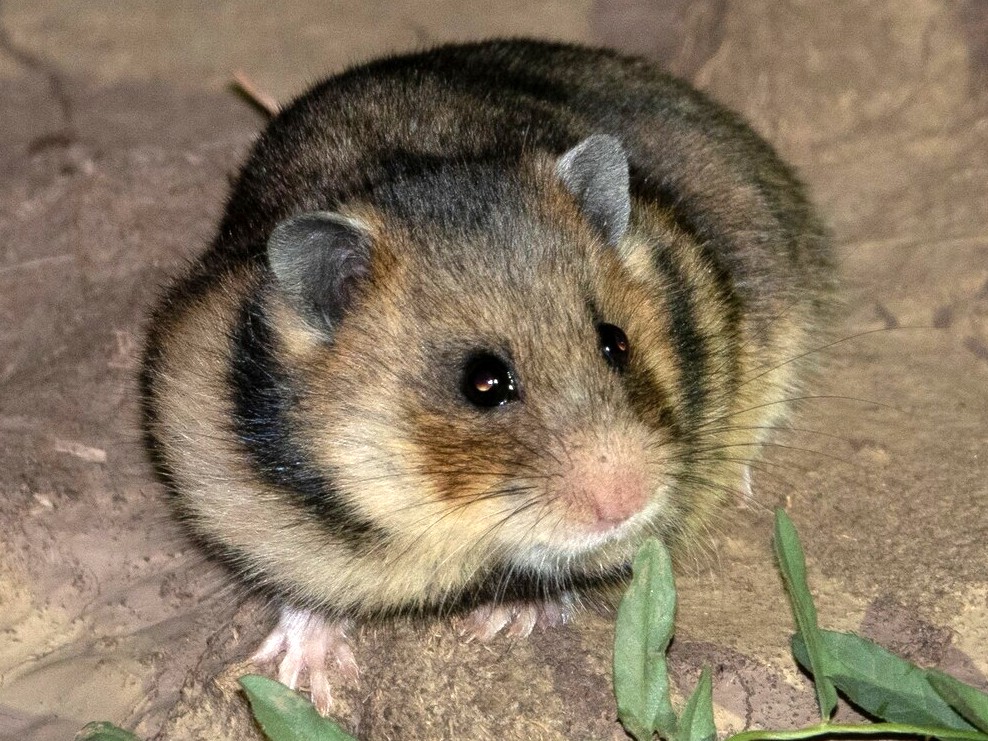
Head close-up
Identification
A medium-sized hamster: head-body 14 to 17 cm, tail 1.8 to 2.6 cm, weight 80 to 150 g — somewhat more than half the size of the Common Hamster and considerably larger than the Grey Hamster. The back is ochre to reddish brown with a dark wash and has a faint dark dorsal stripe in the middle; the flanks are paler buff, the belly white to cream. The decisive character is on the chest: a black band running from the throat across the chest to behind the forelegs, bordered on each side by a small white spot. The head has distinct blackish-brown cheek stripes. The ears are large and round for a hamster, thinly haired and grey along the upper edge; the eyes are large and black. The tail is short, thick and haired. It has cheek pouches; an animal collecting seed has a broadened, almost square head.
Similar species
Within its range confusion is almost impossible. The Common Hamster also occurs in the Dobruja, but it is two to three times as heavy and has an entirely black belly instead of a black chest band. The Grey Hamster is much smaller, uniformly grey, without black markings and with a longer, clearly visible tail. Wood mice and the Striped Field Mouse are slimmer and long-tailed, and the Striped Field Mouse has a sharp black dorsal stripe instead of a chest band. In a photograph and in the hand the black chest band is sufficient. A robust, round, short-tailed rodent crossing a bare field track at night in northern Dobruja is the Romanian Hamster, unless the animal is clearly the size of a guinea pig; it is then a Common Hamster.
Habitat
Xerophilous steppe and steppe grassland on the plateau of northern Dobruja: uncultivated, ungrazed or lightly grazed grassy slopes, rank vegetation, stony steppe hills and the edges of limestone outcrops. It uses field margins with lucerne and maize but avoids the cultivated plot itself. It also occurs in fringe vegetation along scrub and on abandoned land. Decisive are a deep, dry, free-draining soil and a sward that has not been grazed short. It occurs from just above sea level along the Danube to about 400 m.
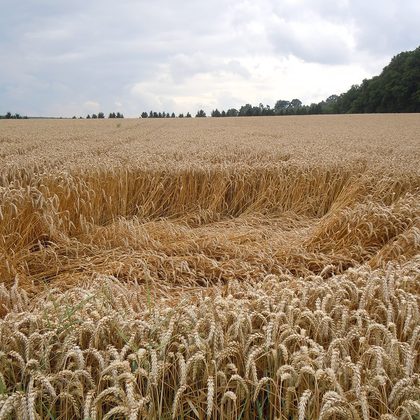
Where the animal is most at home, classified with EUNIS — the European standard for habitats.



Distribution
One of the smallest ranges in Europe: south-eastern Romania and north-eastern Bulgaria, mainly the Dobruja plateau between the lower Danube and the Black Sea, with its centre in northern Dobruja around Casimcea. In Bulgaria it reaches roughly the Shumen–Varna line; the type specimen was collected at Shumen in 1898. It occurs nowhere else in the world.
- Native
- dark = core range, pale = thinly spread
Way of life
Strictly nocturnal, with most activity in the first hours after sunset and again shortly before dawn; by day it stays deep in the burrow. It is solitary — each adult has its own burrow — and does not tolerate conspecifics outside the breeding season. The diet consists of seeds, fruit, green plant parts, roots and tubers, supplemented with insects; what is not eaten at once is carried in the cheek pouches to the store chamber. From October to March it undergoes interrupted hibernation: it enters torpor but wakes regularly to feed from its store, like the Common Hamster. Breeding runs from April to August, with a gestation of about fifteen days and litters of one to twelve young; the animals are adult at eight to ten weeks and there are two or three litters a year. In captivity the species is widely used as a laboratory animal in research on hibernation and circadian rhythm; as a result more is known about its physiology than about its life in the field.
Where and when to look
Visit the plateau of northern Dobruja in Romania — the area around Casimcea, the Măcin Mountains, the steppe reserves around Babadag — in late summer or early autumn, when the animals are laying in stores. By day walk the grassy slopes and look for small burrow entrances with a heap of spoil and the cropped paths between them. After dark drive the field tracks at walking pace with a good lamp or a thermal imager; the animals cross the tracks. The best chance comes from a night on a steppe slope with a red lamp directed at a fresh shaft. The species is strictly protected; leave no food waste, because it attracts stray dogs.
Conservation status
Vulnerable (VU, 2023). It was previously listed as Near Threatened (NT); the new category reflects a deterioration. The conversion of steppe to arable land has removed most of the original habitat in the Dobruja, and it cannot persist on cultivated plots. What remains is fragmented into slopes and margins between fields, cut through by roads and wind farms. In addition there are overgrazing of the remaining steppe, the use of rodenticides on adjoining fields and, in recent years, stray dogs, which cause considerable mortality in the Romanian steppe. Because the entire world range is small and lies in two countries, every loss of habitat has relatively large consequences. Measures regarded as effective are: not ploughing the remaining steppe, moderating grazing, keeping poison off the margins and connecting the remaining slopes. Romania and Bulgaria protect the species strictly, and a captive-breeding programme has been set up as a reserve population.
Scientific name
Mesocricetus newtoni | (Nehring, 1898)
Nehring described the species in 1898 as Cricetus Newtoni; because it was later moved to another genus, the author and year stand in brackets. Mesocricetus joins Greek mesos, 'middle', to Cricetus: the hamster standing in size between the large and the small kinds. newtoni honours the British zoologist Alfred Newton (1829–1907), who had figured and briefly described the animal in 1870 without realising it was a distinct species. The specimen the first description was based on came from Bulgaria.