All species › Bats › Vesper bats › Brown long-eared bat
Brown long-eared bat | Plecotus auritus
Gewone grootoorvleermuis | Orejudo Dorado
The Brown Long-eared Bat is the most northerly distributed of the seven Plecotus species in the guide area: from Ireland and southern Scandinavia to the Urals and the Caucasus, with a separate subspecies in central and south-west Iberia. The ears are 29 to 35 mm long, almost as long as head and body together (39 to 46 mm); the forearm measures 35.5 to 42.8 mm and weight is 6 to 9 grams. It is a woodland bat that takes prey both in flight and by picking it off leaves and twigs, and roosts in church lofts, houses, tree holes and bat boxes.

Tracks
The clearest sign is the feeding perch: large prey is carried to a fixed perch such as a beam in a barn, a porch or a church loft, and beneath it lie discarded moth wings together with droppings. In summer roosts in lofts the bats often hang along the ridge or in gaps between beams; colonies are small and often go undetected. In tree holes and bat boxes colonies switch roosts every one to five days within a radius of about 100 m. In winter the bats hang singly or in small groups in caves, mines, cellars, bunkers, rock crevices, woodpiles and hollow trees, often free against the wall with the ears tucked under the wings. On a bat detector the calls sound like quiet, dry clicks; because of their low intensity the species is under-recorded in acoustic surveys.
Identification
A medium-sized bat with very long ears (29–35 mm) joined across the forehead by a fold of skin. The dorsal fur is long and woolly, brown with a reddish tinge; the underparts are shorter-haired, yellowish to cream. The face is pale brown to cream, without a dark mask; ears and tragus are the same colour as the face. The wings are broad. Thumb, claws and feet are large and covered with relatively long hairs; the thumb is longer than 6.5 mm and strongly curved. Below the lower lip there is a banana-shaped, not triangular, chin pad. At rest the ears are folded back under the wings so that only the lance-shaped tragus sticks out. Flight is slow and highly manoeuvrable, with short spells of hovering close to foliage. Echolocation consists of short frequency-modulated pulses, usually with two clear harmonics: the first with maximum energy at 25 to 30 kHz, the second at 50 to 60 kHz. Pulses are emitted through the mouth or the nose and are faint; on a detector the bat is often audible only within a few metres. Chromosomes 2n = 32.
Similar species
Within the genus, field identification is rarely conclusive; the call separates Plecotus from other genera but not the species from each other. The Grey Long-eared Bat (P. austriacus) has a dark facial mask with a long dark muzzle, greyer upperparts, whitish underparts, a broad tragus (over 5.5 mm wide and over 14 mm long), a thumb shorter than 6.5 mm and bare-looking feet; the penis is club-shaped and broadened at the tip, whereas in the Brown Long-eared Bat it narrows towards the end. The Mountain Long-eared Bat (P. macrobullaris) has an equally long, curved thumb with long claws, but an inverted triangular chin pad, a brown mask from mouth to behind the eyes, a whitish throat and a cylindrical penis; in the Alps and Pyrenees both species fly side by side. Kolombatovic's Long-eared Bat (P. kolombatovici) of the Adriatic and Aegean coasts is smaller (forearm 36–39 mm), has a tragus shorter than 14 mm, short claws and a face and chin almost entirely covered in fur. On Sardinia the Sardinian Long-eared Bat (P. sardus) also occurs, with a tragus longer than 18 mm. The Barbastelle (Barbastella barbastellus) also has ears joined over the head, but they are short, broad and black. Where several Plecotus species occur together, a secure identification requires a combination of measurements on a bat in the hand, or DNA; in Switzerland eight body measurements assigned 97.5 per cent of bats correctly.
Habitat
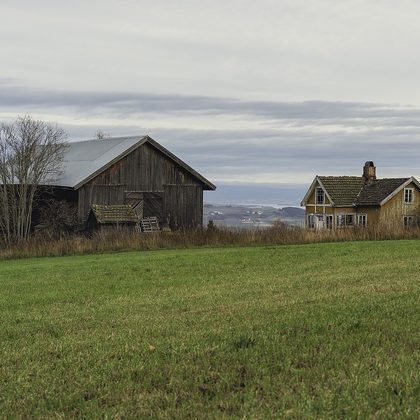
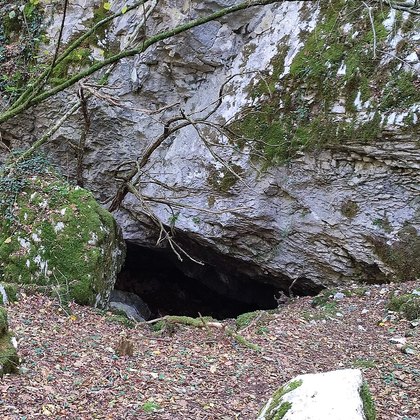
In the north mainly broadleaved, coniferous and mixed woodland, in the south also open country and farmland; also parks, gardens, hedgerows and woodland edges in villages and towns. It has been recorded in pine, beech and oak woodland from almost sea level to over 2000 m. Woodland and hedgerows are selected over other terrain for foraging, and individuals often return to the same places; some authors report that open areas are avoided. Summer roosts are in warm spaces: lofts, churches, old buildings, tree holes and bat boxes. Hibernation sites have temperatures of 3 to 7 °C.
Where the animal is most at home, classified with EUNIS — the European standard for habitats.





Distribution
Most of Europe: Ireland and Britain, northern Iberia, Sardinia, southern Scandinavia and southern Finland, and east through Russia to the Urals and the Caucasus. The nominate form P. a. auritus occupies that whole area; P. a. begognae (de Paz, 1994), slightly larger, occurs in central and south-west Iberia. Populations further east in Asia, formerly included in this species, are now treated as separate species. At the southern edge of the range, along the Mediterranean, the species is scarcer and locally rare.
- Native
- dark = core range, pale = thinly spread
Way of life
The bats emerge late, usually about one hour after sunset, and forage throughout the night. The diet consists mainly of moths, with noctuids as the largest group, supplemented with flies, grasshoppers and non-flying arthropods: centipedes, spiders, harvestmen, earwigs and caterpillars. The species hunts in flight and by picking prey off leaves and twigs (gleaning); it also locates prey by listening for the fluttering of moths and by sight, and hunting success is highest when hearing, echolocation and vision are all available. Females form maternity colonies of 5 to 50, rarely more than 100; males usually live alone. In late June 1 or 2 young are born, which fly at six weeks; sexual maturity follows in the first or second year. In autumn, and sometimes in spring, the bats swarm at caves and mines. Winter is spent in hibernation. The species is regarded as sedentary; the longest recorded movement is about 90 km, in Germany.
Where and when to look
Search church lofts and barns for moth remains beneath a beam; at dusk, about an hour after sunset, the bats leave along the wall or a line of trees. With a bat detector you will hear a long-eared bat only at short range; a thermal camera or a red-filtered torch shows the long ears in flight. To be certain of the species, the colour of the face, the width of the tragus and the length of the thumb are the characters to check; this requires the bat in the hand, which is only allowed under licence.
Conservation status
Least Concern (LC) on the global Red List, assessed in 2023. The species is widespread and common, especially in central Europe. At the edges of its range, such as along the Mediterranean, it is less abundant or locally rare, and in Turkey it is probably decreasing. Causes cited are habitat loss, the reduction of mature and natural woodland and the felling of old roost trees during timber extraction. The species is listed in Annex IV of the Habitats Directive and is covered by the Bern Convention and the EUROBATS Agreement.
Scientific name
Plecotus auritus | (Linnaeus, 1758)
Linnaeus described the species in 1758 as Vespertilio auritus; because it was later moved to another genus, the author and year stand in brackets. Plecotus is Greek, from plekein, 'to plait, twist together', and ous, genitive ōtos, 'ear', after the huge ears joined across the forehead. auritus is Latin for 'long-eared', from auris, 'ear', after ears almost as long as the animal itself. The specimen the first description was based on came from Germany, Berlin.