All species › Rodents › Mice and rats › Bushy-tailed jird
Bushy-tailed jird | Sekeetamys calurus
Sekeetamys calurus | Sekeetamys calurus
Sekeetamys calurus, the Bushy-tailed Jird, is a gerbilline of the rock deserts of Sinai, the Eastern Desert of Egypt, the Negev and southern Jordan, and the only species in its genus. It differs from the other gerbillines in three respects: the tail carries a dense brush of long hairs, the animal digs no burrow but lives in rock crevices and climbs steep faces, and the diet consists mainly of insects.

Tracks
The species does not dig and is therefore not found in sand. By day it rests in rock crevices and under boulders, and that is where the signs are. Seed remains, empty seed capsules and bits of succulent plant have been found in and in front of occupied crevices in sandstone and granite; that combination is the most useful sign. Beside them lie remains of the main food: legs, wing cases and head capsules of crickets and cockroaches, usually under a ledge where the animal has eaten. Droppings are black, spindle-shaped, three to four millimetres long, and lie at fixed places on a ledge or a flat stone, in latrines of the kind the spiny mice also make; a heap of droppings alone therefore does not show which species is present. Prints are hardly ever found, because the animal travels over stone. Where blown sand lies against a rock foot, a faint, elongated impression of the narrow hind foot may show, four toes in front and five behind. The most reliable evidence comes from pellets of Barn Owl and Eagle Owl from rocky desert, in which the species is recognisable by the skull with its grooved incisors and inflated bullae.
Identification
A small to medium gerbilline of 98 to 130 millimetres head-body and 26 to 50 grams, with a tail about a fifth longer than the body. The tail is the main character: densely set with long black hairs projecting sideways in two rows, and white-tipped; no other gerbilline has such a tail. The back is pale brownish yellow to sandy buff, speckled with black because each hair is grey at the base, with a yellowish band below a black tip; the flanks are paler and carry a yellow or orange line from wrist to ankle. The belly is pure white. The ears are large, darkly pigmented, rounded at the tip and thinly haired, the eyes large and dark. The hind feet are long and narrow with naked soles, built for climbing rather than digging. The skull is recognised by the inflated bullae, the sharp cranial ridges, the long narrow rostrum and the backward-sloping upper incisors, each with a single longitudinal groove.
Similar species
The tail is always decisive. Wagner's Gerbil (Gerbillus dasyurus) uses the same crevices in Egypt and the Negev and is about the same size, but has a thinly haired tail with at most a small end pencil and no white tip. Sundevall's Jird (Meriones crassus) is heavier, digs burrows in sand and has a short dark tail brush on a pale tail base. The spiny mice, the Cairo (Acomys cahirinus) and the Golden (A. russatus), live in the same rocks; they have a spiny coat and a naked, brittle tail that is often partly missing, and the Golden Spiny Mouse is also diurnal. The Garden Dormouse has a comparable tail, but a black eye mask, and does not occur in this region. A sandy rodent running over rocks at night with a black, white-tipped bushy tail is, in Sinai, the Negev and southern Jordan, this species.
Habitat
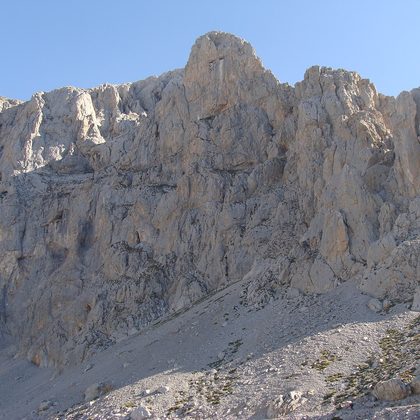
Exclusively rocky terrain: rock faces and sandstone cliffs, crevices in granite and the spaces between large boulders, in arid country. The species occurs in the mountains of Sinai, but not above six hundred metres. It is not known from sandy areas, whereas the jirds avoid rock. In the rock desert of Egypt it lives alongside the Cairo Spiny Mouse, the Golden Spiny Mouse and Wagner's Gerbil; these four species use the same crevices and differ in activity time and diet.
Where the animal is most at home, classified with EUNIS — the European standard for habitats.


Distribution
A small, fragmented range. The nominate form lives on the Sinai Peninsula, in southern Israel, in south-western Jordan and in an isolated population in central Arabia; the darker animals of the Eastern Desert of Egypt are recognised as the subspecies makrami. The guide area includes Sinai, the Eastern Desert of Egypt, the Negev and the rock desert of southern Jordan. In Israel the range has shifted northward over time, from the area around Nahal Tze'elim towards Ein Gedi on the Dead Sea. The taxonomic and ecological status of the central Arabian population has not been studied.
- Native
- dark = core range, pale = thinly spread
Way of life
Nocturnal. The species climbs fast over boulders and up steep faces, carrying the tail upright and curved forward over the back. By day it sits in a crevice or under a boulder; no burrow is dug. It is an omnivore with a diet consisting mainly of insects, supplemented with green plant material, seeds and pieces of succulent; captives ate cockroaches and crickets. In the Negev density has been estimated at 0.8 to 3 animals per hectare. Little is known of breeding in the wild: pregnant females have been found in February and March. Captive animals in the early twentieth century produced litters in every month except September; across 47 litters the average was 2.8 young, with two litters of six as the maximum. Females have four pairs of nipples. The species neither hibernates nor keeps a winter rest.
Where and when to look
Find a sandstone cliff or a boulder field in a dry wadi below six hundred metres, and after dark sit with a red lamp where crevices and ledges meet. In the Negev the wadis draining to the Dead Sea, around Ein Gedi and Nahal Tze'elim, are the best-known sites; in Sinai granite wadis are suitable. The animal moves fast and vertically, so light the face upward as well as the ground; the white tail tip is often the first thing visible. By day you can search crevices for seed capsules, cricket remains and latrines, but spiny mice use the same crevices. The species is nowhere numerous.
Conservation status
Least Concern (2016). The species is nowhere numerous: in Israel it was regarded as moderately common in the 1950s, and in the Negev no more than three animals per hectare have ever been measured. No serious threats have been established, and the habitat, bare rock below six hundred metres, is little used by people. The range in Israel has grown rather than shrunk. Open questions are the taxonomic and ecological status of the isolated population in central Arabia, and the near absence of genetic data on the species beyond the karyotype.
Scientific name
Sekeetamys calurus | (O. Thomas, 1892)
O. Thomas described the species in 1892 as Gerbillus calurus; because it was later moved to another genus, the author and year stand in brackets. Sekeetamys ends in Greek mys, 'mouse'; the first element cannot be placed, and Ellerman never said in 1947 what he meant by it. calurus is Greek for 'beautiful-tailed', from kalos, 'beautiful', and oura, 'tail', after the long tail with its white tuft at the tip. The specimen the first description was based on came from Egypt, Sinai.