All species › Rodents › Mice and rats › Striped Field Mouse
Striped Field Mouse | Apodemus agrarius
Brandmuis | Ratón Listado
The Striped Field Mouse is the only European Apodemus that can be identified without handling the animal: a black stripe runs along the back from the head to the root of the tail, a feature found in no other European mouse. It is also the only member of the genus that is regularly active by day. Since the twentieth century it has been spreading westward, to Denmark, eastern Germany, northern Italy and, since the 1990s, Austria.

Tracks
The Striped Field Mouse digs, so its signs are easier to find than those of most mice. It makes simple burrow systems 30 to 40 cm deep with three or four entrances and a nest chamber lined with dry plant material; the entrances are bare, round holes two to three centimetres across in a ditch bank, a field margin or under a tussock, without a spoil heap. In late summer and autumn short, flattened runs lead from these holes through the grass. In winter it moves into hayricks, barns, root clamps and stores; there, heaps of husks and dark, spindle-shaped droppings three to five millimetres long can be found. The feeding signs resemble those of the Wood Mouse: seeds and stones with a round hole, and cereal ears bitten off at the node and stripped of grain. In snow or fine dust it leaves the same bounding trail as other Apodemus species: four prints in a group, the five-toed hind feet ahead of the four-toed fore feet, but with shorter bounds, because it is shorter in the leg. In central and eastern Europe it is frequently found in Barn Owl and Short-eared Owl pellets; in many districts its spread was first detected in this way.
In its habitat

Head close-up

Identification
A small, thickset mouse with head-body 7.5 to 12 cm, a tail of 6.5 to 11.5 cm that is shorter than head and body, and a weight of 16 to 38 g. The upperparts are yellowish to reddish brown, the underparts greyish white, and along the midline of the back runs a black stripe from between the ears to the root of the tail, more or less sharply defined but almost always visible in adults. The ears are small and rounded and half hidden in the fur; the eyes are smaller than in the Wood Mouse and the muzzle blunter. The tail is bicoloured, dark above and pale below, and thinly haired. The body therefore appears shorter and rounder than in the Wood Mouse and Yellow-necked Mouse, both of which have long ears, bulging eyes and a tail as long as head and body.
Similar species
When the back is visible, the Striped Field Mouse is the only European mouse with a continuous black dorsal stripe; Wood Mouse and Yellow-necked Mouse have at most a darker tinge of guard hairs on the back, and their character is on the chest (a yellow spot or yellow band), not on the back. If only the head or flank is visible, the small rounded ears and short tail are decisive: in Wood and Yellow-necked Mice the tail is about as long as head and body together, in the Striped Field Mouse clearly shorter. The Harvest Mouse is half the size, orange-brown, unstriped and has a prehensile tail. Young House Mice are greyer and duller, lack the sharp line between back and belly and have a strong smell. Confusion with voles hardly occurs: they have a blunt muzzle, ears hidden in the fur and a tail much shorter than the body. Other striped murids occur in eastern Asia, but in Europe the dorsal stripe is decisive.
Habitat
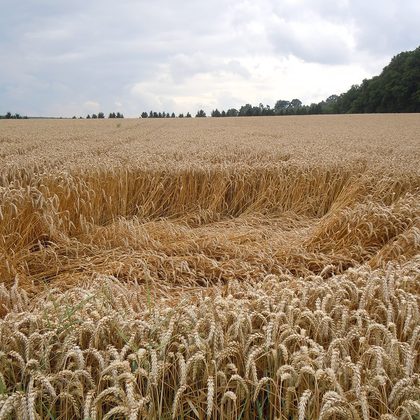
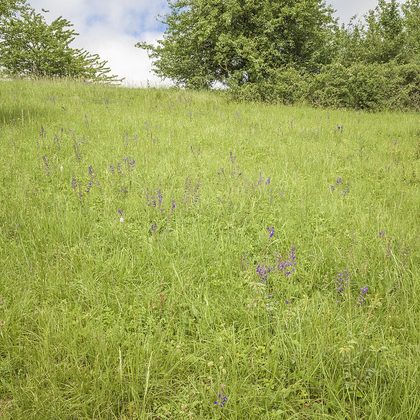
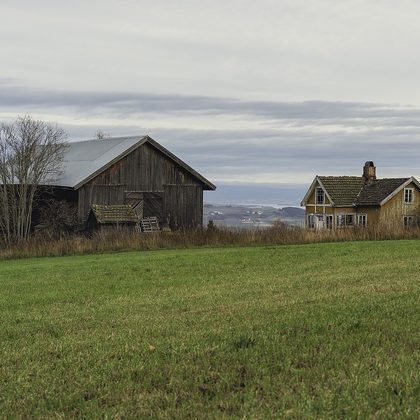
Mainly edge habitats: wood edges, shelterbelts, ditch banks, arable margins, rough ground and neglected corners, and from there fields, allotments and gardens. It prefers a dense herb and shrub layer with little or no canopy; in the south of its range it has been found in bramble thickets under open woodland. Closed old woodland and bare, continuously cultivated land are avoided. Also reedbeds, marsh edges, wet grassland and ditch verges. In autumn and winter it moves to farmyards: barns, hayricks, stores and sometimes houses. In North Macedonia it has been recorded up to 1750 m.
Where the animal is most at home, classified with EUNIS — the European standard for habitats.




Distribution
The range consists of two separate parts. The western part runs from Denmark, Germany and northern Italy eastward through central and eastern Europe into southern Siberia and western China; the eastern part covers the Russian Far East, eastern Mongolia, China, northern Myanmar, Korea, Taiwan and the Senkaku Islands of Japan. In Europe it is an eastern species expanding westward: Denmark and northern Germany have long been occupied, Austria was reached in the 1990s, and in northern and north-eastern Italy it occurs in the Po plain. The species is absent from the Iberian Peninsula, France, the Low Countries, Britain and Ireland; the westernmost populations are in eastern Germany and Denmark. In the east of the range numbers fluctuate strongly and plague years occur.
- Native
- dark = core range, pale = thinly spread
Way of life
It is the only European Apodemus regularly seen by day: it is diurnal or crepuscular, in summer mainly at dusk and at night, in winter mainly by day. It climbs moderately and mostly stays on the ground. The diet consists of seeds, buds, fruit and berries in varying proportions, supplemented by insects, worms and molluscs; on farmland it eats grain and root crops. It does not hibernate and is active all year; in frost it moves into human stores. Breeding takes place in spring and summer, with litters of one to ten young, averaging about five. Daily travel distance is small (a mean of just over forty metres for males and thirty metres for females was measured) and home ranges measure 100 to 2400 square metres, with no great difference between the sexes. The species is one of the principal hantavirus hosts in eastern Europe and eastern Asia; caution is therefore advised in dusty barns.
Where and when to look
The species can also be observed by day. In Poland, the Czech Republic, Hungary or eastern Germany, walk along a ditch, a field margin or a rank wood edge on a mild morning or late afternoon and watch for a small, dark-backed mouse moving low through the grass; in winter the daytime chance is greatest. A second method is searching barns: from October to March the animals live in hay, straw and grain stores and are easy to find with a torch. A third method is pellet analysis: in central and eastern Europe the species is frequently found in pellets, and the short tail and small ears immediately separate it from the Wood Mouse in the hand.
Conservation status
Least Concern (2016); one of the few European rodents whose range is growing. The species benefits from small-scale arable land with rough margins, from ditches and from human food stores, and has been spreading gradually westward since the twentieth century. Locally, strong population peaks occur in which the species is regarded as an agricultural pest, damaging grain, root crops and stored produce; these peaks subsequently decline. Attention to the species concerns mainly its role as a hantavirus host, not its survival.
Scientific name
Apodemus agrarius | (Pallas, 1771)
Pallas described the species in 1771 as Mus agrarius; because it was later moved to another genus, the author and year stand in brackets. Apodemus is Greek, from apodēmos, 'away from home'. agrarius is Latin for 'of the field', from ager, 'field, farmland'. The specimen the first description was based on came from Russia.