All species › Rodents › Mice and rats › Cairo spiny mouse
Cairo spiny mouse | Acomys cahirinus
Egyptische stekelmuis | Acomys cahirinus
The Cairo Spiny Mouse (Acomys cahirinus) is a mouse with a coat of spiny hairs, whose young are born furred and with open eyes. Like other spiny mice it has skin that tears away under slight tension, which helps the animal to escape from an attacker. The species lives in the rock deserts of north-eastern Africa. Since the Mammal Diversity Database also includes the spiny mice of Crete, Cyprus and southern Turkey in this species, it also occurs in Europe.

Tracks
A spiny mouse leaves few signs, and these usually lie on stone. Prints are seldom found: the animal weighs less than 50 g and moves over rock, grit and masonry. In fine dust or spilt flour in a shed it leaves a mouse print of at most 1 cm, with four toes on the fore foot and five on the hind foot. The droppings are more useful: black, glossy, spindle-shaped, 3 to 5 mm long, and not scattered but in small heaps at a fixed spot, such as a ledge, a flat slab or the edge of a crevice. Such a latrine is the clearest sign that a crevice is occupied. Occupied crevices have polished edges and a faint musky smell, with gnawed seeds, date stones and empty snail shells at the entrance. The feeding signs are those of an omnivore: cricket legs and beetle wing cases, gnawed barley grains, and hollowed snail shells with a broadly gnawed aperture. In pellets of Barn Owl and Eagle Owl the spiny mouse is one of the most frequent prey species in rocky terrain; a few pellets from below a rock ledge are usually enough to establish its presence. A less frequent sign is pieces of torn-off skin and broken tails in a snake's hole or below an owl perch, from animals that escaped a predator and lost a large part of the skin of the back.
Identification
A stocky, grey-brown to sandy mouse of 10 to 12 cm head-body length, with a tail of about the same length. The coat is characteristic: back and flanks carry flattened, stiff spiny hairs that point backwards and give the back a rough, ribbed appearance; against the lie of the hair they are immediately felt with a finger. The belly is white and sharply demarcated. The ears are large (18 to 24 mm) and thin, the eyes large and black, the muzzle pointed. The tail is sparsely haired, ringed and brittle, and is often shorter than normal: a spiny mouse held by the tail loses it, and the tail does not grow back. On Crete the back is greyer and the flanks reddish yellow; in Egypt and Libya the animal is paler and sandier. The young are furred at birth and open their eyes within two days.
Similar species
Confusion is mainly possible with other spiny mice. The Arabian Spiny Mouse (Acomys dimidiatus) is barely separable in the field: it is on average slightly smaller and paler sandy, with a distinct white patch behind the base of the ear and below the eye, and replaces the Cairo Spiny Mouse east of the Nile and the Suez Canal. Where both occur, karyotype and DNA are decisive. The Golden Spiny Mouse (Acomys russatus) is immediately recognised by its short tail, 68 to 78 mm, a little over half to three-quarters of the head-body length, and by its rusty to golden-orange back; it is also diurnal, whereas this species is active at night. House Mouse and Black Rat occur in the same buildings in Egypt and on the islands, but lack the spiny coat and have a smooth, supple tail. The young Wood Mouse on Crete and Cyprus has larger hind feet, makes longer bounds and has no spines.
Habitat
Dry, stony terrain with crevices: rock faces, scree, dry wadi beds with boulders, limestone plateaus and the dry-stone walls of old terraces; on Crete and Cyprus also phrygana and low maquis, into olive groves and the edges of villages. Sandy areas, the habitat of gerbils, are avoided. The species seldom occurs above 1500 m and in farmland uses old dry-stone walls, which offer the same crevices as a rocky slope. Around farms, granaries and temple ruins it lives close to people without becoming established in buildings.
Where the animal is most at home, classified with EUNIS — the European standard for habitats.
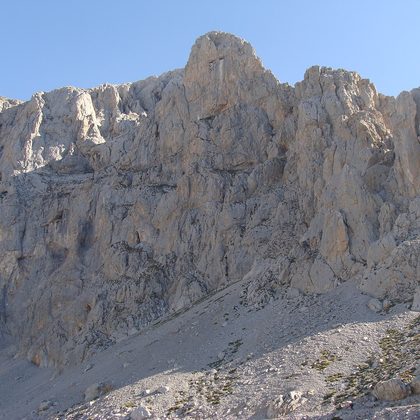


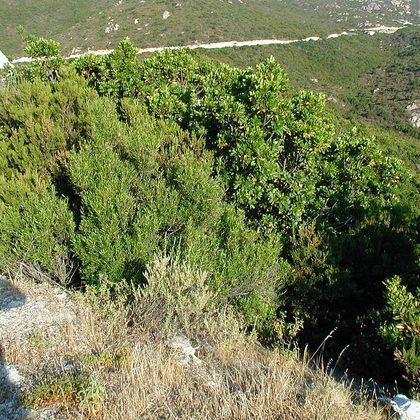
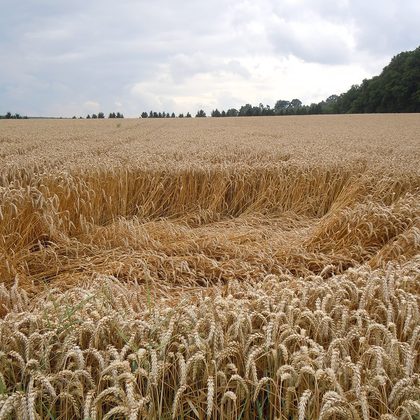
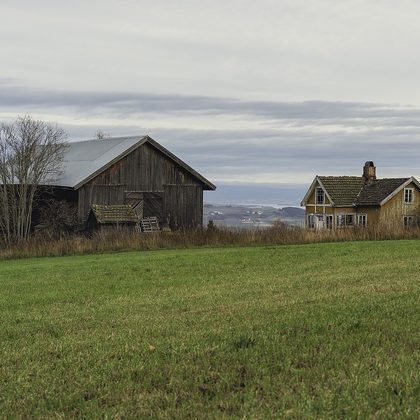
Distribution
From Libya and Egypt east to Sudan, Eritrea, Ethiopia and Djibouti, and north to Sinai and south-eastern Israel. In North Africa the range covers the whole Egyptian rock desert on both sides of the Nile and the coast of Cyrenaica. Since version 2.5 the Mammal Diversity Database, on the basis of genetic work, also includes minous of Crete, nesiotes of Cyprus and cilicicus of the Turkish south coast near Silifke in this species. On Crete it occurs mainly in the west, around Chania and Souda; on Cyprus in the dry interior. How the island populations arrived has not been established: under their own power via a land connection that no longer exists, or with ship cargo in the Bronze Age.
- Native
- dark = core range, pale = thinly spread
Way of life
Mainly nocturnal, in Egypt also in the first hour after sunrise and the last hour before sunset, and on Crete mainly at dusk. The species lives in groups with a core of females, which give birth in the same crevice, suckle one another's young and rear the young together; such cooperative breeding is rare among rodents. Omnivorous; in studied diets crickets make up the largest share (50 to nearly 60 per cent), together with barley grains, green leaves, seeds, snails, spiders, carrion and in villages human food waste. It can go about nine days without moisture-containing food. Gestation is five to six weeks, long compared with other mice, and the litter comprises one to five young, which are born furred and with open eyes and move about independently within a few days. A female gives birth three to four times a year; the young are adult at two to three months. In captivity they reach four years, in the wild much less. As a defence, the skin of spiny mice tears under slight tension, leaving an attacker with a piece of coat; in two related East African species such wounds have been shown to heal without scarring, with hair follicles, skin glands and cartilage being formed anew. There is no hibernation.
Where and when to look
Find a rock face with crevices, sit down in the last daylight and wait. In Egypt abandoned limestone quarries and wadis with large boulders are suitable; on Crete the dry-stone walls and rock edges of the Akrotiri peninsula and the area around Chania are known sites, in the first half hour after sunset. Use a red lamp: in white light the animal retreats into the crevice and does not return. Without a sighting the species can be established from latrines of glossy black droppings on ledges and from owl pellets below a perch, from which the spiny hairs are easily picked out. Never pick up a spiny mouse by the tail: it breaks off.
Conservation status
Least Concern (LC, 2016). The species is common in bare rocky areas and also uses walls, ruins and grain stores. Attention focuses on the island populations: the Crete spiny mouse was on the Red List as a separate species, Acomys minous, as Data Deficient (DD), and the Cyprus animal was regarded as a vulnerable island endemic. Because the Mammal Diversity Database now places them in A. cahirinus, they fall under the assessment of a widespread species and no longer have a status of their own; the size of the island populations has not changed as a result of this taxonomic change.
Scientific name
Acomys cahirinus | (É. Geoffroy Saint-Hilaire, 1803)
É. Geoffroy Saint-Hilaire described the species in 1803 as Mus cahirinus; because it was later moved to another genus, the author and year stand in brackets. Acomys is Greek, from akē, 'point, sharp tip', and mys, 'mouse', after the spiny hairs on the back. cahirinus means 'of Cairo', after the type locality; the city's Arabic name is al-Qāhira. The specimen the first description was based on came from Egypt, Cairo.