All species › Rodents › Squirrels and marmots › Caucasian Mountain Ground Squirrel
Caucasian Mountain Ground Squirrel | Spermophilus musicus
Spermophilus musicus | Spermophilus musicus
Spermophilus musicus is the ground squirrel that occurs highest of all European species: on the northern flank of the central Greater Caucasus, up to 3,200 metres, among lichen-covered basalt blocks in the Elbrus area. Ménétries named it musicus, 'the singer', in 1832, after its clear whistling call. Since 2024 the species has been understood more broadly than the mountain form alone: the sandy-coloured steppe animals between Dnieper and Volga are included as well.
Tracks
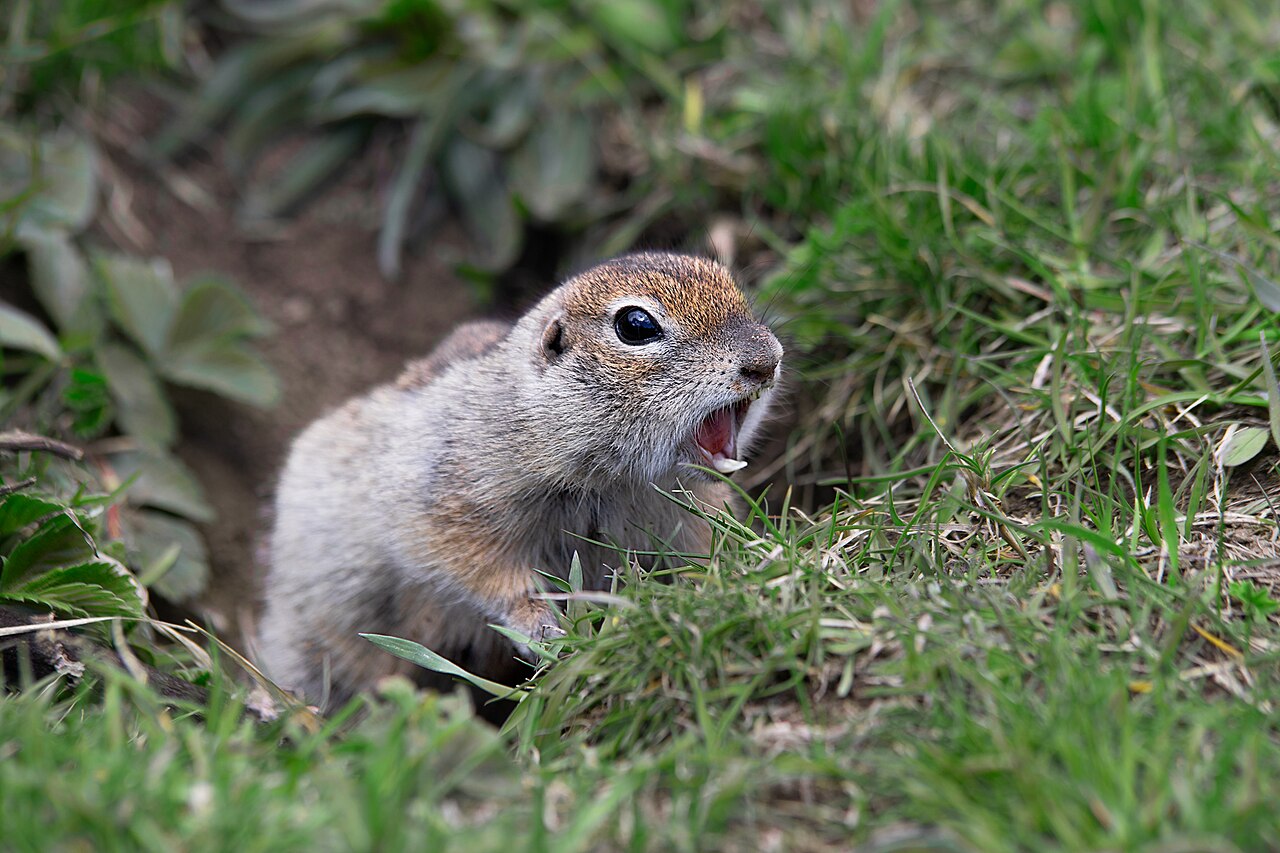
The clearest sign is the colony. In the mountains the burrow entrances lie under and between boulders and in the grassy patches between them; they are five to eight centimetres across and run obliquely into the slope. In front of each entrance lies a bare fan of earth and stone chippings, visible at a distance as a pale patch in the meadow. Around these patches the grass is grazed shorter and differently coloured, and narrow paths worn into the turf run between the entrances. Boulders next to an entrance serve as fixed lookouts; the stone there is worn smooth and sometimes greasy. In the lowland steppe boulders are absent and only the pale fan of earth remains, often dozens on a single field. Droppings are small, dark and sausage-shaped and lie scattered around the feeding areas. The most useful sign is the call after which the species is named: a clear, sustained whistle repeated from burrow to burrow, usually heard before the animals are seen.
In its habitat

Head close-up

Identification
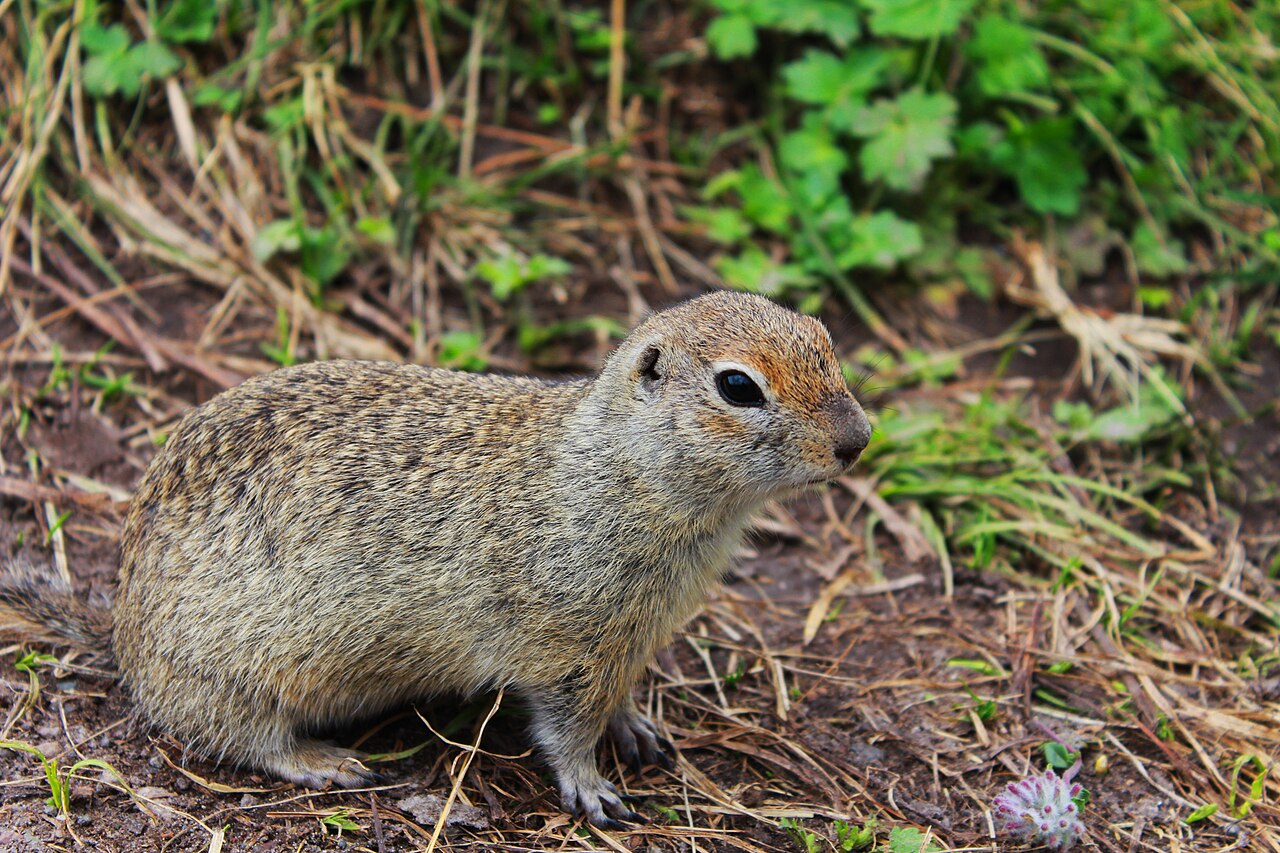
Head-body 20.5 to 24 cm, tail 4.5 to 5 cm, weight around 235 g; slightly heavier than the European souslik, with a short tail of just over a fifth of the body length. The back is ochre-yellow to greyish brown with a fine pale speckling formed by pale hair tips rather than spots; at ten metres the back looks plain. Mountain animals are darker and warmer brown, with a reddish-brown to rusty head and eye region contrasting with the greyer back; the lowland steppe form is paler and yellower. Throat and belly are yellowish white, the eye-ring is pale but not sharply defined, and the ears are very small and round. The tail is short-haired, coloured like the back above, with a narrow dark band before a pale tip. The posture is that of all sousliks: upright at the burrow entrance, neck stretched, forefeet held against the chest.
Similar species
Range is decisive. On the mountain meadows and screes of the Caucasus above 1,150 m this is the only ground squirrel; the Alpine Marmot does not occur there, and no other animal of this size lives in diurnal colonies above the treeline. In the steppe between Dnieper and Volga, where the lowland form of this species has been placed since 2024, it differs from neighbouring species in being uniformly sandy and lacking white spots: the Speckled Ground Squirrel, which occurs in the forest-steppe to the north, is distinctly pearled, which can be seen through binoculars or on a photograph. East of the Volga lives the Little Ground Squirrel, which is very similar and cannot always be separated even in the hand; there the river is the boundary. West of the Dnieper lives the likewise spotted S. odessanus, and further west the European souslik; neither borders the range of this species. The Turkish species occur south of the Caucasus and the Black Sea. Outside the genus, the Bobak Marmot is five times heavier, the Caucasian Squirrel lives in trees and has a bushy tail, and steppe lemmings and hamsters are smaller and not active by day in open terrain.
Habitat
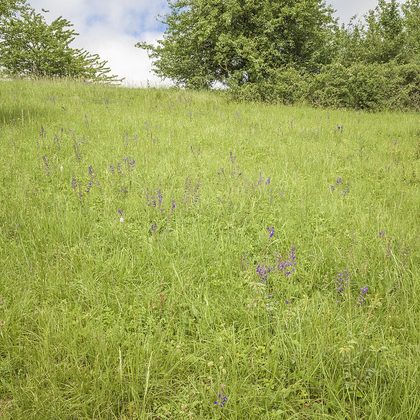
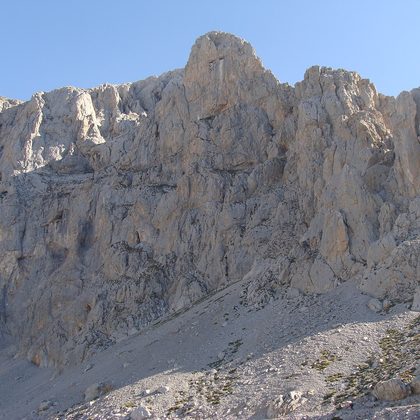
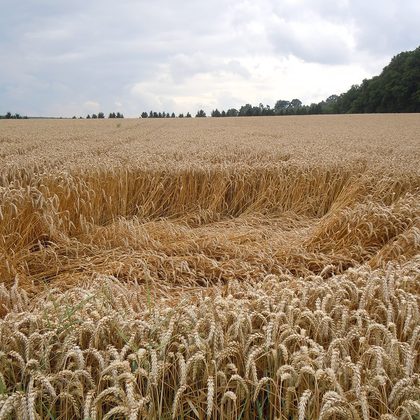
In the Caucasus, subalpine and alpine meadows, grassy slopes and patches of grassland between screes and boulders, from 1,150 to 3,200 m; the largest colonies lie on the upper alpine meadows and pastures of the northern, western and eastern slopes of Elbrus, where the soil is deep enough to dig. In the lowlands between Dnieper and Volga, dry and semi-dry steppe, wormwood steppe, grazed slopes, field margins and fallow land. Both forms depend on dry, free-draining soil and low vegetation. Tall grass and dense scrub are avoided.
Where the animal is most at home, classified with EUNIS — the European standard for habitats.



Distribution
The core area is the North Caucasus: Kabardino-Balkaria, Karachay-Cherkessia, North Ossetia and adjacent Georgia. There the species is common on the highest meadows; the total mountain range is small, a few hundred square kilometres. Since the 2024 revision the lowland form of the steppe between Dnieper and Volga, including the Crimea and southern Ukraine, has also been assigned to this species; it was previously placed under the Little Ground Squirrel. The western part of this lowland range, the Crimea and the steppe north of the Black Sea, is where the species is declining fastest.
- Native
- dark = core range, pale = thinly spread
Way of life
The species is strictly diurnal, most active in the morning and late afternoon; on hot days the animals stay underground around midday. They live in colonies, but each adult has its own burrow system; communal family burrows as in marmots do not occur. Food consists of grass, herbs, flowers, seeds, bulbs and tubers, in the mountains mainly young growth appearing shortly after snowmelt. Hibernation lasts from about October to April, six to seven months, and the entrance is plugged from within. On the highest slopes hibernation lasts longer; in the warm lowland steppe the animals go underground earlier, and there hibernation follows directly on a summer dormancy that may begin as early as July or August. There is a single mating period shortly after emergence; after about four weeks' gestation five to eight young are born, which appear above ground after a month and breed after one hibernation. Predators are fox, stone marten, stoat, steppe polecat and Golden Eagle; in the mountains the species is a regular prey of the Golden Eagle, and a long whistle from the colony almost always indicates an eagle overhead.
Where and when to look
In the central Caucasus the best period is June to mid-September, between seven and eleven in the morning, above the treeline. Known sites are the meadows of Dzhily-Su on the upper Malka at the foot of Elbrus, and the Prielbrusye National Park; the animals there are not very shy. First search with binoculars for the pale fans of earth among the boulders, then sit down fifty metres away and wait until the whistling stops. In the lowlands, in the Crimea and the south Ukrainian steppe, April to June is the best period; grazed slopes and old railway embankments are suitable sites. After September the animals are hibernating everywhere.
Conservation status
Least Concern (2024). This is the lowest threat category of any European souslik, but the assessment rests mainly on the mountain population. That population lives at high altitude in terrain of difficult access, is little affected by arable farming and is increasing on some slopes. The lowland part of the species, included only since 2024, is by contrast in steep decline: in the Crimea and the south Ukrainian steppe numbers have fallen sharply since the 1980s through ploughing of steppe plots, the loss of extensive grazing and drought. The LC category therefore covers two parts of the population with different trends; until the new species concept is incorporated in a new assessment, it says little about the European part of the population. In the Caucasus overgrazing of the highest meadows and the expansion of ski areas are the main threats; both are local and do not threaten the survival of the species.
Scientific name
Spermophilus musicus | Ménétries, 1832
Ménétries described the species in 1832 and placed it straight away in the genus where it still stands. Spermophilus is Greek, from sperma, 'seed', and philos, 'loving': the seed-lover, after the food the animal carries to its burrow in its cheek pouches. musicus is Latin for 'musical, tuneful', after the clear whistle with which the animal gives the alarm. The specimen the first description was based on came from Georgia, Ush-Kulan.