All species › Rodents › Squirrels and marmots › European ground squirrel
European ground squirrel | Spermophilus citellus
Siesel | Ardilla Terrestre
The European Ground Squirrel, or souslik, is the only ground squirrel whose range reaches central Europe. The species lives in colonies on short-grazed steppe and on similar ground, such as sheep pasture, airfields, dykes and golf courses. It is exclusively diurnal and hibernates for about half the year, from August to March, in a burrow a metre or more below ground. Since 2023 it has been listed as Endangered on the Red List, mainly because of the loss of short-grazed steppe vegetation in Europe.
Tracks
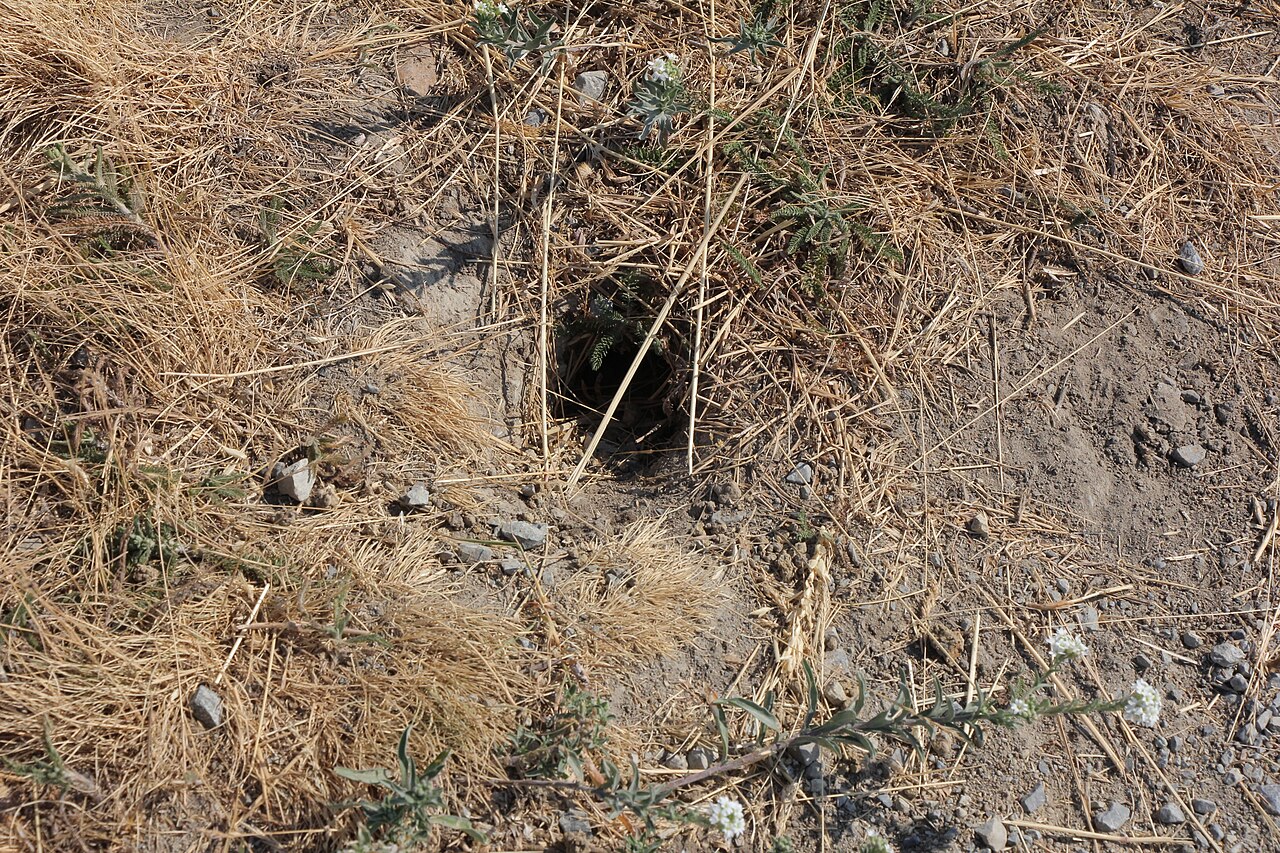
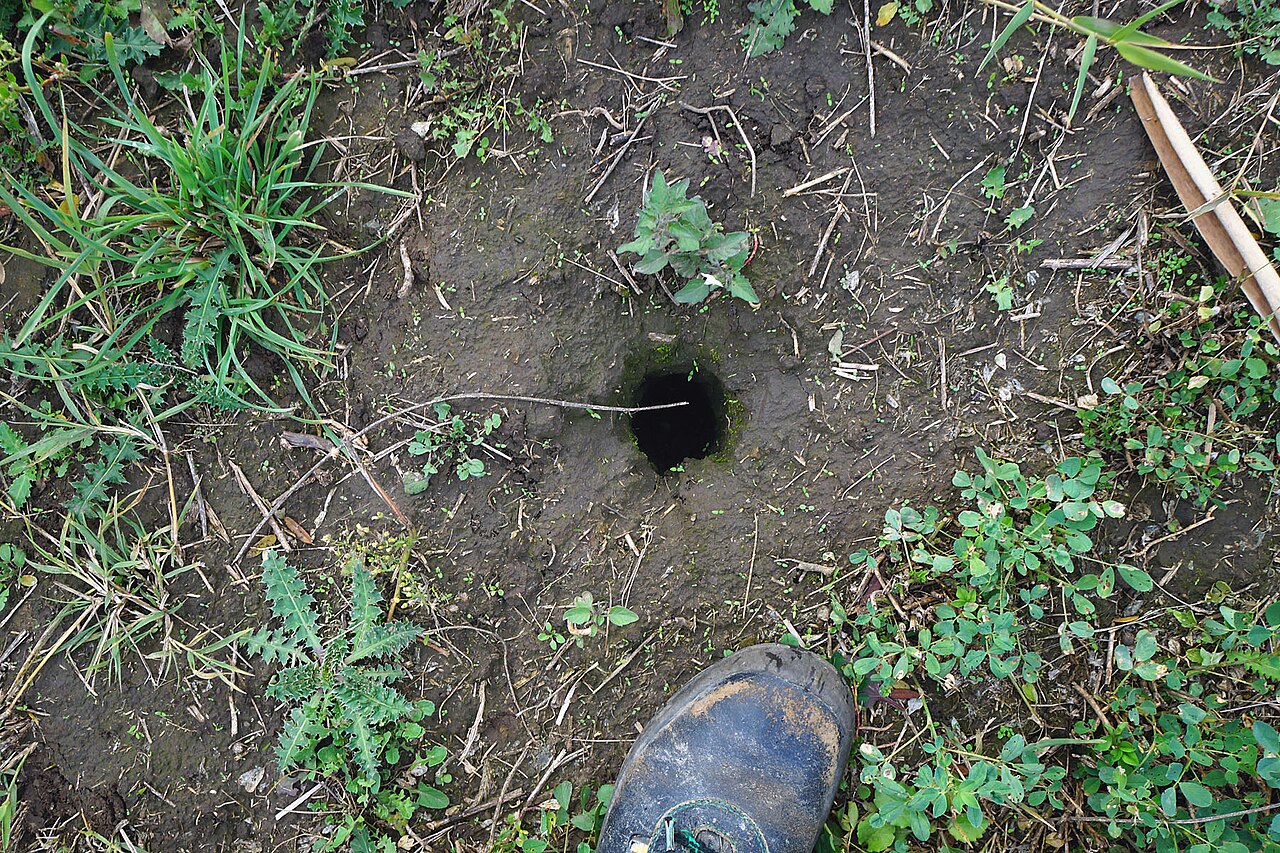
The main sign is the colony itself, recognisable from a hundred metres. Look for burrow entrances five to ten centimetres across, round to slightly oval, running obliquely into the ground and without the spoil threshold of a badger sett; a system has one to five entrances, tunnels half a metre to four and a half metres long, and reaches two metres deep. In front of fresh entrances lies a fan of thrown-out earth that stands out pale against the sward: on ploughed or stony ground a light patch, in grass a bare one. Around the entrances the grass is grazed shorter than beyond and differently coloured, and narrow paths worn into the turf run between the entrances. An entrance plugged with soil from the inside means that the occupant is hibernating; this begins as early as August, so that a colony looks abandoned in September while it is occupied. Droppings are small, dark and elongated, about half a centimetre thick, and lie scattered around the feeding areas, not in a latrine. On field margins lie bitten-off ears and seed heads dragged towards the burrow. The alarm call is a sharp, high whistle of a tenth of a second, usually in two notes, repeated through the whole colony as soon as a buzzard flies over; immediately afterwards all animals are underground.

In its habitat
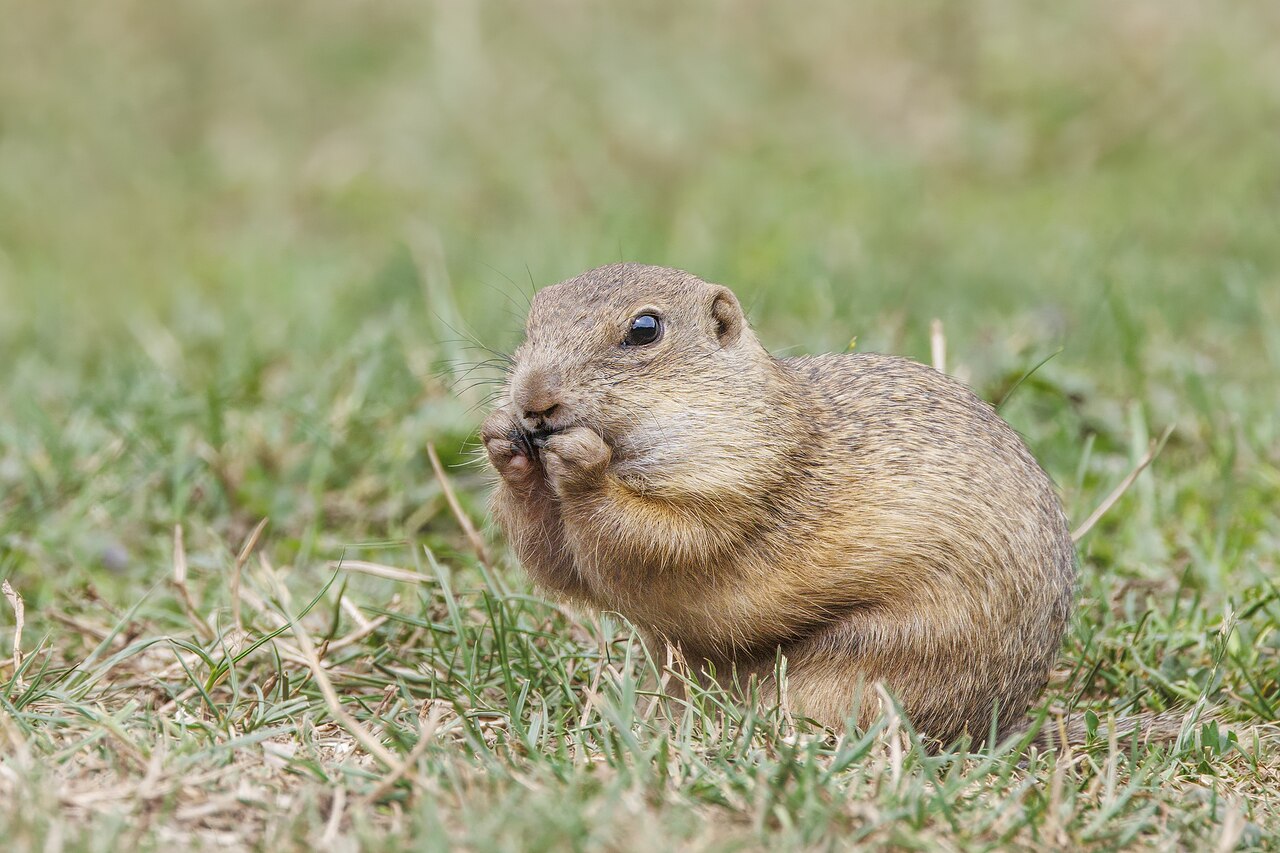
Head close-up
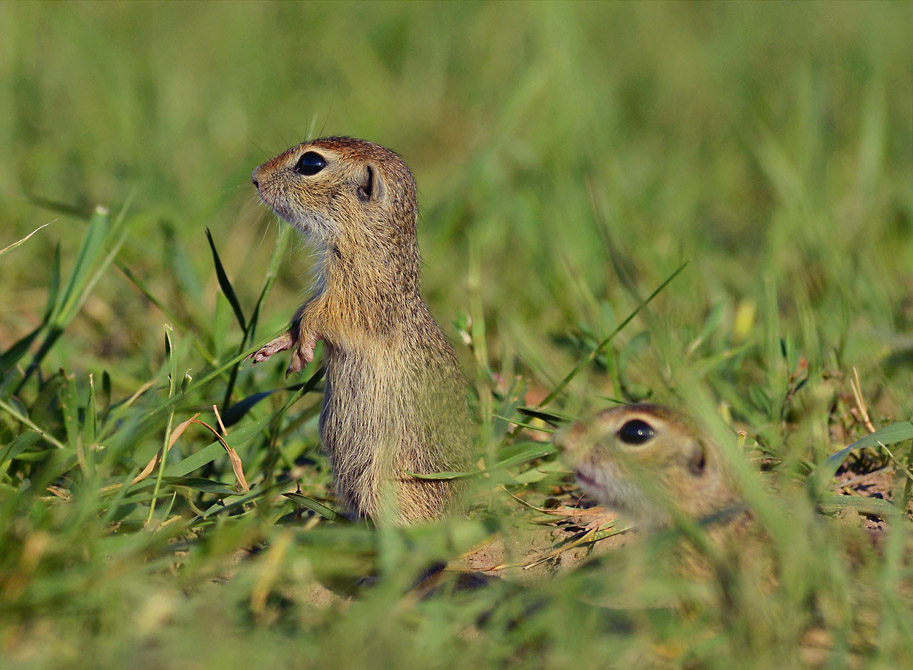
The young
Identification
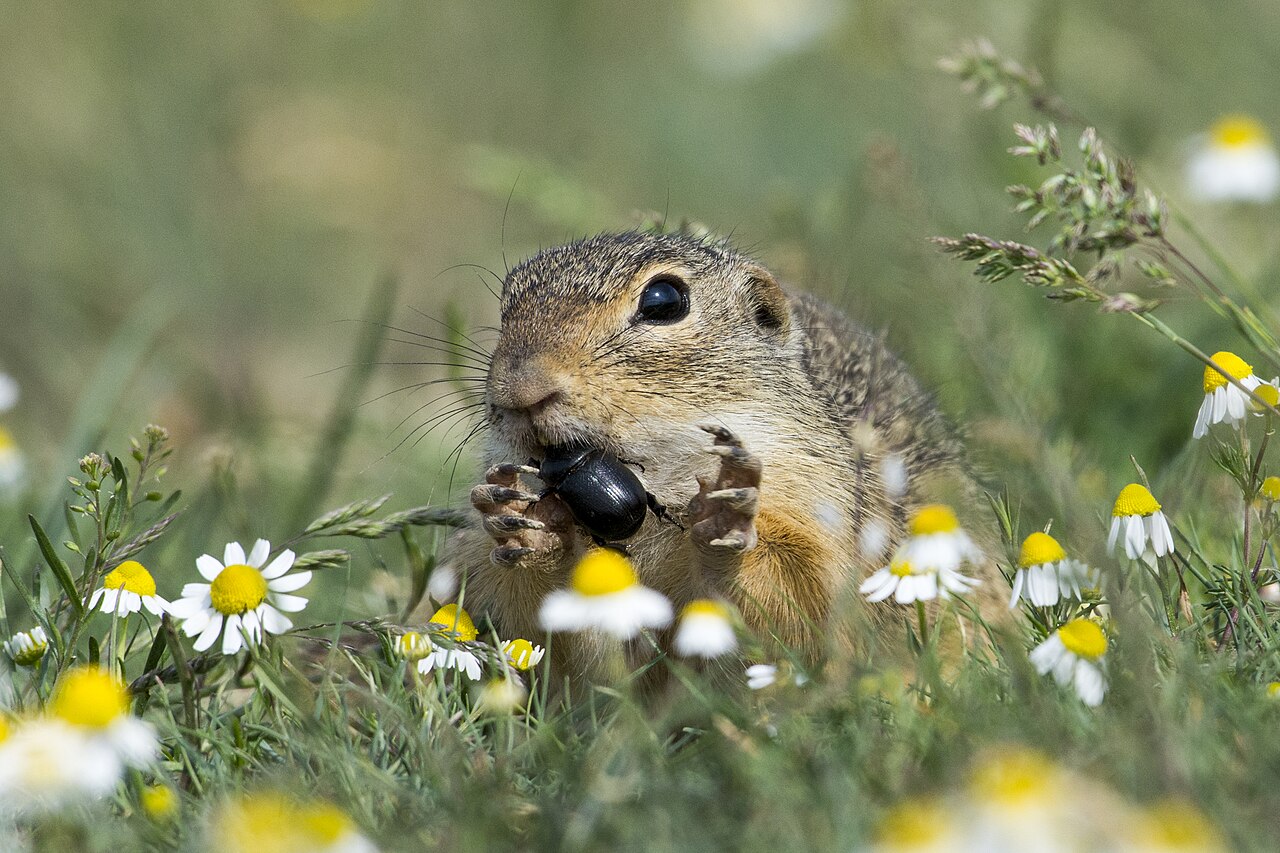
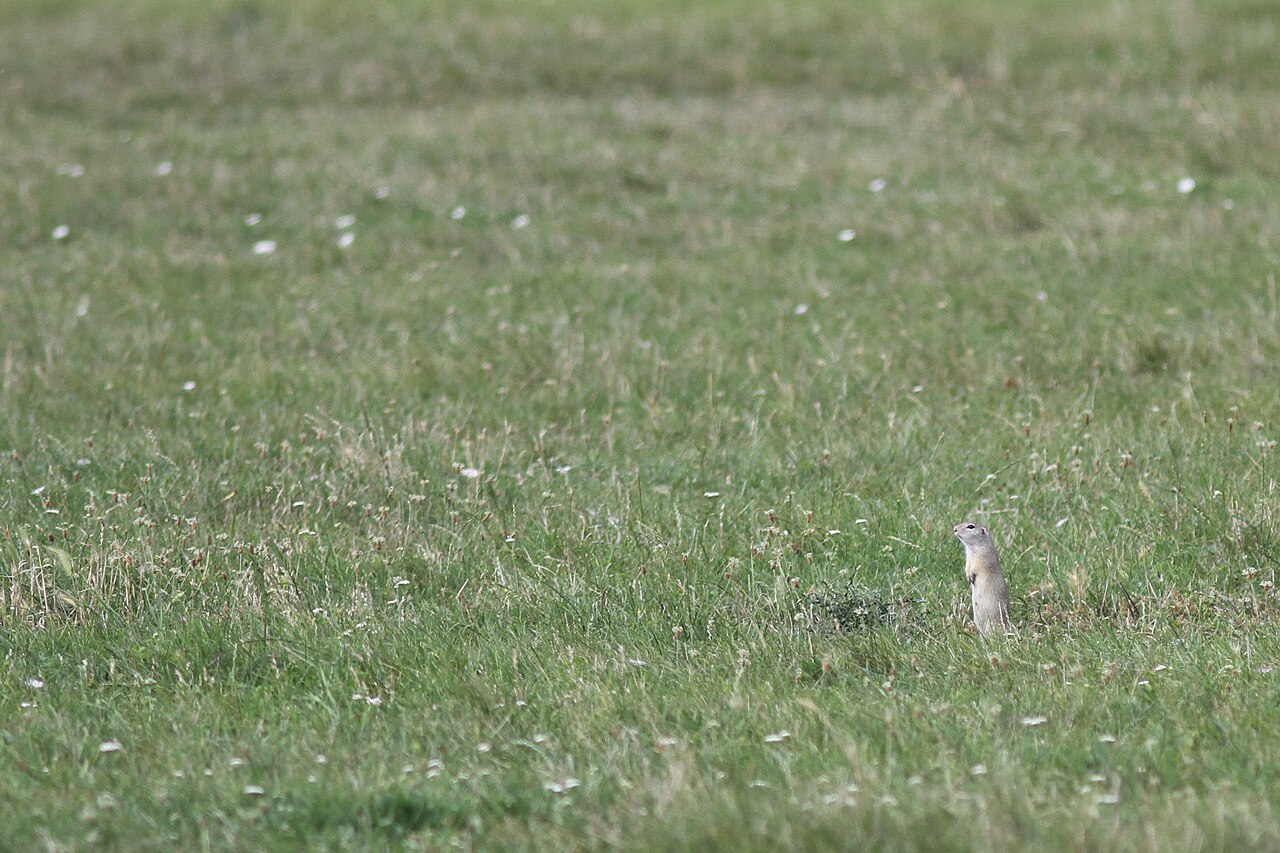
A thickset ground rodent the size of a small rat, head-body 17 to 23 cm, with a short tail of 3 to 9 cm, at most a third of the body length, and a weight that rises from 125 to 380 g during the summer. The back is sandy buff to greyish beige with a fine, cloudy black vermiculation; these are not true spots, and at ten metres the back appears plain. Flanks and belly are yellower, the throat whitish and the eye-ring faint and pale. The ears are very small and rounded and almost disappear into the fur; the eyes are large, black and set high on the head. The tail is thin and short-haired, vermiculated above like the back and darker towards the tip. The fore feet carry strong digging claws. In the field posture is the most useful character: bolt upright at the burrow entrance, with the fore paws against the chest.
Similar species
In ground squirrels range, not colour, is decisive: the seven European species exclude one another almost everywhere, and with one exception only one species is to be expected at any site. The souslik is the species of central and south-eastern Europe: eastern Austria, Moravia, Slovakia, Hungary, Romania, Serbia, Bulgaria, North Macedonia, northern Greece, Moldova, right-bank Ukraine and European Turkey. A ground squirrel in that area is a souslik. The exception is Moldova and western Ukraine, where the species occurs alongside Spermophilus odessanus; there the difference shows in a photograph: odessanus has sharply defined white spots two to five millimetres across over the whole back, the souslik only a vague vermiculation. East of the Dnieper lives the Speckled Ground Squirrel (S. suslicus), also clearly spotted; it nowhere occurs together with the souslik. In the Caucasus and the south Russian steppe lives S. musicus, east of the Volga the Little Ground Squirrel (S. pygmaeus), in Anatolia S. xanthoprymnus and in the Taurus S. taurensis; none of these four overlaps with the souslik, and the Bosphorus separates it from the two Turkish species. Outside the genus the differences are clear: the Bobak Marmot lives in the same Ukrainian steppe but is four to ten times heavier, the Common Hamster is nocturnal and black-bellied, the Red Squirrel lives in trees and has a bushy tail, and the Siberian Chipmunk has five black stripes down the back.
Habitat
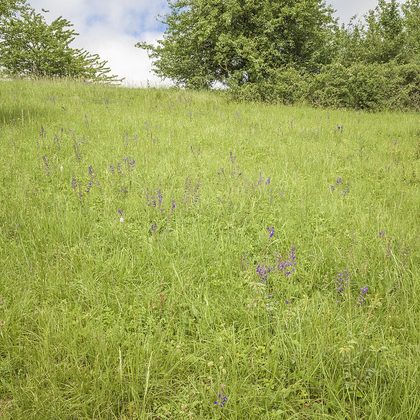
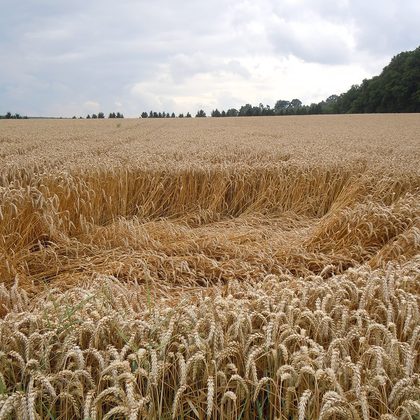
Short-grazed dry steppe and comparable ground shaped by people: sheep and horse pasture, dykes and embankments, field margins, fallow, airfields, sports grounds, golf courses and old cemeteries. Two requirements are decisive. The soil must be deep and free-draining, such as loess, sand or light loam, not wet clay, and the vegetation must stay short: in grass thirty centimetres tall the species cannot see approaching predators, and a colony then disappears within a few years. The species therefore depends on grazing or mowing; when a pasture becomes rank or is sown with a dense sward, the colony disappears. It occurs from sea level to about 2,500 m; in the Balkans up to the mountain meadows of Pirin and Rila.
Where the animal is most at home, classified with EUNIS — the European standard for habitats.



Distribution
The range runs from eastern Austria and southern Moravia through Slovakia, Hungary, Romania, Serbia, Croatia, Bulgaria, North Macedonia and northern Greece to Moldova, right-bank Ukraine and European Turkey. Eastern Austria and southern Moravia form the western limit. In south-eastern Poland the species died out and has been reintroduced since 2005 with animals from Slovakia; in Germany it disappeared in the twentieth century. It does not occur, and never has occurred, in the Low Countries, the British Isles or the Iberian Peninsula. Over the last fifty years the range has not so much shrunk as fragmented: hundreds of separate colonies remain, some no larger than a hectare, with kilometres of arable land between them. Easily accessible colonies lie around Vienna: in the Weinviertel, the Marchfeld and the Donau-Auen National Park, and on the Perchtoldsdorfer Heide, where the animals can be seen beside the paths.
- Native
- dark = core range, pale = thinly spread
Way of life
Exclusively diurnal, most active in the morning and late afternoon; on hot middays the animals stay underground. The species is loosely colonial, unlike the marmot: the animals live close together, but each adult has its own burrow system and there is no shared family burrow. The diet consists of grasses, herbs, flowers, seeds, roots and tubers, with much young green growth in spring and cereal grain in summer, and also grasshoppers, beetles and occasionally a nest of young mice. Food not eaten at once is carried to the burrow in the cheek pouches. Hibernation is obligatory and long: adults enter in August or September, juveniles somewhat later, and they reappear only in February or March; in the Balkan mountain meadows hibernation lasts longer than in the warm lowland steppe. The entrance is plugged from inside. There is a single mating period shortly after emergence; after 25 to 30 days' gestation two to eleven young are born, which come above ground at about four weeks and leave at nine weeks, usually no more than a few hundred metres. Because of this short dispersal distance, a colony that dies out is not recolonised naturally. Predators are Red Fox, Polecat, Stoat and above all Steppe Eagle, Eastern Imperial Eagle and Saker Falcon; in the wild the animals rarely live beyond three years.
Where and when to look
The best period is April to June, between nine in the morning and midday, on a short-grazed slope or dyke in eastern Austria, Hungary or southern Slovakia. First search with binoculars for pale heaps of earth and shorter patches in the grass, then sit down twenty metres away and wait ten minutes: when the whistling stops, the heads emerge from the entrances one by one. At sites with many walkers, such as the Perchtoldsdorfer Heide near Vienna and the Neusiedler See National Park, the animals allow an approach to about ten metres. In July and August the adults are already entering hibernation and at most a few young can be seen. The whistle is often the first sign of a colony not yet found by eye.
Conservation status
Endangered (2023). The species is declining steeply in Europe. The cause is not hunting or poisoning but the loss of short-grazed vegetation: extensive grazing with sheep and horses has almost ceased in central Europe, and what did not become rank was ploughed or reseeded. A few dozen colonies remain in the Czech Republic, the species has disappeared from Germany and in Poland it has been reintroduced. Where it still occurs in good numbers, as in eastern Austria, it depends on management: grazing with sheep, mowing, or an airfield where the grass is kept short. Conflicts with development arise there too: the colony at Vienna-Hausfeld was a political issue for years, because a housing estate was planned on the city's last souslik meadow. Reintroductions in Poland and the Czech Republic and the return of grazing to a number of Hungarian and Slovak reserves show that the decline is reversible.
Scientific name
Spermophilus citellus | (Linnaeus, 1766)
Linnaeus described the species in 1766 as Mus Citellus; because it was later moved to another genus, the author and year stand in brackets. Spermophilus is Greek, from sperma, 'seed', and philos, 'loving': the seed-lover, after the food the animal carries to its burrow in its cheek pouches. citellus is the Latinized form of the animal's Central European name, German Ziesel and Czech sysel, which Gesner set down as citellus in the sixteenth century; the further origin of that word is disputed. The specimen the first description was based on came from Austria, Wagram.