All species › Even-toed ungulates › Deer › Elk
Elk | Alces alces
Eland | Alce
The elk (Alces alces), known in North America as moose, is the largest deer in the world and lives in the boreal and temperate forests of northern and eastern Europe, Siberia and North America. In Europe it occurs in Scandinavia, Finland, the Baltic states, Poland, Belarus and Russia. From Poland the species is recolonising eastern Germany and Czechia, where it was absent for centuries.

Tracks
The slot is the largest of all European deer. The halves splay under the weight, and in soft ground and snow the dew claws register; this increases the bearing surface and limits sinking in. The droppings are large, oval, fibrous pellets from woody food in winter, softer and sometimes clumped in summer. Other signs are broken and bitten tops and twigs of young pines, willows, birches and aspens, and bark stripped from trunks.
Identification
A very large, long-legged deer of 240 to 310 cm head-body length and 170 to 210 cm shoulder height; bulls weigh about 320 to 475 kg, cows 275 to 375 kg. The tail is short, 5 to 12 cm. The coat is dark brown to blackish, the long legs paler grey. The withers are higher than the rump. The head is long, with a broad, overhanging upper lip, and both sexes have a flap of skin under the throat, the bell. Only the bull carries antlers: in northern Europe usually palmate, with a broad palm bearing tines along the edge; in the south of the range beams without a palm, with tines only, occur more often. Calves are reddish brown and unspotted.
Similar species
The red deer is smaller, reddish brown to greyish brown, with a pale rump patch, a shorter head without an overhanging lip and round, branched antlers. Bison bonasus in Poland and Belarus is a bovid with horns, a heavy head carried low, a high hump over the shoulders and short legs. At dusk and at a distance an elk may be taken for a horse or cattle; the high withers, long legs and long head decide.
Habitat
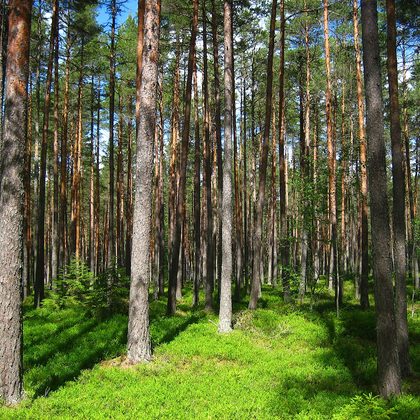
Boreal and mixed forest with swamps, bogs, lakes and river valleys with willow scrub, and clear-cuts with young regrowth. In summer the elk also feeds in shallow water. In Poland a large population lives in the marshes of the Biebrza valley.
Where the animal is most at home, classified with EUNIS — the European standard for habitats.


Distribution
In Europe: Norway (about 120,000 animals around 2009), Sweden (300,000 to 400,000), Finland (about 115,000 around 2009), Latvia, Estonia, Lithuania, Belarus, Poland (about 28,000, including the Biebrza valley, Kampinos and Białowieża Forest) and European Russia, with a Russian population of about 600,000 in 2007. From Poland elk move into eastern Germany and Czechia, where populations are becoming re-established. The species is absent from western Europe; wandering young animals sometimes turn up far outside the range.
- Native
- dark = core range, pale = thinly spread
Way of life
The elk is active by day and at dusk and outside the rut usually lives alone or as a cow with calf. It is a browser: in summer herbs, leaves and shoots of willow and birch and aquatic plants such as water lilies and pondweed, which supply sodium; in winter twigs, bark and needles, especially of pine. It cannot digest hay. The rut falls in September and October. After a gestation of about eight months one or two calves are born in May or June; with good food conditions 30 to 40 per cent of births are twins.
Where and when to look
Elk are best seen in Sweden, Finland and Norway in the early morning and evening, at the edges of clear-cuts, bogs and lakes, often also along roads. In Poland Biebrza National Park is suitable in spring, when the marshes are flooded and the animals stand on the higher ground. Drive slowly in elk country at dusk and keep your distance from cows with calves and from bulls in the rut.
Conservation status
Least Concern (LC, 2016). The elk is numerous in Scandinavia and Finland and is hunted intensively there: in Sweden 100,000 to 150,000 animals are shot each year. Collisions with cars and trains are an important cause of death; in Norway trains have killed about 13,000 elk since 2000, and in Sweden roads are fenced where collisions are frequent. In central Europe the species is returning after centuries of absence, and the wolf is once again a natural predator there.
Scientific name
Alces alces | (Linnaeus, 1758)
Linnaeus described the species in 1758 as Cervus Alces; because it was later moved to another genus, the author and year stand in brackets. Alces is the Latin word for 'elk'; Caesar and Pliny took it over from a Germanic language. The specific name repeats the genus name. The specimen the first description was based on came from Sweden.