All species › Hedgehogs, shrews and moles › Shrews › Eurasian Pygmy Shrew
Eurasian Pygmy Shrew | Sorex minutus
Dwergspitsmuis | Musaraña Enana
The Eurasian Pygmy Shrew is one of the smallest mammals in Europe: an adult weighs three to five grams. It lives in almost any vegetated landscape with a dense herb layer, from dunes and heathland to rough grassland, bogs and hedgerows, from Ireland to beyond Lake Baikal. Its low weight obliges it to feed almost continuously, and in winter it even shrinks. It is common in most regions but seldom the most numerous shrew.

Tracks
There are no signs unique to the Pygmy Shrew. It uses narrow runs and tunnels under the litter layer and in dense grass, often those of voles; droppings a few millimetres long with shiny insect fragments cannot be told from those of other shrews. High, shrill squeaks from the grass, especially in summer and autumn when young animals seek a range of their own, betray shrews but not the species. The Pygmy Shrew is recorded most often in owl pellets, especially those of the Barn Owl: its small skulls and lower jaws with red-brown tooth tips are recognisable and separable by size from those of the larger Sorex shrews.
Identification
A very small Sorex with a relatively large head, a fine pointed snout and a long, thick tail. The back is sandy brown to dark brown, the belly greyish white to pale grey, sometimes with a yellowish tinge; the dark back colour extends far down the flanks and the border with the belly is not sharp, so the coat looks two-toned rather than three-toned as in the Common Shrew. The tail reaches about 70 to 80 per cent of head-body length, is bicoloured, clearly constricted at the base, and in young animals densely haired with a small tuft at the tip that later wears away. The tooth tips are red-brown. Head-body 4.0 to 6.4 cm, tail 3.3 to 4.7 cm, hind foot under 12 mm, weight 2.5 to 5.5 g.
Similar species
The main confusion is with the Common Shrew (Sorex araneus) and, where it occurs, the Crowned Shrew (Sorex coronatus). These are clearly larger and heavier, with a three-toned coat of dark back and paler flank band, and a tail that is relatively shorter and not constricted at the base. In the hand the combination of weight, a hind foot shorter than 12 mm and tail proportion decides; young Common Shrews are smaller but already have the shorter tail and three-toned coat. In Scandinavia, Finland and eastern Europe the Eurasian Least Shrew (Sorex minutissimus), which is even smaller with a relatively shorter tail, and the larger Laxmann's Shrew (Sorex caecutiens) also occur; there identification is only possible in the hand and often only certain from the skull. White-toothed shrews (Crocidura), and in the south the Etruscan Shrew (Suncus etruscus), have white teeth, prominent ears and long scattered hairs on the tail. An animal that merely darts through the grass cannot be identified to species.
Habitat
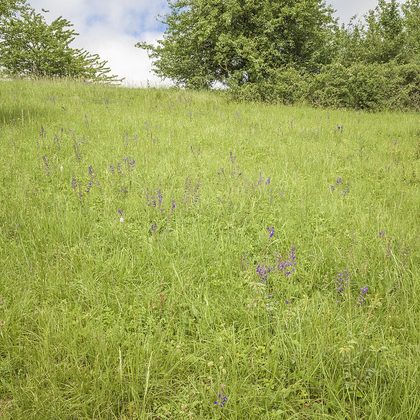
Almost any ground with a dense, damp herb layer: rough grassland, hay meadows, wet grassland, heathland, raised bog and fen, reed and sedge swamp, dunes, hedgerows, field banks, road verges and woodland edges. A cool, damp soil and plenty of ground cover are important. Extensive closed forest, especially conifer forest with a moss floor, and built-up areas are avoided. In the south of its range the species is tied to areas with sufficient rainfall and to the mountains; in Iberia it has been trapped from sea level to 2,000 m.
Where the animal is most at home, classified with EUNIS — the European standard for habitats.


Distribution
From Ireland and northern Iberia through almost all of Europe and Siberia to the Yenisei and Lake Baikal, and in the south-east to the Altai and Tian Shan. It is absent from Iceland, Shetland and the Channel Islands and from the dry south of the Mediterranean region. In Ireland it is the only Sorex, and genetic studies indicate that Irish animals derive from south-western Europe and probably arrived with people. In Iberia the range runs from northern Portugal and Galicia to humid eastern Catalonia and the northern Iberian System, with isolated populations in the Sierra de Guadarrama and Sierra de Gredos and in the Sierra de Prades. The Alps, Italy and the southern Balkans hold their own subspecies. In Britain and the Low Countries it occurs almost everywhere with dense, damp vegetation.
- Native
- dark = core range, pale = thinly spread
Way of life
The Pygmy Shrew is active round the clock in short bouts, with peaks at twilight; in England a peak after sunrise and a lower one at dusk have been measured, and in the Netherlands and Poland there is also much daytime activity. Its food is small invertebrates of the ground surface, mainly spiders and beetles, plus woodlice, flies, insect larvae, grasshoppers and small snails; earthworms, which the Common Shrew digs for, are absent from its diet. Each day it eats about one and a quarter times its own weight, and in winter it spends up to half its time foraging. As in other Sorex species, body and even skull shrink in autumn, so that winter animals are up to over a quarter lighter than in summer. It lives solitarily in a defended range of about 500 to 1,850 m², larger in winter than in summer. Breeding runs from April to October, with two to four litters of usually four to eight young after a gestation of about three weeks. A Pygmy Shrew lives no more than about fifteen months and does not survive a second winter.
Where and when to look
The species is common but rarely seen well. The best chance is on a summer evening or early morning along a rough grass margin, heath edge or hedge bank, where standing still you may hear high squeaks and sometimes see a tiny animal dash across an open patch. Refugia such as sheets of roofing felt or boards laid in rough vegetation and lifted now and then offer a brief look. Watch the proportions: a tiny body with a large head and a long, thick tail points to this species. Dissecting Barn Owl pellets gives the most reliable records; Pygmy Shrew skulls stand out by their size. In Britain live-trapping shrews requires a licence, and because of their high energy needs traps have to be checked frequently.
Conservation status
Least Concern globally (2016), with a very large range. Across most of Europe the species is common, though seldom the most numerous shrew; after a crash in the shrew community it sometimes temporarily dominates, so its numbers can move in counterphase with those of the Common Shrew. The highest densities are reached in Europe, especially in Ireland and on some Baltic islands where it is the only Sorex. Local declines follow the loss of rough vegetation: intensive mowing of verges and ditch banks, removal of hedgerows and drainage. In Britain it is protected against certain methods of killing and taking under Schedule 6 of the Wildlife and Countryside Act, and it is listed on Appendix III of the Bern Convention. In the east of its range numbers are falling, and in Yakutia it is on the regional Red List.
Scientific name
Sorex minutus | Linnaeus, 1766
Linnaeus described the species in 1766 and placed it straight away in the genus where it still stands. Sorex is the Latin word for a shrew. minutus is Latin for 'small', the past participle of minuere, 'to lessen'. The specimen the first description was based on came from Russia, Siberia.