All species › Rodents › Voles and hamsters › Eurasian Water Vole
Eurasian Water Vole | Arvicola amphibius
Woelrat | Rata topera
The Eurasian Water Vole is the largest vole in Europe and occurs in two forms: a water-dwelling form along ditch banks and waterside margins and a burrowing form in the root zone of meadow, vegetable garden and orchard. The earth heaps of the burrowing form are often taken for molehills; part of the 'molehills' in gardens and pastures belong to this species.

Tracks
The earth heaps of the water vole are among the most frequently misidentified signs in Europe. The burrowing water vole throws up earth heaps that are usually taken for molehills, but the difference is visible at once. A molehill is a cone of loose, crumbly soil, 10 to 30 cm high and 20 to 40 cm across, pushed up from below through a vertical shaft, and therefore has no visible opening: the centre is closed. The water vole heap is flatter and broader, irregular and kidney-shaped rather than conical, and the soil is pushed out sideways from a sloping tunnel; the opening therefore lies to one side, at the edge of the heap, and is oval, wider than tall and often still open. The soil contains bitten root fragments, grass stems and plant parts, because the water vole digs through the root zone and the mole through the earthworm layer. The tunnel itself is also characteristic: the mole's tunnel is round and taller than wide, the water vole's oval and wider than tall, with a flat floor. A second unambiguous sign is root damage. The water vole peels the tap roots of carrot, parsnip and salsify, hollows out tulip, crocus and dahlia bulbs, and gnaws the roots of young fruit trees underground, so that an apple tree yellows in summer and can be pulled out without resistance; the root collar is then gnawed smooth, with paired incisor grooves. Nurseries and young orchards can lose whole rows of trees this way in a single winter. In the water-dwelling form the signs lie along the bank: burrow entrances in the bank, oval and wider than tall, some just above and some below the waterline, surrounded by a close-cropped patch of grass half a metre across where the animal has eaten everything within reach of the entrance. From there runs, narrow cleared paths, lead through the bankside vegetation, and along them lie feeding stations: small piles of reed, sedge and grass stems in lengths of five to ten centimetres, cut at about 45 degrees, because the animal sits upright and holds the stem in its forepaws. The droppings are the most reliable evidence: 8 to 12 mm long and 4 to 5 mm thick, cylindrical with blunt rounded ends, buff to green-brown, dark green inside when broken, and odourless. They are not scattered but left in latrines: small fixed heaps on a raised spot near a burrow or on a flat ledge at the water's edge, with which a female marks her stretch of bank. Rat droppings are larger, tapered, dark and strong-smelling. The print is rarely seen and only in silt: the fore foot registers four toes in a star shape, the hind foot five, with widely splayed toes; the print is about the size of a fingertip. In winter the burrowing continues under the snow, and at the thaw the tunnel system lies in the grass as winding ridges of soil.

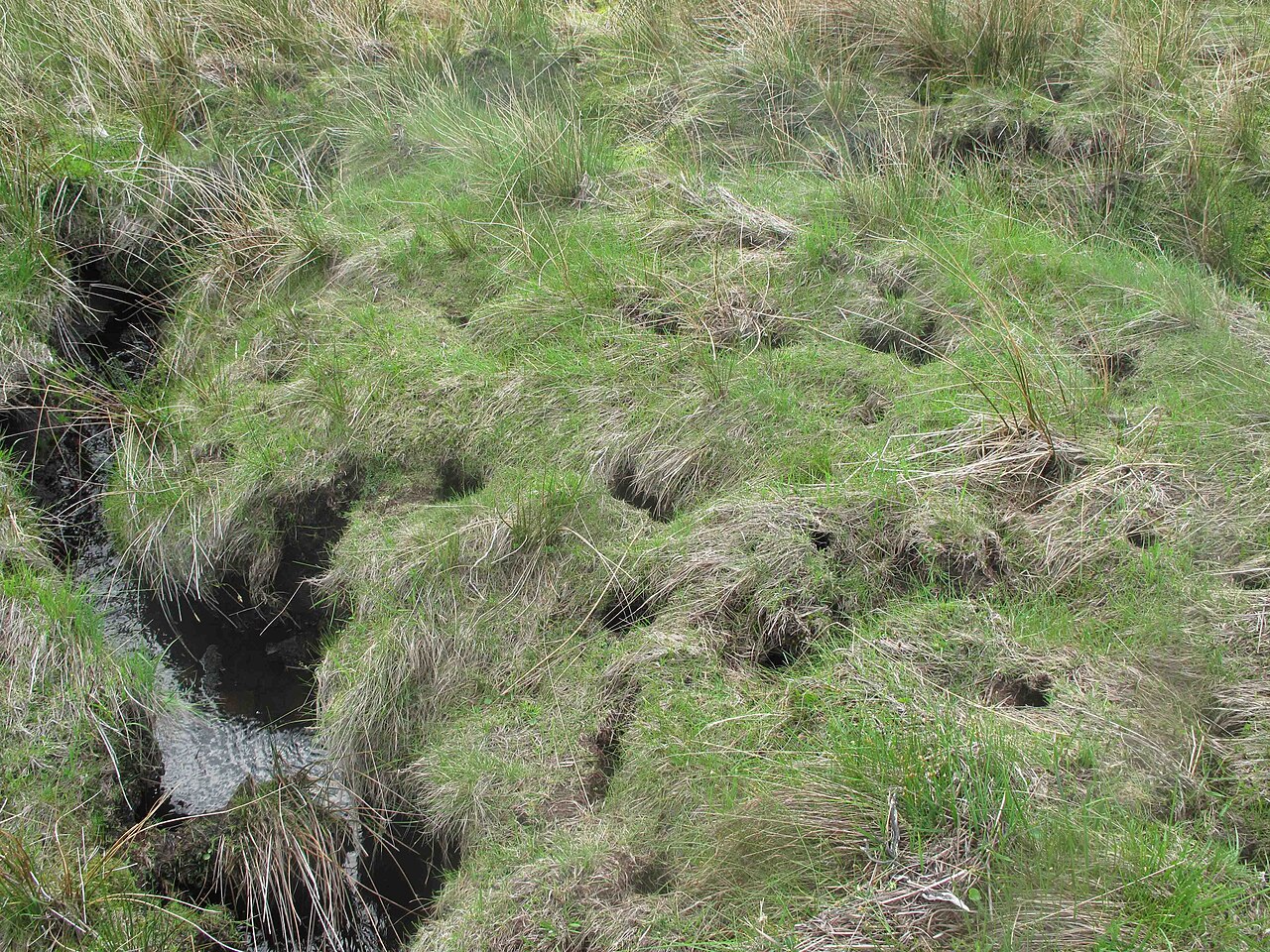
In its habitat

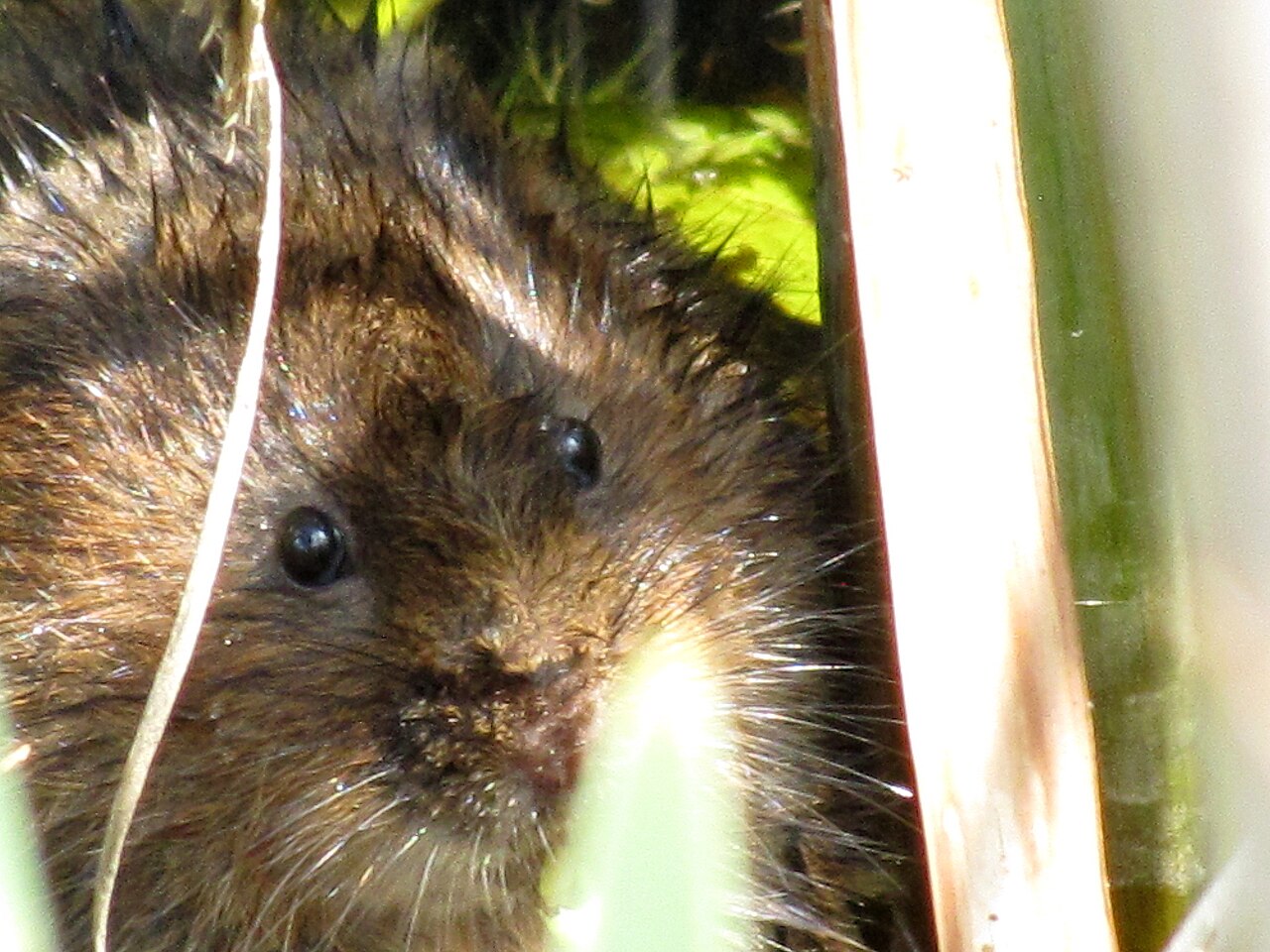
Head close-up
Identification
A heavy, thickset vole with a blunt, rounded muzzle, small ears all but sunk in the fur and small dark eyes. The coat is dense and glossy, grey-brown to dark brown and sometimes almost black, the belly grey to dirty white. The tail is furred, uniformly dark, and about half to two-thirds the head-body length: long for a vole, short for a rat. The incisors are orange-yellow. A swimming animal floats high with its back dry and leaves a trail of bubbles; it dives with a slap of the tail and can cross a ditch underwater. Besides the water-dwelling form there is the fossorial form, called scherman in the Alps: smaller, shorter-tailed, paler and greyer, with broader forefeet, and hardly ever found near water. Both forms belong to the same species.
Similar species
The main confusion is the Brown Rat, which lives on the same banks and grows as large; it has a pointed muzzle, large naked ears standing well clear of the fur, and a scaly, hairless tail as long as the body and pale beneath. The water vole has a blunter muzzle, smaller ears and a shorter tail. The Muskrat is far bigger (head-body to 35 cm), with a laterally flattened naked tail and fringes of stiff hairs on the hind feet. Common Vole, Field Vole and Bank Vole, at 9 to 13 cm, are less than half as long; a large common vole and a young water vole can look alike in a photograph, and then the tail decides, being more than a third of the body in the water vole. The Mole occurs in the same fields but is hardly ever seen above ground; there the question concerns the heaps, not the animal (see the signs). At the southern edge of the range identification is difficult: in France, Spain and Portugal the Southwestern Water Vole (Arvicola sapidus) occurs, larger and darker, partly overlapping with this species in France and northern Spain; in Italy, Slovenia and Ticino Arvicola destructor cannot be separated from it in the field, and the same holds for Arvicola persicus in the Caucasus. Where the species do not occur together, locality decides, not appearance.
Habitat
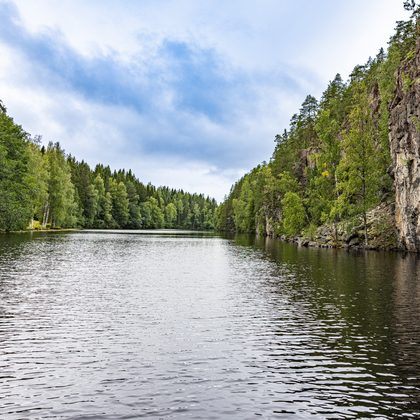
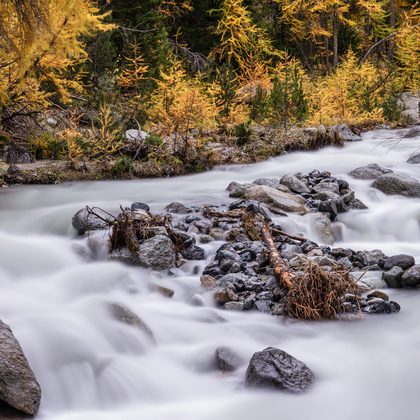
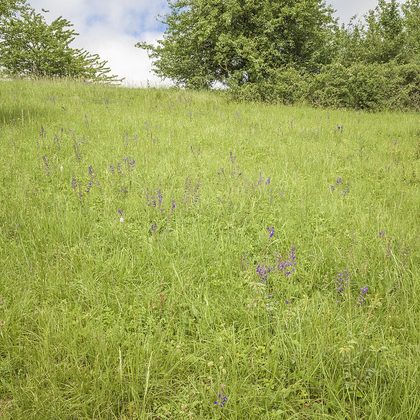
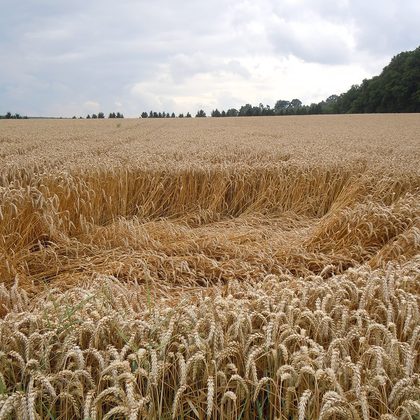
The two forms of the water vole occupy different habitats. The water-dwelling form lives by slow-flowing or still fresh water with a steep, vegetated bank and at least twenty centimetres of water: ditches, drains, brooks, canals, ponds, fen pools, reedbeds and sedge marshes. Grazed-out or revetted banks are avoided, because the animal needs a dense herb layer to move through and soil to dig in. The fossorial form lives away from water in damp grassland, hay meadow, orchards, tree nurseries, kitchen gardens, dykes, railway embankments and mountain pasture, in the Alps well above the treeline. It avoids heavy clay and stony ground and prefers deep, loose, moist soil.
Where the animal is most at home, classified with EUNIS — the European standard for habitats.



Distribution
The water vole occurs from Britain and northern Spain to Siberia, and from northern Scandinavia to the Mediterranean; in the mountains to well over 3000 metres. It is absent from Ireland, Portugal, Iceland and most Mediterranean islands. In the Iberian Peninsula it is limited to the Pyrenees and the Cantabrian Mountains, with the fossorial form in meadows and mountain pastures of northern Spain; in central and southern Spain the Southwestern Water Vole (Arvicola sapidus) is the large waterside vole. In the Netherlands the species occurs throughout except on the Wadden islands and is common along ditches with rough banks, especially in the wetter west and north; in southern Limburg the fossorial form also occurs. In Belgium the picture is similar, with the fossorial form in the Ardennes. In Britain the water vole was formerly the commonest mammal of the waterside; since the 1970s it has been lost from more than nine tenths of its former sites and from many catchments altogether. Strongholds remain in the Scottish Highlands, parts of the Norfolk and Suffolk Broads, the Yorkshire and Kent marshes, and the city of Glasgow, where a fossorial population lives in grassland well away from water.
- Native
- dark = core range, pale = thinly spread
Way of life
The water vole is active in short bouts throughout day and night, with most activity at dusk and in the early morning; it is readily seen by day, especially where it is not persecuted. It is almost wholly herbivorous: grasses, sedges, reed, herbs, roots, tubers, bulbs and bark, with seeds and fruit in late summer and the occasional snail or insect. It eats about eighty per cent of its own body mass every day, which explains the extent of the feeding signs. For winter it lays up underground stores of roots and tubers; it does not hibernate and burrows on beneath the snow. Females defend a linear territory along the bank and mark it with latrines; males range over a longer stretch containing several females. Litters follow one another from March to September: after twenty to thirty days' gestation three to eight young, up to five litters a year, and spring-born young breed in the same summer. Life expectancy is short: most animals do not survive a second winter. Fox, stoat, weasel, polecat, grey heron, buzzard, long-eared owl, pike and, in Britain, the naturalised American Mink are predators.
Where and when to look
In May or June the early morning is suitable along a ditch or brook with a rough, unrevetted bank. The water vole can be heard by a plop: not a leap but a short, heavy drop, after which a trail of bubbles runs to the far side. After about ten minutes of sitting still, the animal usually returns to the same spot. Along the same bank the cropped patch around a burrow entrance and the latrine above it can be found, even when the animal itself does not appear. In autumn and winter pastures, orchards and gardens are suitable for tracking: at each heap it can be checked whether the opening lies in the middle or to one side. A young fruit tree that yellows by March and comes out of the ground without resistance indicates root damage.
Conservation status
Least Concern (LC, 2021), and across its whole range one of the commonest mammals in Europe. Regionally the picture differs. In Britain the species has declined by more than ninety per cent since the 1970s and disappeared over large areas, through the straightening and revetting of watercourses, the removal of bank vegetation and above all the naturalised American Mink, which is small enough to enter the burrows; recovery there relies on mink control and reintroduction. On the continent no national decline is documented, but tightly managed, revetted and steep ditch profiles are unfavourable there too, and the species disappears from areas where banks are mown bare every year. The fossorial form is regarded in parts of central Europe as a pest of orchards and nurseries; control of those animals also affects the water-dwelling ones, and this conflict shapes management.
Scientific name
Arvicola amphibius | (Linnaeus, 1758)
Linnaeus described the species in 1758 as Mus amphibius; because it was later moved to another genus, the author and year stand in brackets. Arvicola is Latin, from arvum, 'ploughed land', and colere, 'to inhabit': the dweller in the fields. amphibius is Greek amphibios, 'living a double life', from amphi, 'on both sides', and bios, 'life', after its existence on land and in water. The specimen the first description was based on came from England.