All species › Bats › Vesper bats › Felten's Myotis
Felten's Myotis | Myotis punicus
Myotis punicus | Murciélago ratonero del Maghreb
Felten's Myotis is the large Myotis of the Maghreb and of Corsica, Sardinia, Malta, Gozo and Pantelleria. Felten described it in 1977 as a subspecies of the Lesser Mouse-eared Bat (M. blythii), with a type locality in a cave near El Haouaria on Cape Bon, Tunisia. Genetic studies around 2000 showed that the large Myotis of North Africa and of Corsica and Sardinia form a lineage of their own, clearly distinct from both the Greater and the Lesser Mouse-eared Bat; since then it has been treated as a species. Forearm 54 to 63.9 mm, weight 19 to 25 grams.
No photograph of a living wild animal of this species with a suitable Creative Commons licence exists. Do you have one that meets the rules? Send it in.
Tracks
Maternity colonies are always underground, in caves or mines, and number several hundred to 1000 adult females; they often share the space with horseshoe bats, Schreibers's Long-fingered Bat and Long-fingered Bat. Single bats, usually males, roost in ruins, tunnels, roofs and crevices in bridges, and defend their spot in the mating season. Droppings accumulate at the colonies, and the bats can be counted at the entrances at emergence.
Identification
Head-body 67 to 79 mm, ear 26.1 to 29 mm, forearm 54 to 63.9 mm, wingspan 350 to 410 mm. The dorsal fur is soft and dark brown or grey, contrasting with the whitish or pale brown underparts. The ears are long. The tragus is fully pigmented, without the dark tip of the Greater Mouse-eared Bat. The wing is attached at the base of the toes. The call consists of strongly modulated pulses from 80 to 90 kHz down to 20 to 30 kHz, with peak energy around 30 kHz; according to the handbook it is almost identical to that of the Greater and Lesser Mouse-eared Bats. The handbook gives no tail length for this species.
Similar species
The species is cryptic relative to the Greater Mouse-eared Bat (M. myotis) and the Lesser Mouse-eared Bat (M. blythii). According to the handbook it resembles the Lesser Mouse-eared Bat more closely, but it cannot be identified to species on external characters alone. The fully pigmented tragus, without a dark tip, points towards this species and away from the Greater Mouse-eared Bat. The three species cannot be separated by their calls. In practice assignment rests mainly on locality: the handbook reports no area where the species occurs together with the Greater or Lesser Mouse-eared Bat, so a large Myotis on Corsica, Sardinia, Malta, Gozo or Pantelleria, or in the Maghreb, is treated as this species. Genetically the three species are strongly differentiated. A record outside the known range, for example on Sicily or in southern Italy, requires DNA.
Habitat
Various habitats, especially open ground with low or sparse vegetation such as pastures, farmland and grassland, from sea level to about 1200 m. The species rarely hunts in forest or dense vegetation, but does forage along edges and linear features. In North Africa it also hunts in semi-desert. Roosts are natural and artificial underground sites, and buildings. On Corsica the roosts have internal temperatures of 4 to 9 °C in winter and 10 to 28 °C in summer.
Where the animal is most at home, classified with EUNIS — the European standard for habitats.

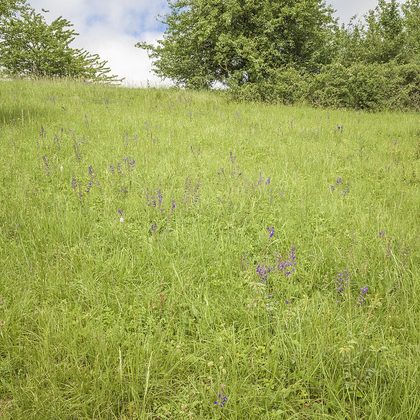
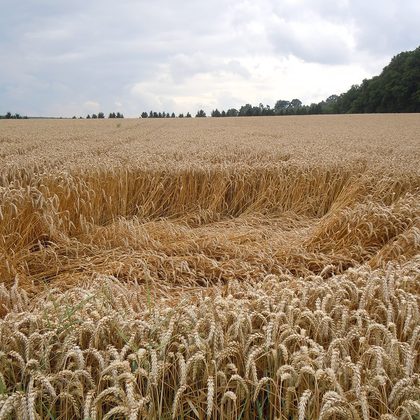

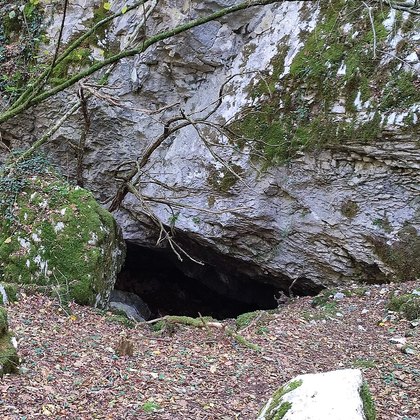

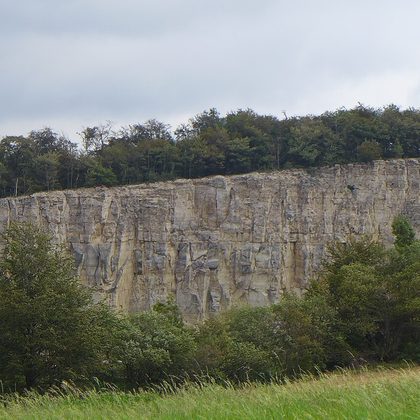
Distribution
The western Mediterranean islands of Corsica, Sardinia, Malta, Gozo and Pantelleria, and in North Africa north-western Morocco, Algeria, Tunisia and Libya. The populations of North Africa and of the islands are strongly differentiated genetically; even the 12 km wide strait between Corsica and Sardinia appears to limit gene flow. The divergence of these populations is placed in the Early to Middle Pleistocene. The species is treated as monotypic.
- Native
- dark = core range, pale = thinly spread
Way of life
The diet consists mainly of grasshoppers, bush-crickets, crickets, beetles and moths; locally also many flies, and further cicadas and spiders. The species flies low over short or heavily grazed grassland and takes prey from the ground, hovering above it and seizing it with the feet or landing on it. When few prey are available on the ground it switches to catching flying insects. Young are born in March and April in Algeria and in May in Morocco; females are sexually mature in their first year. The mating season is usually in August. Hibernation sites lie close to the maternity roosts, sometimes in the same cave. The longest reported movement is about 22 km. Maximum age is given as 5 to 8 years.
Where and when to look
On Corsica, Sardinia and Malta large maternity colonies in caves can be counted at emergence at dusk, from the entrance; the bats then hunt over grazed grassland and fields in the surroundings. Do not enter maternity caves: disturbance is one of the main threats. Capturing and handling bats requires a licence in the European Union.
Conservation status
Data Deficient (DD) on the global Red List, assessed in 2016, with a decreasing trend. The main threats are disturbance of caves and mines by visitors, fires and vandalism; the handbook also reports that bats have been caught for medical purposes. On Corsica, Sardinia and Malta the species falls under Annexes II and IV of the Habitats Directive: Annex IV covers all bats, and because the animals there were formerly included in the Greater and Lesser Mouse-eared Bats, which are listed in Annex II, the European Commission also treats this species as an Annex II species, for which Special Areas of Conservation must be designated.
Scientific name
Myotis punicus | Felten in Felten, Spitzenberger, & Storch, 1977
Felten in Felten, Spitzenberger, & Storch described the species in 1977 and placed it straight away in the genus where it still stands. Myotis is Greek, from mys, genitive myos, 'mouse', and ous, genitive ōtos, 'ear': 'mouse-ear'. punicus is Latin for 'Punic, Carthaginian', from Poeni, the Roman name for the Phoenicians of Carthage; the type material comes from Cape Bon, close to the ancient city. The specimen the first description was based on came from Tunisia, Cape Bon.