All species › Carnivores › Dogs, wolves and foxes › Golden jackal
Golden jackal | Canis aureus
Gewone jakhals | Chacal dorado
Until a few decades ago the Golden Jackal was confined in Europe to Greece and the Balkans. Since the 1950s it has spread north and west; in 2022 and 2023 the first animals were recorded in Finland, in Norway north of the Arctic Circle and in Spain. Since 2015 the species has been regarded as Eurasian: the African populations formerly included under the same name are now treated as a separate species, Canis lupaster.

Tracks
The fore print measures 5.5 to 6.5 cm long and 3.8 to 4.4 cm wide, the hind print 5.0 to 5.7 by 3.4 to 3.9 cm: slightly larger than a fox's. The diagnostic feature is that the pads of the two middle toes are fused at the base into a horseshoe shape, on fore and hind feet; this can only be seen in a perfect print. When trotting, the jackal places the hind foot slightly behind the fore print rather than in it. The scat cannot be separated with certainty from that of fox or dog in the field, and a killed prey animal cannot be attributed to the jackal on appearance alone. The most useful sign is the howling, heard mainly from December to April, the pairing and breeding season.
Identification
A canid between fox and wolf. Compared with the Red Fox it is longer-legged and more stockily built, with a shorter tail of 20 to 30 cm that is usually the darkest part of the animal. The coat is golden to yellowish-brown, mottled darker on back and flanks by a mix of black, brown and white hairs, sometimes forming a dark saddle. There is white around the mouth and on the throat and chest. The backs of the ears are golden brown, not black as in the fox. Compared with the wolf it is much smaller and slighter, with a slimmer muzzle. In Europe males weigh 11 to 16 kg and females 8 to 13 kg, with a shoulder height of 44 to 50 cm; the measurements at the head of this page come from a range-wide review and are lower.
Similar species
The Red Fox is the commonest mistake: smaller, shorter-legged, redder, with black ear backs, black 'socks' and a longer tail usually tipped white. The Grey Wolf is much larger, with a broader head and heavier build; a young wolf in summer is the most difficult case. Large yellowish-brown dogs of shepherd type can look like a jackal on a camera-trap image. North Africa holds Canis lupaster, which looks almost identical and was formerly included in the same species; within the guide area the two barely overlap. The howl is reliable: two or three low, simple howls running into a high-pitched staccato series of calls.
Habitat
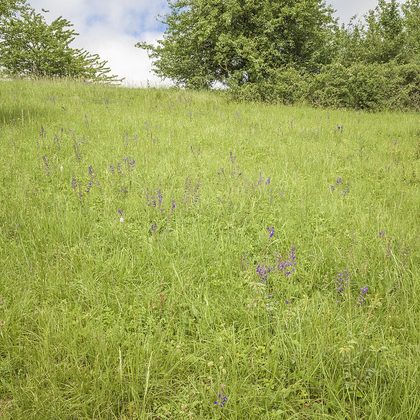
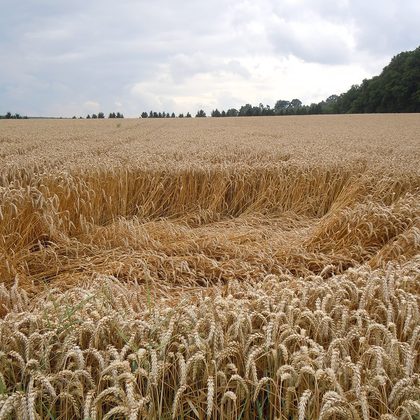
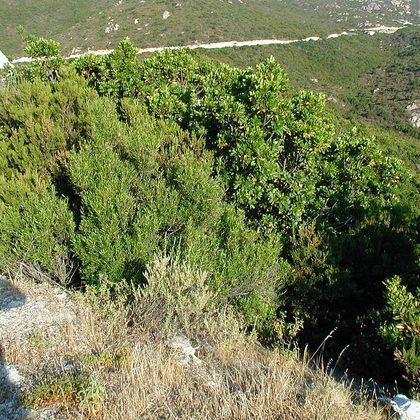
In Europe mainly richly structured country close to water: reedbeds, marshes, riverbanks and rough vegetation interspersed with fields. It avoids high ground with lasting snow cover, intensively farmed land without cover and areas occupied by wolves. Elsewhere in its range it also lives in forest, mangrove, farmland and on the edges of villages and towns, where it searches for refuse at night; in India it has been recorded up to 2000 m.
Where the animal is most at home, classified with EUNIS — the European standard for habitats.




Distribution
From south-eastern Europe and Turkey through the Levant, the Arabian Peninsula, Iran and Central Asia to India, Sri Lanka and parts of South-east Asia. In Europe the centre of gravity lay until a few decades ago in Greece and the Balkans. From the 1950s the species spread north and west; the first records from western and northern Europe came in 2015 and 2016, and breeding has since been confirmed in Italy, Germany, the Czech Republic and Poland, among others. The furthest finds so far are an animal in Finland (March 2022), one in Norway north of the Arctic Circle (February 2023) and one in Spain (January 2023). Within the guide area by far the largest number of GBIF records comes from Israel; in Europe Romania, Greece, Italy and Bulgaria follow.
- Native
- dark = core range, pale = thinly spread
Way of life
Mainly nocturnal, but active by day where undisturbed or when prey is then available. Jackals live singly, in pairs or in small groups; pairs usually stay together for life and jointly defend a range of roughly 5 to 15 km². It is an omnivore: rodents, amphibians, reptiles, hares, birds, carrion and plant food, and in groups also larger prey. In Europe mating takes place in January and February; after about 60 days usually four or five pups are born, exceptionally up to twelve. Older offspring sometimes help feed them. Young animals can disperse more than 200 km, which accounts for the rapid spread. In the wild they live up to about eight years. The species does not hibernate.
Where and when to look
Howling is the easiest way to detect the species: at dusk or at night, at a quiet spot in a known area, especially between December and April. In the Balkans and north-eastern Italy reedbeds and riverbanks are the best places to search. Outside the established range the animals are dispersers; a photograph, a sound recording or a sample for DNA analysis is then needed for a record to be assessed, because prints, scat and prey remains are not conclusive.
Conservation status
Least Concern (LC, 2018), and the European population is growing. In the EU the species is on Annex V of the Habitats Directive: it may be hunted as long as its conservation status remains favourable. The spread is regarded as natural, not as a human-caused introduction, although some countries have classified the species as alien. The causes cited are the disappearance of the wolf from large parts of Europe, climate warming, landscape change and the species' adaptability. Illegal killing, shooting through mistaken identity and road traffic are the main causes of death.
Scientific name
Canis aureus | Linnaeus, 1758
Linnaeus described the species in 1758 and placed it straight away in the genus where it still stands. Canis is the Latin word for 'dog'. aureus is Latin for 'golden', from aurum, 'gold', after the golden-yellow coat. The specimen the first description was based on came from Iran.