All species › Rodents › Jerboas › Great Jerboa
Great Jerboa | Allactaga major
Grote paardenspringmuis | Gran Jerboa
The Great Jerboa is the largest jerboa in Europe and one of the largest in the world. It moves by hopping on its hind legs, covers more than a metre per bound and reaches speeds of forty kilometres an hour. By day it stays in a burrow with a plugged entrance; at night it forages in open steppe and along steppe tracks. The ears are almost six centimetres long. Only the western edge of a large Asian range lies in Europe.

Tracks
The species hops and does not walk; in sand or dust on a steppe track it leaves a series of paired hind-foot prints with no other prints between them. Forefoot prints are absent, because the forelimbs are held against the chest; they appear only where the animal has stopped to dig or feed, as two small prints close together. The hind foot has five toes, but only the three middle ones bear weight; the print is therefore three-pronged, with the claw points in front and behind them the mark of the stiff brush of hairs under the foot. The distance between successive pairs is 80 to 125 centimetres at an easy pace and several metres in a startled animal; the trail then breaks up into separate groups that are difficult to link. At high speed the two prints of a pair lie side by side, at low speed one is slightly ahead of the other. The second sign is the burrow entrance: a sloping tunnel plugged with earth by day, with the excavated soil lying not at the opening but as a flat, elongated heap at some distance, because the animal carries the soil away. There are three types of burrow: a permanent summer burrow with chambers and blind escape tunnels, a deeper winter burrow, and shallow, sloping bolt-holes a few decimetres long used by day while away from the main burrow. Droppings are small, hard, dry and elongated and lie scattered.
Identification
Head-body 18.7 to 26 cm, tail 25 to 30.5 cm, weight 260 to 415 grams. A short, broad head with very large eyes, ears 57 to 59 millimetres long carried erect, short forelimbs held against the chest, and hind legs almost half the body length. The coat is brownish grey to pale sandy grey with rufous tones; belly and inner limbs are white, the thighs rusty yellow with a white stripe behind. The tail is about one and a half times the body length and ends in a flat, two-coloured banner: a black band followed by a pure white tip. The hind foot has five toes, the two outer ones much smaller; this five-toed foot separates the genus from all three-toed jerboas. The species does not walk but hops, with the body upright and the tail as a counterweight.
Similar species
No other five-toed jerboa occurs in Ukraine; a large rodent hopping on two legs in the East European steppe there is this species. Stylodipus telum also lives in the sandy steppes of southern Ukraine but is less than half as long, has three toes, much shorter ears and a thick tail with a poorly developed banner. Further east there are smaller Allactaga and Scarturus species, which can be separated on size and ear length. A hare is about ten times heavier and runs on four legs; a gerbil is small, runs on four legs and has a haired tail without a banner. The trail is unambiguous: no other European mammal leaves pairs of hind-foot prints about a metre apart.
Habitat
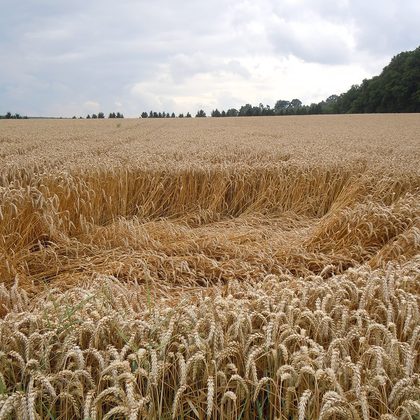
Open, dry, sparsely vegetated steppe on firm ground: feather-grass and fescue steppe poor in herbs, wormwood steppe, salt steppe, bare slopes of ravines and balkas, and man-made variants of these: verges of steppe roads, field margins, fallow land and overgrazed pasture. Tall, dense grass is avoided because the species cannot hop there. Unlike the sand-dwelling jerboas it prefers loamy and clayey soils; loose drift sand is occupied by Stylodipus. In the arable regions of southern Russia and Ukraine road verges are often the last remaining habitat.
Where the animal is most at home, classified with EUNIS — the European standard for habitats.



Distribution
From the steppes of eastern Ukraine and southern Russia east through Kazakhstan and northern Uzbekistan to western Siberia and Xinjiang. Only the western edge of this largely Asian range lies in Europe: the steppe and forest-steppe of Ukraine east of the Dnieper, the area around the Sea of Azov, and the Russian steppes along the Don, the Volga and in the southern Urals. The western limit has shifted eastwards over the past century as the steppe was ploughed. European records are scarce: GBIF holds fewer than a hundred records since 2006 for the westernmost part of the range, west of about 37° E; this reflects both low observer effort and the scarcity of the species.
- Native
- dark = core range, pale = thinly spread
Way of life
Strictly nocturnal: the animals emerge shortly after sunset and are back in the burrow before dawn. Solitary, with its own burrow system, and not markedly territorial. The diet changes with the season: in spring mainly underground plant parts, dug out with the incisors, including bulbs of Gagea; later seeds, young shoots, bark and a considerable proportion of insects. The species does not drink and obtains water from its food. Hibernation is deep and long: the animals disappear in September, sometimes not until October, and re-emerge between mid-March and April, spending four to six and a half months underground; several animals sometimes hibernate in one nest. Breeding follows hibernation: a gestation of about 25 days and one, in good years two, litters of one to eight, usually three to six young. In suitable areas densities of five to eight animals per hectare have been measured. Few animals live beyond three years. When in danger the animal does not flee in a straight line but with unpredictable side leaps at right angles to its direction, at speeds of up to forty and briefly fifty kilometres an hour. Predators include Corsac Fox and Eagle Owl.
Where and when to look
The species is best found at night with headlights. On a warm, windless night in May, June or July, drive at walking pace along an unpaved steppe track in eastern Ukraine or southern Russia with the windows open, and watch for red eyeshine low above the ground and for hopping movements in the verge. A startled animal often stands upright for several seconds with the ears raised before leaping away sideways. By day, search the dust of tracks for the series of paired prints about a metre apart and follow it back to the plugged burrow. Do not dig. The entire European range of the species lies in an area where war is being fought or where there are mines; choose the area carefully and with local guidance.
Conservation status
Least Concern (LC, 2016); the Asian part of the range is large and numbers there are still considerable. In Europe the species lives at the western edge of its range, in a landscape almost entirely ploughed within two centuries: a few per cent of the Pontic steppe remains, fragmented across reserves, railway embankments and burial mounds. Numbers in Ukraine and south-western Russia have been declining for decades, populations are becoming isolated from each other, and since 2022 war damage, fires and minefields have been added. The species is on several regional red lists, and the IUCN assessment stresses that numbers should continue to be monitored. The global category mainly reflects the situation in Asia, not in Europe.
Scientific name
Allactaga major | (Kerr, 1792)
Kerr described the species in 1792 as Dipus sibiricus major; because it was later moved to another genus, the author and year stand in brackets. Allactaga is taken from a Turkic or Tatar name for the jerboa, alaktaga. major is Latin for 'the larger', the comparative of magnus: Kerr distinguished the animal as the large form alongside the other jerboas. The specimen the first description was based on came from Kazakhstan, Kostanay.