All species › Rodents › Beavers › North American Beaver
North American Beaver | Castor canadensis
Canadese bever | Castor canadensis
The North American Beaver is a beaver from North America that was released in Finland in 1937: seven animals, two years after nineteen Norwegian (Eurasian) beavers had been reintroduced. At the time it was not known that two species were involved. The North American beavers increased faster: by 1999 there were about twelve thousand, against fifteen hundred Eurasian. In the field the two species cannot be separated.

Tracks
The signs are identical to those of the Eurasian Beaver: gnawing by Castor canadensis cannot be distinguished from that of Castor fiber. Stems gnawed with a constriction from two sides or to a point, broad parallel tooth grooves in the white wood, a ring of chips five to ten centimetres long around them, and gnawing that almost always lies within sixty metres of water occur in both species; a felled birch in Finland shows only that a beaver is present. The same applies to the lodge of sticks and mud with underwater entrances, the bank burrow in a steep bank, the slide thirty to fifty centimetres wide from the water up the bank, dug canals, scent mounds with castoreum along the territory boundary, peeled white sticks in the water and the sunken winter cache by the lodge entrance. Finnish research indicates that the North American Beaver on average builds dams more often and in greater number than the Eurasian, which in the flat, wet Finnish landscape leads to larger impoundments; this is an indication, not an identification character. Droppings and hairs are the most important sign for this species, because the species can be determined from them by DNA analysis; finds can be reported to the Finnish or Russian management authorities.


In its habitat
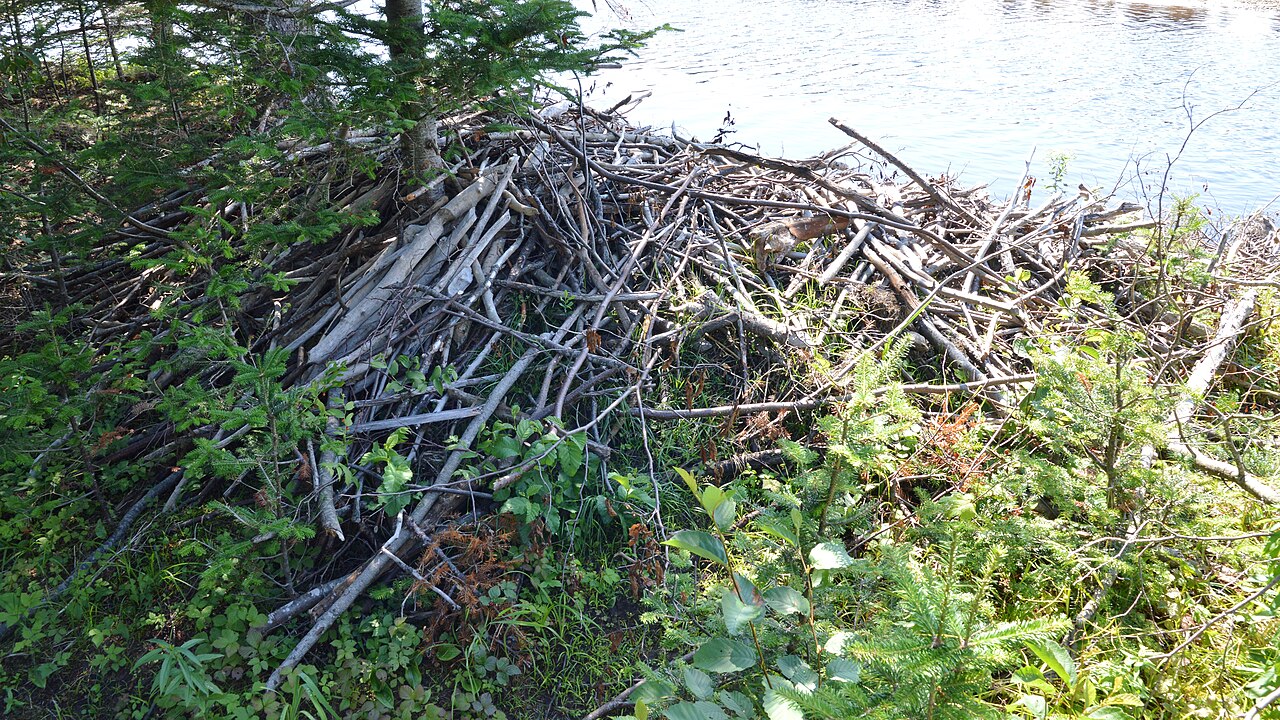
Identification
A heavy, low, broad water rodent of 80 to 90 cm head-body and fifteen to twenty kilos, with dense chestnut to nearly black fur, a blunt head, small round ears set high on the head and orange incisors that grow throughout life. The tail is naked, with horny scales, and horizontally flattened, 20 to 30 cm long; the hind feet are fully webbed, the forefeet small and able to grasp. This description also applies to the Eurasian Beaver. The differences given in the literature (a slightly broader tail, a somewhat darker coat, a shorter and broader muzzle) are averages with complete overlap and cannot be used on a living animal in the water. The only firm distinction lies in the skeleton and the genome: the nasal opening of the skull is squarer in this species, and Castor canadensis has forty chromosomes, the Eurasian Beaver forty-eight. Hybrids are therefore impossible; repeated attempts in captivity have never produced young.
Similar species
The Eurasian Beaver is the only species with which confusion is possible, and that confusion is complete: the two species cannot be separated in the field. Gnawing, dam, lodge and slide are also the same; a willow stump gnawed to a point gives no information on the species. Identification rests on DNA from droppings or hairs, or on the skull of a dead animal. In practice the species of a beaver in Finland, Karelia and the rest of north-west Russia cannot be determined without such analysis; elsewhere in Europe a beaver is a Eurasian Beaver. Other aquatic mammals can be distinguished: the Coypu is half the length, with a round tail and white whiskers, the Muskrat is smaller still, with a laterally flattened tail, and the Otter is slender and dives with a rolling movement.
Habitat
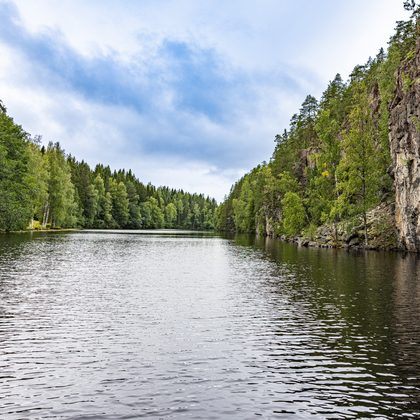
Slow-flowing streams, rivers, lake shores, bog pools and marshes with a broad fringe of willow, birch, aspen and alder; in Finland mainly the small-scale, water-rich forest and mire landscape of the east and centre of the country. The species needs water deep enough to keep the lodge entrance submerged (where it is too shallow, it is deepened with a dam) and soft banks to dig in. Otherwise it has few requirements; in North America it also occurs in suburbs, and in Fennoscandia it reaches into the northern conifer belt.
Where the animal is most at home, classified with EUNIS — the European standard for habitats.



Distribution
Native to North America, from Alaska and Canada to northern Mexico. All European populations derive from the release of seven animals in Finland in 1937, from New York State, two years after the reintroduction of nineteen Eurasian Beavers from Norway. Only later was it established that two species were involved. The North American Beaver now occupies eastern and central Finland, where it has displaced the Eurasian Beaver or increased faster; from Finland it has spread into Russian Karelia, and it also occurs in some other parts of Russia, where it was also released directly. Scattered records from Germany, Poland, Belgium and elsewhere in Europe concern escaped or misidentified animals, not populations; outside Finland and Russia beavers in Europe are Eurasian Beavers.
- Established introduction
- dark = core range, pale = thinly spread
Way of life
Nocturnal; the first animals are in the water around sunset, the last shortly after sunrise. Herbivorous: in summer water plants, herbs, grasses and leaves, in winter almost exclusively bark and cambium of willow, aspen, birch and alder; for this a cache of branches is stored underwater by the lodge entrance in late summer. The species lives in family groups (a monogamous pair with the young of this year and last year, four to eight animals) that occupy half a kilometre to a kilometre and a half of shoreline and mark it with castoreum. Mating in winter; after a gestation of just over a hundred days, two to four young are born in spring or early summer, furred and with open eyes, and they enter the water within a few days. Two-year-olds disperse five to ten kilometres. There is no hibernation: under the ice the animal swims between lodge and cache, and in the northern winter it is not visible for months.
Where and when to look
The species can be seen only in Finland, Karelia and parts of Russia, and even there the species cannot be determined in the field. Go in May or June, when it hardly gets dark in Finland, and sit in the late evening by a lake or impoundment with the wind blowing off the water; listen for the slap of a tail on the water surface, which is usually the first sign. By day look for the dam and the lodge and follow the slide into the wood to the place where trees have been felled. Droppings and hairs are in Finland the only way to establish which beaver is present.
Conservation status
Least Concern globally (LC, 2016); this assessment concerns the native range in North America, where the species has recovered from centuries of fur trapping to many millions of animals. In Europe the North American Beaver was added to the Union list of invasive alien species of Union concern (Regulation 1143/2014) by Commission Implementing Regulation (EU) 2025/1422 of 17 July 2025; for this species the obligations take effect only on 7 August 2027, to give member states time to adapt their management measures. From then on keeping, breeding, transporting, trading and releasing are prohibited, and member states must manage established populations. The problem is not that it lives differently from the Eurasian Beaver (the differences are small) but that it occupies the same niche. Hybridisation is ruled out by the difference in chromosome number, so there is no genetic mixing, but there is displacement. In Finland this has been clearly established: the released North American beavers increased faster than the reintroduced Eurasian ones and now occupy by far the greater part of the country, while the Eurasian Beaver remained confined to the south-west. An eradication strategy was proposed in the scientific literature in 2012; it was never implemented, and with tens of thousands of animals in Finland and north-west Russia eradication is probably no longer feasible. Finland hunts the species and carries out management aimed at giving the Eurasian Beaver space in the south-west. The spread began with the release in 1937, twenty-two years before it was established that two species existed.
Scientific name
Castor canadensis | Kuhl, 1820
Kuhl described the species in 1820 and placed it straight away in the genus where it still stands. Castor is the Latin word for 'beaver', borrowed from Greek kastōr. canadensis means 'of Canada', after the country the first described animal came from. The specimen the first description was based on came from Canada.