All species › Bats › Horseshoe bats › Greater horseshoe bat
Greater horseshoe bat | Rhinolophus ferrumequinum
Grote hoefijzerneus | Murciélago Grande de Herradura
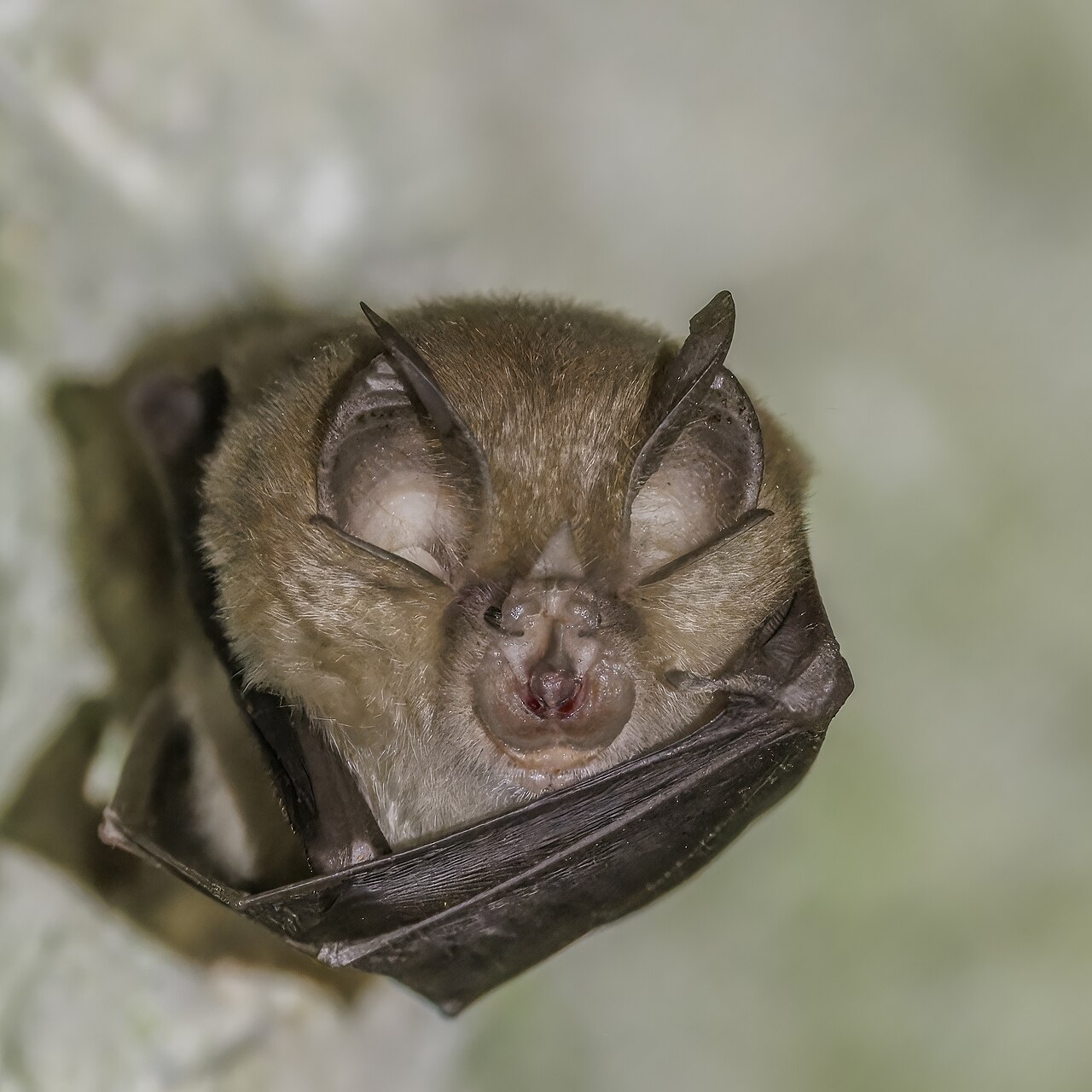
The Greater Horseshoe Bat is the largest European horseshoe bat. At rest it hangs free by the feet with the wings wrapped completely around the body; in Europe this posture occurs only in horseshoe bats and allows identification in a cave or cellar without handling. Dung beetles make up an important part of the diet, which makes the species dependent on grazed pasture with livestock.
Tracks
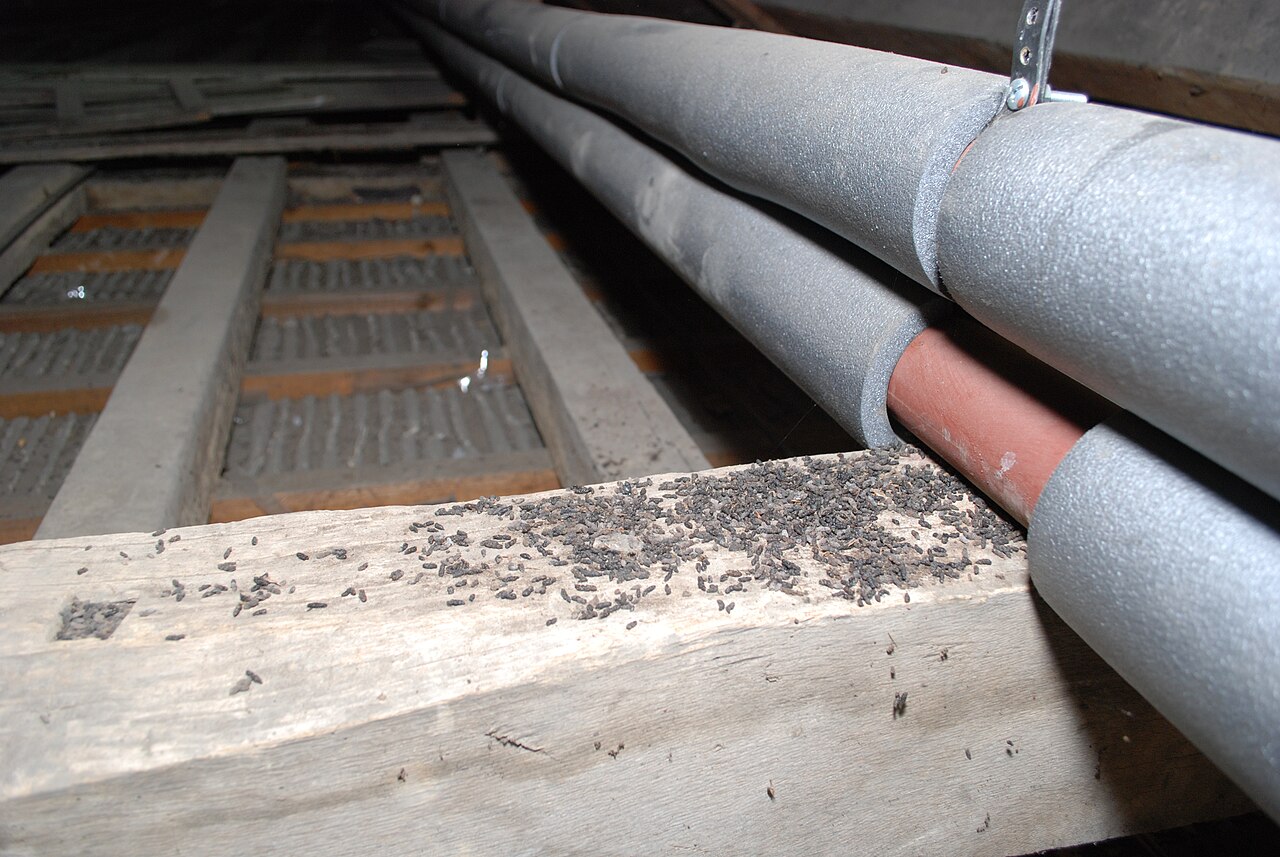
The signs of this species are tied to fixed places. Under a night roost (a beam in a barn, a porch, a gateway, a bridge, a cave entrance) lies a small pile of droppings mixed with the bitten-off wings of large moths and, in May and June, the pronota and wing cases of cockchafers and dung beetles. This follows from the hunting method: the animal hangs from a branch or beam, catches prey from there and returns to eat it hanging, letting the indigestible parts fall. Such piles of wings and wing cases are absent under pipistrelles. The droppings are larger than those of the common species, a good centimetre long and correspondingly thick, black and brittle, and crumble between the fingers into glittering beetle fragments. In the hibernation site (a cave, a marl quarry, an ice house, a disused mine) the animal itself can be found: hanging free from the ceiling, wrapped in its wings, often with droplets of condensation on the fur, usually some metres from the entrance in the dampest, least draughty passage. In a church or castle loft a maternity colony can be recognised by a broad band of droppings under the ridge and a strong smell. On a bat detector the species is unambiguous: a long, constant-frequency whistle around 82 kHz, which sounds like a squeaking door hinge and is produced by no other European bat outside its own family.
In its habitat

Identification
A large bat with a forearm of 51 to 61 mm, greyish-brown above with a faint reddish or buff wash and dirty white to grey below; young animals are greyer. The face carries the character that gives the family its name: an intricate, fleshy nose-leaf in the shape of a horseshoe, with a pointed lancet above and a saddle-shaped central piece between. The call is emitted through the nostrils and directed by the nose-leaf. The ears are large, pointed and mobile and have no tragus; this separates the whole family from all other European bats. The wings are broad and rounded; flight is slow, low and fluttering, often with short glides along a hedge. At rest the animal hangs free by the feet, with the wings wrapped completely around body and head; no other European bat outside this family does this.
Similar species
The Lesser Horseshoe Bat (Rhinolophus hipposideros) hangs in the same way but is clearly smaller (forearm 35 to 42.5 mm, against 51 to 61 mm in the Greater), and in a hibernation site usually hangs as scattered single animals across the ceiling. Where both occur, size at a distance is the only usable character; the difference is large enough. More difficult are Mehely's Horseshoe Bat (R. mehelyi) and Blasius's Horseshoe Bat (R. blasii), which occur alongside the Greater Horseshoe Bat in Iberia and the Balkans and are close to it in size. They can be separated by the shape of the nose-leaf and the facial pattern; this requires an animal in the hand or a very good photograph, and in a dark cave identification is not possible. From all other European bats the species is immediately distinguishable: no other has a nose-leaf, no other hangs free with the wings wrapped around the body, and all others have a tragus.
Habitat
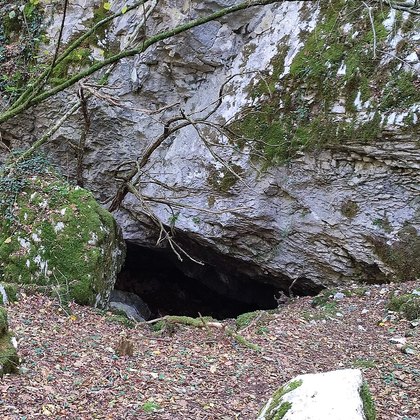
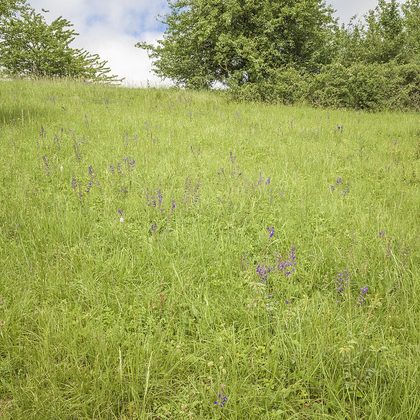
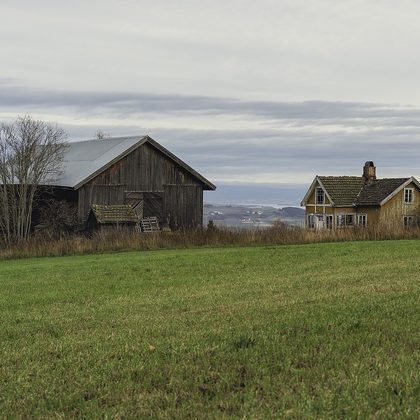
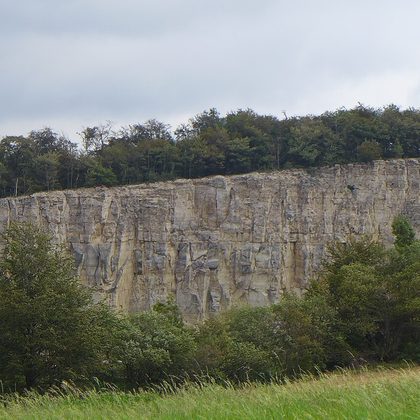
Warm, small-scale hill country: grazed pasture and wood pasture bordered by hedges and shelterbelts, old broadleaved woodland, orchards, sunken lanes and stream valleys. Foraging areas rarely lie more than a few kilometres from the roost and are reached along tall vegetation; gaps in hedges form a barrier for this species. In summer it needs large, warm, draught-free lofts with an open flight entrance (churches, castles, farm buildings), because it does not crawl through crevices as a pipistrelle does. In winter it needs caves, quarries, mines and cellars with a stable temperature and high humidity. The combination of these two requirements largely determines its distribution.
Where the animal is most at home, classified with EUNIS — the European standard for habitats.



Distribution
Southern and western Europe, North Africa and east into Asia; in Europe the northern limit runs through southern England, Wales, Belgium, southern Germany and Poland. In the Iberian Peninsula the species occurs throughout and on the Balearics, with colonies in caves, mines and buildings in Andalusia, Extremadura, Castile, the Iberian System, Catalonia and the Cantabrian coast, among other regions; in France, Italy and the Balkans it is also a common cave bat. Together with France and Italy, the Iberian Peninsula holds an important part of the European population. In Britain, at the north-western edge of the range, colonies live in Devon, Somerset, Dorset, Gloucestershire and South Wales, several thousand animals in total, hibernating in old mines and caves and breeding in a small number of large, protected buildings; this population declined by more than ninety per cent during the twentieth century and has been increasing again since the 1980s. In the Netherlands the species is extinct as a breeding bat: the last maternity colonies in South Limburg disappeared in the twentieth century, and only a few animals still hibernate in the marl quarries of the Sint-Pietersberg and surroundings. In Belgium a small population survives in Wallonia.
- Native
- dark = core range, pale = thinly spread
Way of life
Nocturnal and a late emerger: the animals leave the loft only when it is almost dark and hunt low over and along grazed pasture, hedges and woodland edges, alternating with waiting from a perch. The diet consists of large moths, cockchafers and above all dung beetles. This makes the species vulnerable: dung beetles live in cow pats, and fields without livestock, or with livestock treated with wormers (avermectins), do not produce them. In May the females occupy the maternity roost, where in June or July they have one young a year, which flies at a month old; colonies number tens to a few hundred animals and, where the building allows, are in use for centuries. From October to April the animals hibernate in cave or quarry, body temperature falling to just above that of the surroundings; disturbance during those months costs an animal part of its fat reserve and can be fatal. An age of thirty years has been recorded.
Where and when to look
The species is much easier to see in southern Europe than in the north. On a summer evening at a church, castle, farm building or cave entrance in south-west France, Extremadura, Andalusia, the Iberian System or Tuscany, slow, fluttering bats fly along the wall at dusk; a detector tuned to 82 kHz confirms the identification. In south-west England and South Wales some managed colonies hold public emergence evenings; this is the best opportunity to see the species in north-west Europe. Do not enter a cave, mine or quarry yourself in winter: one sweep of a lamp along a ceiling can kill a whole group of hibernating animals, and it is prohibited in almost every country. Instead, look under porches and gateways for piles of moth wings and wing cases. At a show cave, ask whether visiting is regulated: some caves close the sections with colonies from October to April.
Conservation status
Least Concern globally (LC, 2016). Within Europe the situation differs by region. In north-western Europe the species has disappeared from or declined strongly at the edge of its range: it is extinct as a breeding species in the Netherlands, reduced to a few sites in Belgium, and declined by more than ninety per cent in Britain during the twentieth century. In southern Europe it is still common, but the same threats apply. The causes are known: the loss of grazed pasture with hedges and of tree lines used as flight routes, the closing of church and castle lofts with netting, the sealing and tourist development of caves and hibernation sites, disturbance during hibernation, the abandonment of extensive grazing, and the loss of dung beetles due to wormers in livestock farming. Targeted management is effective: in south-west England and Wales the population has grown since the 1980s because maternity roofs were kept open and protected, mine entrances were gated against people but not against bats, and extensively grazed pasture was restored around the colonies; populations elsewhere also increase where such measures are taken.
Scientific name
Rhinolophus ferrumequinum | (von Schreber, 1774)
Von Schreber described the species in 1774 as Vespertilio ferrum-equinum; because it was later moved to another genus, the author and year stand in brackets. Rhinolophus is Greek, from rhis, genitive rhinos, 'nose', and lophos, 'crest', after the nose-leaf. ferrumequinum is Latin for 'horseshoe', from ferrum, 'iron', and equinus, 'of a horse', after the shape of the nose-leaf. The specimen the first description was based on came from France.