All species › Carnivores › Dogs, wolves and foxes › Grey Wolf
Grey Wolf | Canis lupus
Wolf | Lobo
The wolf is scarce in Europe and hard to establish in the field: print, dropping and trail cannot be separated with certainty from those of a dog, and identification rests in practice on DNA. Populations in the Iberian Peninsula and Italy survived persecution; since the turn of the century the species has moved back west out of eastern Europe into Germany, Denmark, the Netherlands, Belgium and the Alps. Public debate has since centred on management and on living alongside the species.

Tracks
The signs that settle the fox do not settle the wolf. The print is large: the forefoot roughly 8 to 11 cm long and 7 to 9 cm wide, four toes with heavy oval pads and blunt claw marks, the two middle toes standing clearly ahead of the outer ones. A large dog produces the same print, and the straight-edge test separates fox from dog, not wolf from dog. The trail is the most useful field character. A wolf registers over great distances — hind foot into the fore print, prints almost in a single line — and holds that line for kilometres with a stride of 70 to 90 cm and great regularity, straight across open country, over frozen ditches and along wood edges, with a fixed direction and without detours. A dog casts about, doubles back, sniffs sideways and almost always has a human nearby; a human trail beside the animal trail decides more than the print does. In a pack the animals walk in each other's prints, so that a trail of five wolves resembles that of one. The dropping is 2 to 3.5 cm thick and up to 20 cm long, twisted, grey and packed with hair and bone splinters, drawn to a pinched point, and is left in plain view at track junctions, on forest rides and in the middle of a route; with time it bleaches white and chalky. A dog on dry food leaves a smooth brown dropping without hair; the difference is real and often the first usable one. There is also the kill, usually roe deer, red deer, fallow deer, wild boar or sheep, with bites to the throat and flank and the belly opened; within a few nights the carcass is reduced to skin, head and feet. A lynx by contrast covers its kill, and a fox arrives only as a scavenger. In spring there is the rendezvous site, a clearing where cubs are left: flattened grass, quantities of hair, small bones and droppings of several sizes together. The howl is low, drawn out and rising, with no barking element; it is audible for kilometres and in late summer, when the cubs answer, is the simplest proof that a pack is resident.


In its habitat

Identification
A large, long-legged canid with a level back, deep chest, heavy neck and a short muzzle with small, triangular, erect ears. The tail is full, hangs straight down or just above the line of the back and usually ends dark; it is never curled over the back as in many dogs. The colour is grey with rusty and ochre tones, a paler mask around muzzle and cheeks, often a dark saddle and dark lines down the forelegs; black and near-white animals occur. In the Iberian Peninsula the black stripe on the front of the forelegs is characteristic, together with the white lip and the dark tail band that give the Iberian wolf, Canis lupus signatus, its name; it is slightly smaller and more reddish-brown than northern wolves. The legs are long and the feet large; in motion the wolf trots low, with long strides and steadily, the head level with the back or slightly below. Winter fur is heavy and makes the animal broader; a moulting wolf in June is thin and angular and is regularly taken for a sick dog. By late summer a cub already has the build of an adult, with a shorter muzzle and darker fur. A northern she-wolf weighs about ten times as much as a fox of four or five kilos.
Similar species
Most reported wolves are dogs. Large shepherd breeds — German and east European shepherds, huskies, malinois, and above all the Czechoslovakian Wolfdog and the Saarloos Wolfdog, bred from wolf crosses — cannot be told with certainty from a wolf on a camera-trap frame or a phone photograph. What decides is the combination of features and never one feature: a wolf has a relatively smaller ear, a shorter and broader muzzle, a longer leg and a hanging tail, and a proportionately heavier head; a shepherd dog has a sloping back and larger, more pointed ears. A pale Golden Jackal is the second mistake: far smaller and slighter, sharper in the muzzle, shorter-tailed and relatively long-legged; it occurs in part of the wolf's range. A Red Fox is taken for a wolf cub only at range; the tail settles it, being nearly two-thirds of the body and white-tipped in the fox. Shoulder height, colour and the impression of size on a photograph are not decisive. In practice only DNA from saliva, a dropping or hair, or a series of images showing behaviour, decides.
Habitat
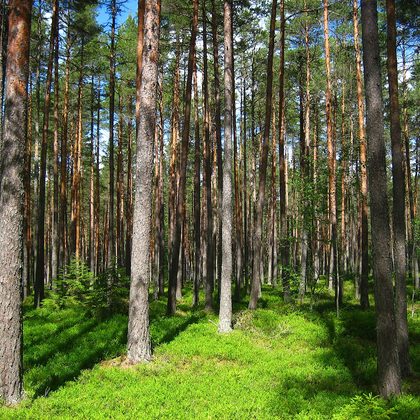
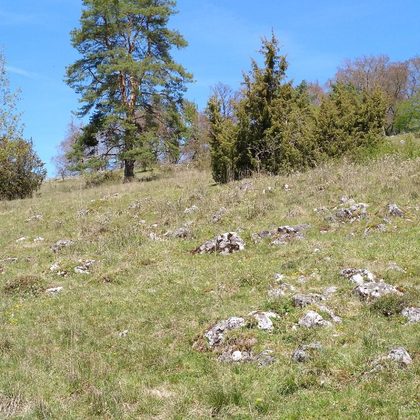
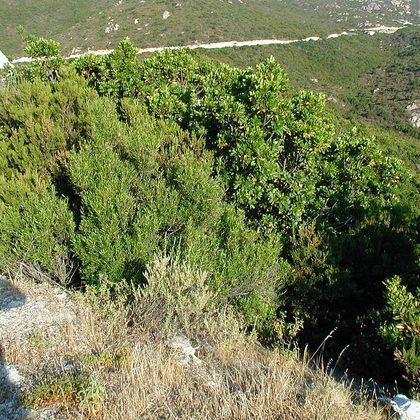
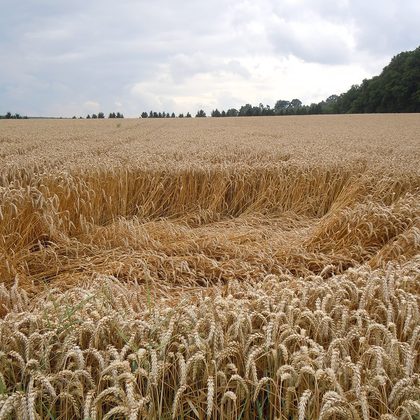
The species makes few demands on the landscape: taiga, mixed woodland, lowland bog, steppe, mountain pasture above the treeline, Mediterranean maquis, wide arable plains, and even old military training grounds and lignite workings. In north-west Iberia the wolf occupies mountain heath and beech forest as well as almost treeless cereal plains. What it needs is not wilderness but enough wild ungulates and enough quiet to lie up by day: a dense thicket, a reedbed, a young plantation, rough ground where nobody walks. As a result the wolf has also settled in densely populated, intensively used landscapes, as in Germany and the Netherlands. Open, populated farmland is not avoided on principle, but there the animal is seen almost only at night.
Where the animal is most at home, classified with EUNIS — the European standard for habitats.



Distribution
The wolf occurs from Iberia and Italy to Siberia, with the core in eastern Europe, the Balkans, the Carpathians and Russia. The Iberian and Italian wolves are two southern populations that survived persecution. In the Iberian Peninsula the population is large and continuous: it occupies Galicia, Asturias, Cantabria, Castile and León — above all Zamora, León and the Sierra de la Culebra — and much of the Basque Country, La Rioja and northern Palencia and Burgos. In the 1970s it was reduced to the north-west; since the 1980s it has recovered towards the east and south. The river Duero has for decades been the administrative boundary of its management; south of it only small nuclei remain, and the isolated Sierra Morena population is considered extinct. In Portugal the species survives north of the Duero. Since about 2000 the wolf has spread west year on year out of the German-Polish lowland, into Germany, Denmark, the Netherlands, Belgium, France and the Alps. In the Netherlands, where it had been absent since 1869, the first wanderer appeared in 2015, the first litter was born on the Veluwe in 2019, and eleven packs were present in 2024, with the Veluwe, the Drenthe-Friesland border area and Noord-Brabant and Limburg as core areas. In Belgium a pack settled in the Limburg border area from 2018; in Wallonia wolves live in the Hautes Fagnes and the Ardennes. The wolf is absent from Britain and Ireland: it was exterminated in England by the sixteenth century, in Scotland by the eighteenth and in Ireland by about 1786, and every British record is an escaped hybrid, a dog or an unverified report. Dispersing young wolves turn up hundreds of kilometres outside known range, sometimes within a few weeks; a wolf on open farmland or a heath outside a known pack area is almost always such a disperser.
- Native
- dark = core range, pale = thinly spread
Way of life
The wolf is mainly nocturnal in populated country and far more diurnal where it is left alone. It lives in a pack, which is almost always a single family: a breeding pair with this year's cubs and sometimes last year's. The old picture of unrelated animals fighting for rank is wrong. A territory covers from a few tens to a few hundred square kilometres, in central Europe usually a few hundred, and is marked out with droppings, urine and howling. The prey in Europe is chiefly roe deer, red deer, fallow deer and wild boar, with hares, small game and carrion; where stock is unprotected also sheep and goats, and in north-west Iberia also livestock and farm carrion. There is one litter a year: mating in February, and after about 62 days four to six cubs in April or May, in a dug den, an old badger sett or under a stump. From summer the cubs are moved between rendezvous sites and by autumn they join the hunt. Young animals leave at around two years to find a territory and a mate; this explains the wolves that suddenly appear hundreds of kilometres outside any known range. The wolf does not rest in winter, and winter is when it is easiest to follow, with the pack hunting together for most of the time.
Where and when to look
A sighting is rare. The chances are best where the species has long been established — the Carpathians, the Abruzzo, north-west Spain including the Sierra de la Culebra in Zamora, the German Lausitz — at first light or at dusk, with a telescope from high ground over an open valley, heath-covered slopes or a snow-covered clear-fell. In areas with only dispersing or newly settled animals, tracking in snow or on sandy forest roads is the most useful method: a straight line of large prints can be followed, and the question is whether a human trail runs beside it. In August and September listening yields most: at dusk, on high ground in an area where a pack is known, the cubs answer the howling of the older animals. Visiting a rendezvous site and howling in reply disturb the pack, and a disturbed pack moves its cubs. A record counts only with an image and, where possible, a hair or scat sample; the sample provides the final certainty.
Conservation status
Least Concern globally (LC, 2018); that assessment says little about Europe, where some populations grow while others stay small and isolated. The return is contested. The wolf is strictly protected under the Habitats Directive and the Bern Convention; since 2023 that protection has been in dispute, and its status has been lowered first under the Bern Convention and then in European law. In Spain the conflict concerns damage to extensively kept livestock, late compensation payments, poaching, poison and snares, and the legal question of whether the wolf north of the Duero should be a game species or a protected one. In the Netherlands and Belgium the debate concerns sheep behind inadequate fencing, wolves losing their wariness, and compensation. In Britain and Ireland it concerns only whether the species should ever be reintroduced, in countries without large predators where red deer numbers are controlled only by shooting. Scientifically the picture is simpler: where there are ungulates and no illegal shooting, the wolf maintains itself without management. Illegal killing, poisoning and traffic are the main causes of death, and hybridisation with dogs is a real problem in southern and eastern Europe.
Scientific name
Canis lupus | Linnaeus, 1758
Linnaeus described the species in 1758 and placed it straight away in the genus where it still stands. Canis is the Latin word for 'dog'. lupus is the Latin word for 'wolf'. The specimen the first description was based on came from Sweden.