All species › Even-toed ungulates › Porpoises › Harbour porpoise
Harbour porpoise | Phocoena phocoena
Bruinvis | Marsopa común
The Harbour Porpoise is the smallest cetacean of European seas and the only one that occurs regularly in the southern North Sea and the Baltic. It lives over the continental shelf, mostly in water less than two hundred metres deep, from the Barents Sea and Iceland to the Bay of Biscay, with separate populations in the Baltic, the Black Sea and along the coasts of Iberia and north-west Africa. In the southern North Sea the species had all but disappeared in the 1970s and 1980s; since the start of this century it has become common there again.
Tracks
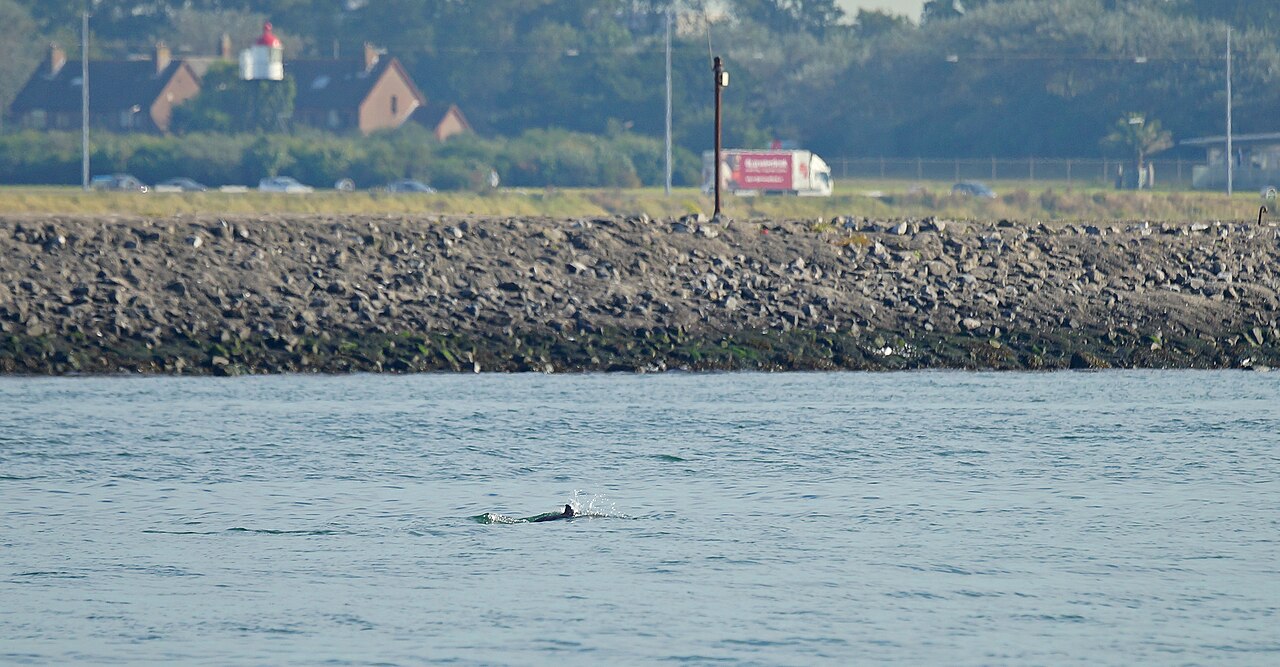
The Harbour Porpoise leaves no signs on land; what the observer has is the picture at the surface. The blow is almost never visible. In calm weather and at close range it can sometimes be heard: a short, sharp puff, like a sneeze. The animal surfaces in a smooth, forward-rolling movement: first the crown, then the back with the fin, then the body sinks away without the tail showing. Usually two to four such breaths follow in quick succession, after which the animal stays under for a minute or more. The species rarely leaps and almost never rides the bow wave of a ship. Groups are small, usually one to three animals, at food concentrations sometimes dozens. Visibility depends heavily on the sea: at Beaufort three or more, with whitecaps, a porpoise is hard to detect at all. What else is found on the beach are stranded animals; in the Netherlands and Belgium these go to the stranding networks for examination.
Identification
Small and stocky, with no beak and no forehead: the head is round and blunt and the mouthline slopes up towards the eye. The back is dark brownish grey to blackish brown, the flanks paler grey, the belly white; a grey stripe runs from the corner of the mouth to the flipper. The dorsal fin is small, low and triangular, broad-based with a straight or slightly convex trailing edge, and sits in the middle of the back. Adults are 1.35 to 1.90 m long; females are slightly larger than males. At the surface you usually see only a dark back with the small triangle on it, rising in a short rolling movement and sinking again.
Similar species
In the North Sea and the Baltic the Harbour Porpoise is the only small cetacean seen regularly from the coast, and confusion there is rare. Further west and north it may be confused with dolphins. The Bottlenose Dolphin is twice as long, has a short but distinct beak and a tall, sickle-shaped dorsal fin, and often leaps. The White-beaked Dolphin and the Common Dolphin are larger, have a beak and a taller, curved fin, and move fast and restlessly with much spray; porpoises rarely do. A porpoise surfacing briefly far away can resemble a Harbour Seal lifting its head; the fin decides, since a seal has none. When in doubt the rhythm helps: a porpoise surfaces a few times in quick succession and then disappears for a minute or more, whereas a seal stays lying with its head above water.
Habitat
Shallow water over the continental shelf, mostly less than two hundred metres deep, with a preference for areas of strong current, sandbanks and fronts where fish gather. The species comes close inshore and into sea inlets, harbours and tidal channels; in the Netherlands also into the Oosterschelde and the Westerschelde. It forages largely near the bottom, on fish such as herring, sprat, sandeels, cod, whiting and gobies, supplemented by squid and crustaceans. Most dives last about a minute; the deepest recorded dives exceed two hundred metres.
Where the animal is most at home, classified with EUNIS — the European standard for habitats.


Distribution
The whole north-east Atlantic over the continental shelf, from the Barents Sea and Iceland to France and northern Spain. The 2016 survey estimated about 467,000 Harbour Porpoises in European Atlantic waters, that of 2022 about 339,000 in the North Sea alone. In the North Sea the centre of distribution has shifted south since the 1990s, to the waters off eastern and south-east England and the Dutch and Belgian coasts. Around the British Isles there are concentrations off south-west Ireland, west Wales and western and eastern Scotland. In Danish waters, the Kattegat and the Belts the species is common; in the Baltic Proper a separate population of an estimated five hundred animals survives. The Black Sea holds the subspecies P. p. relicta, which has also been recorded in the northern Aegean. In the Mediterranean itself the porpoise is virtually absent. Along the Atlantic coast of Portugal and north-west Spain lives a small population that differs genetically from the northern one. In the Netherlands the species is present all year, with most sightings from December to April.
- Native
- dark = core range, pale = thinly spread
Way of life
Active by day and night; the species forages both by day and at night. Usually alone or in small groups of two or three, without fixed social bonds. Mating takes place in summer; after a gestation of about eleven months the calf is born between May and early August, with a peak in late June. The newborn is 70 to 80 cm long and weighs about five kilos. It is suckled for up to about eight months and also takes solid food from four months. Females mature at three to six years and usually calve every other year. Average life span is eight to thirteen years; a few animals reach twenty or more. Porpoises are killed by Bottlenose Dolphins, and in the southern North Sea Grey Seals have been shown to attack them as well.
Where and when to look
Look in calm weather, Beaufort two or less, with the sun behind you. In the Netherlands the harbour piers of IJmuiden, Scheveningen and Katwijk are known sites, and in the Oosterschelde porpoises are seen from the dykes and the Zeeland Bridge; the best months are December to April. Scan the water with binoculars for a dark back briefly breaking the surface, then keep watching the same spot: the animal often surfaces a few times in a row. Around the British Isles, west Wales, the east coast of Scotland and Shetland are good, in Denmark the Belts and the Little Belt. From a ferry the species is hard to see because it dives away from the ship; from the shore, with patience, it works better.
Conservation status
Least Concern (LC, 2020). Some populations fare worse: that of the Baltic Proper is listed as Critically Endangered (CR), the Black Sea subspecies as Endangered (EN). In the Netherlands the species was listed as critically endangered in 1994, as vulnerable in 2009, and as not threatened since 2020. The main threats are bycatch in gillnets, underwater noise from pile driving, seismic surveys and shipping, to which its hearing makes it sensitive, and pollution with PCBs and heavy metals. The Harbour Porpoise is protected under the Habitats Directive and the Bern Convention, and is covered by ASCOBANS, the agreement on the small cetaceans of the Baltic, North East Atlantic, Irish and North Seas.
Scientific name
Phocoena phocoena | (Linnaeus, 1758)
Linnaeus described the species in 1758 as Delphinus Phocoena; because it was later moved to another genus, the author and year stand in brackets. Phocoena is Greek phōkaina, the name for the porpoise, derived from phōkē, 'seal'. The specific name repeats the genus name. The specimen the first description was based on came from Sweden, Baltic Sea.