All species › Rodents › Voles and hamsters › Harting's Vole
Harting's Vole | Microtus hartingi
Microtus hartingi | Microtus hartingi
Microtus hartingi (Harting's Vole) is a large vole of the Balkans and Anatolia that has only recently been recognised as a separate species. Barrett-Hamilton described it in 1903 from specimens from Larissa in Thessaly; it was then included for a century in Günther's Vole (Microtus guentheri). Comparison of the chromosomes of Greek, Thracian and Anatolian animals with those of Levantine animals showed that it is a distinct species, to which the entire European part of the former range of M. guentheri belongs.
No photograph of a living wild animal of this species with a suitable Creative Commons licence exists. Do you have one that meets the rules? Send it in.
Tracks
The tunnels run twenty to forty-five centimetres below ground and can go down to eighty centimetres; a single system has three to fifty entrances and covers three to more than a hundred and fifty square metres. In years of high density a fallow field in Thrace or Thessaly is full of tunnels. Stores of cut grass blades are laid up in the tunnels; unlike its Levantine sister species this species does not store grain, one of the few described behavioural differences between the two. Above ground there are runways between the entrances, small heaps of obliquely cut grass along the runways and latrines with droppings of four to seven millimetres. At high densities the animals stand upright on their hind legs to look around and give a whistling call; this sound above a stubble field indicates a population outbreak. Barn and Short-eared Owl pellets give the most reliable species list, but within the guentheri complex they lead no further than the group.
Identification
Large and heavy for a Microtus: head-body 10.3 to 13.8 cm, weight 31 to 76 grams. The tail is very short, 2.2 to 3.5 cm, about a fifth of head-body length. As in its sister species, the projecting ears and large eyes are conspicuous; they distinguish it from all pine voles. The coat is pale dull buff with dark hair tips that give the back a grizzled appearance, buff on the flanks and buffy white below; the skull is robust, with moderately inflated bullae.
Similar species
The species status rests on characters that are not externally visible. With Günther's Vole (Microtus guentheri), from which it was split, it shares size, colour, build and chromosome number (both 2n = 54). The two cannot be separated in the field or in the hand; the distinction rests on C- and G-banding of the chromosomes and on DNA. Locality is useful: this species lives in southern Serbia, North Macedonia, south-eastern Bulgaria, Greece including Lesbos, Turkish Thrace and western and central Anatolia; Günther's Vole only from south-eastern Turkey onwards. In Bulgaria and northern Greece the Common Vole and Microtus mystacinus also occur: they are clearly smaller and lighter, yellower and shorter-eared, but at a distance the difference is not conclusive; the Common Vole and M. mystacinus are hard to separate from each other even with the skull in hand, and there chromosomes (2n = 46 against 54) or DNA decide. Felten's Vole, Thomas's Pine Vole and the Common Pine Vole, which occur in the same area, are small burrowing voles with very small eyes, hidden ears and an even shorter tail, and can be distinguished. A large, short-tailed, large-eared vole in cereal land in Greece or Thrace is, on the basis of locality, this species.
Habitat
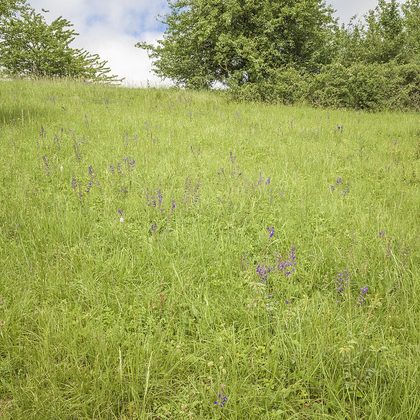
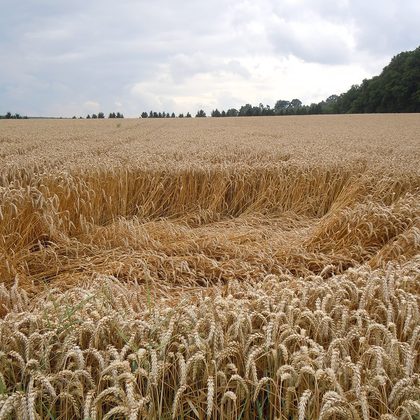
Dry, open ground: pasture, steppe-like grassland, fallow and various kinds of arable land, from sea level to about 1500 metres. The species lives in the cereal and lucerne country of the Balkan lowlands and the Anatolian plateau, and in the stubbles, field margins and neglected plots between them. Unlike the Field Vole and Microtus lavernedii it avoids wet ground, and unlike the pine voles it is not tied to loose, deep soil.
Where the animal is most at home, classified with EUNIS — the European standard for habitats.


Distribution
Southern Serbia, North Macedonia, south-eastern Bulgaria, Greece including the island of Lesbos, Turkish Thrace and western and central Anatolia; the type locality lies at Larissa in Thessaly. The species is the only representative of the guentheri complex in Europe: what older European literature, field guides and distribution atlases give as Microtus guentheri in the Balkans and western Turkey refers to this species. It is absent from western and central Europe.
- Native
- dark = core range, pale = thinly spread
Way of life
Active all year, in short bouts spread over the day and night, shifting towards dusk and night in the hot summer months. Herbivorous, with a daily requirement of fifteen to nineteen grams of dry food: grasses and herbs, vetch, lucerne, dandelion and thyme, supplemented with field crops. The species lives in family groups of a breeding pair with the young of one or two litters. Breeding stops from July to September, the dry months, and continues for the rest of the year. Gestation is twenty-one to twenty-three days in Bulgaria and twenty-two to twenty-four in Anatolia; the mean litter is four to seven and a half young, and a female can produce up to seven litters and forty-two young in a season. Females are sexually mature at thirty-five days. This reproductive capacity explains the plague years that regularly affect farming in Thrace and Anatolia.
Where and when to look
In northern Greece, Thrace or on the Anatolian plateau, check field margins and fallow patches along cereal or lucerne fields: where the species occurs, the entrances lie in groups of dozens, and the runways can be followed like paths through the grass. The best periods are late spring and early autumn, outside the summer heat. In plague years the animals are visible by day, the whistling can be heard over the fields and birds of prey gather: Common Buzzard, Kestrel, Montagu's Harrier and, over the Thracian plain, also Short-toed Eagle and Pallid Harrier. Barn Owl pellets from village churches or abandoned farms give an overview of the small mammals of the area.
Conservation status
Not Evaluated (NE). The IUCN has not yet assessed the species separately since the split; the assessment on the Red List concerns Microtus guentheri in the broad sense, in which this species was included until recently. The species is common and widespread, and in the Balkans and on the Anatolian plateau locally an agricultural pest that damages cereals, lucerne and young plantations in peak years and is controlled with poisoned grain. The island population on Lesbos and the western outliers in Serbia and North Macedonia are the smallest and most isolated parts of the range; almost nothing is known about their size.
Scientific name
Microtus hartingi | Barrett-Hamilton, 1903 (GBIF: Microtus guentheri)
Barrett-Hamilton described the species in 1903 and placed it straight away in the genus where it still stands. Microtus is Greek, from mikros, 'small', and ous, genitive ōtos, 'ear', after the small ears hidden in the fur. hartingi almost certainly honours the British naturalist James Edmund Harting (1841–1928), editor of The Zoologist, to which Barrett-Hamilton contributed regularly; the describer gives no explanation. The specimen the first description was based on came from Greece, Thessaly.