All species › Bats › Vesper bats › Kuhl’s pipistrelle
Kuhl’s pipistrelle | Pipistrellus kuhlii
Kuhls dwergvleermuis | Murciélago de Borde Claro
Kuhl's Pipistrelle (Pipistrellus kuhlii) is a small bat of the Mediterranean and of southern and central Europe, with a forearm of 30 to 37 mm and a weight of 5 to 10 grams. Kuhl described it in 1817 as Vespertilio kuhlii from Trieste. Many individuals have a white border along the trailing edge of the wing. The species lives largely in villages and towns, where it roosts in crevices in buildings and hunts around street lamps, and according to the Handbook of the Mammals of the World its range is expanding to the north and east.
No photograph of a living wild animal of this species with a suitable Creative Commons licence exists. Do you have one that meets the rules? Send it in.
Tracks
In villages and towns maternity colonies are often in roller-shutter boxes, window blinds and under roof tiles, and also in crevices and cavities of buildings, bat boxes, hollow trees and cliffs; they then draw attention through a strong smell and noise, which is how residents notice them. Maternity colonies hold tens to several hundred animals, rarely more than 200, almost all adult females with young; they may be mixed with Common or Savi's Pipistrelles. At dusk the animals hunt singly or in small groups around street lamps and along linear features. From August to early November males make display flights and call to attract females, and animals swarm at mating sites.
Identification
A small bat with very variable fur colour, from dark to pale brown, rusty brown or yellowish, without difference between the sexes. The upperparts are often beige to ochre, the underparts whitish or pale yellow; the contrast between back and belly is not sharp. The skin varies from dark brown to pale or reddish. Along the free edge of the wing and tail membranes there is usually a white stripe of variable width; in the eastern forms it is broader and more diffuse. The wings are blackish or dark brown and broad (wingspan 21 to 23 cm). The ears are short and triangular, with five small folds and an inward-curved, rounded tragus. The inner upper incisor is long and has a single cusp; in Europe this helps to separate it from Nathusius's Pipistrelle, where it has two. Flight is slow, erratic and agile, including among vegetation; when hunting the animal flies at about 4.7 m/s, when commuting at about 9.3 m/s. Search calls have the typical pipistrelle shape, with a peak around 34 to 41 kHz and a duration of up to 14 ms; shape and frequency vary strongly with surroundings, behaviour and weather.
Similar species
The Common Pipistrelle (Pipistrellus pipistrellus) may also have a whitish wing border; it has darker skin and calls higher, with maximum energy at 42 to 51 kHz. Wing venation is similar in the two species. Nathusius's Pipistrelle (P. nathusii) lacks the white border, has longer fur, a different wing venation and a two-cusped inner upper incisor. Its search calls (peak around 38 to 43 kHz) cannot be separated from those of Kuhl's on a bat detector; only the social calls allow the distinction, and not always. The social calls of Kuhl's Pipistrelle consist of two quick frequency-modulated pulses of about 14 to 16 kHz. Savi's Pipistrelle (Hypsugo savii) has a darker back with golden tips and more sharply demarcated pale underparts, and calls a little lower at 30 to 35 kHz, overlapping at the lower end. Rüppell's Bat (Vansonia rueppellii) has a grey back and pure white underparts. The eastern European and Asian form lepidus is treated by the handbook as a subspecies; other authors regard it as a separate species with different song-flight calls.
Habitat
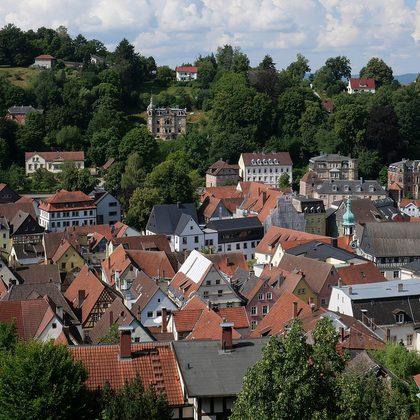
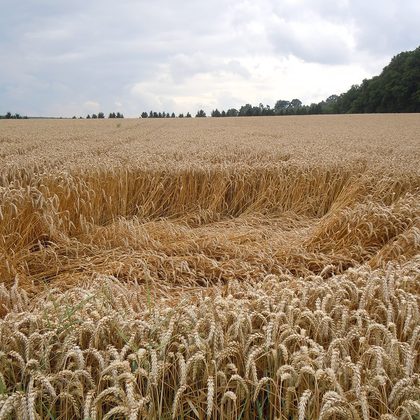
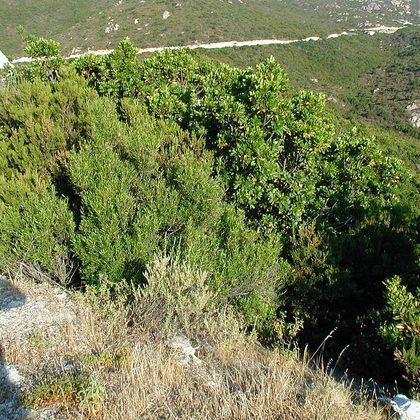
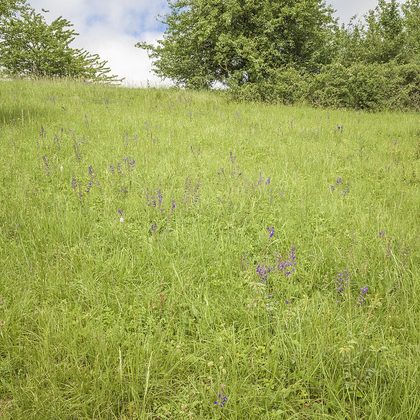
Farmland and built-up areas, and also woodland edges, riparian forest, deserts and semi-deserts with oases, scrub, alpine grassland and pasture; from sea level to about 2000 m, usually below 1000 m. The species avoids the interior of large continuous forests. It hunts 1 to 20 m above ground. According to the handbook, the abundance of roosts in roofs and wall crevices and of insects around street lamps explains the high densities in towns and villages.
Where the animal is most at home, classified with EUNIS — the European standard for habitats.



Distribution
P. k. kuhlii lives in central and southern Europe, from northern France and the Iberian Peninsula east to the Balkans, with its northern limit in southern Germany, southern Czechia, Austria and Slovakia, and on the large Mediterranean islands. P. k. lepidus ranges from southern Poland, eastern Slovakia, Romania, Ukraine and western Russia through western Kazakhstan, the Caucasus and Anatolia to India; P. k. tkhwanius lives in the Levant, Iraq, Iran and the Arabian Peninsula; P. k. marginatus in North Africa from Morocco to Egypt. The handbook tentatively assigns the animals of the Canary Islands to P. hesperidus, and the Madeiran P. maderensis falls genetically within P. kuhlii. The range is expanding north and east, probably along rivers and other linear features in the landscape.
- Native
- dark = core range, pale = thinly spread
Way of life
Nocturnal. In towns the species emerges early, shortly before sunset but later than the Common Pipistrelle, with a first activity peak in the first hours after sunset and a second before sunrise. The food consists of small flying insects: mainly non-biting midges and mosquitoes, also barkflies, hymenopterans, beetles, moths, bugs, caddisflies and lacewings, caught in flight. Females gather from mid-March and stay together until late August; from mid-June to July they give birth to mostly twins. Young females are fertile in their first autumn. Urban colonies give birth earlier and raise more young than rural ones. The species is sedentary and moves at most a few tens of kilometres between maternity, swarming and winter roosts. Hibernation is little studied: in the Balkans hibernating animals have been found in rock crevices, expansion joints, cellars, bridges and buildings; in the Mediterranean it is often interrupted for foraging on mild winter days, and sometimes the animals use the same roost all year. The greatest known age is under eight years.
Where and when to look
The species is best observed on summer evenings in villages and small towns in southern Europe, where the animals hunt around street lamps and along housefronts shortly before and after sunset, often while there is still some daylight. A bat detector at 35 to 40 kHz makes them audible. Separation from Nathusius's Pipistrelle needs the social calls, which are heard mainly from August to early November. A maternity colony in a roller-shutter box can be counted at emergence.
Conservation status
Least Concern (2016). The handbook counts the species among the most adaptable bats in Europe: it lives close to people, is widespread and fairly numerous over most of its range, and its distribution appears to be expanding to the north and east. In Iran and the Caucasus it has been suggested that it displaces the Common Pipistrelle and Savi's Pipistrelle there. No major threats are known; roost disturbance and direct persecution may affect local colonies. Like all bats in the European Union, the species is listed in Annex IV of the Habitats Directive and is covered by the EUROBATS Agreement.
Scientific name
Pipistrellus kuhlii | (Kuhl, 1817)
Kuhl described the species in 1817 as Vespertilio kuhlii; because it was later moved to another genus, the author and year stand in brackets. Pipistrellus is formed from Italian pipistrello, 'bat', which goes back to Latin vespertilio, from vesper, 'evening'. kuhlii honours the German naturalist Heinrich Kuhl (1797–1821), who died on Java at twenty-four. Natterer coined the name; because Kuhl was the first to put it in print, he counts as the author of his own eponym. The specimen the first description was based on came from Italy, Trieste.