All species › Bats › Vesper bats › Long-fingered bat
Long-fingered bat | Myotis capaccinii
Capaccini's vleermuis | Murciélago Ratonero Patudo
The long-fingered bat is a cave-dwelling Myotis of the Mediterranean region that hunts over open, calm water and takes prey from the surface with its large hind feet. It lives in caves and mines throughout the year, often together with Schreibers's long-fingered bat and other cave-dwellers, and has been listed as Vulnerable on the global Red List since 2016.
No photograph of a living wild animal of this species with a suitable Creative Commons licence exists. Do you have one that meets the rules? Send it in.
Tracks
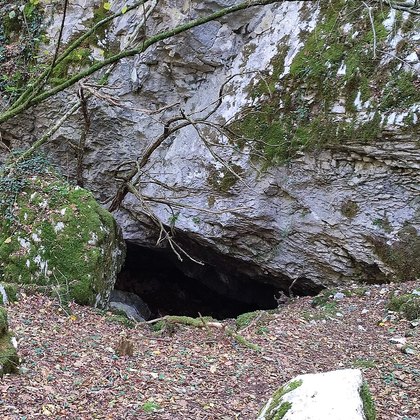
Roosts are caves and mines, usually shared with other cave-dwelling bats. Beneath a maternity colony lies a layer of droppings. In winter the bats hang singly or in clusters in caves, cellars and bunkers; clusters consist mainly of males, while solitary bats are more often females. Over water the species can be seen on warm evenings flying in wide circles just above the surface and dipping its feet into the water.
Identification
A medium-sized Myotis: forearm 38 to 44 mm, weight 7 to 10 g. The key feature is the large, strong hind feet, half as long as the tibia and covered with long, stiff hairs. It is the only European Myotis in which the wing attaches at the distal end of the tibia, not at the toes. The tail membrane and tibia are densely covered in brown hair on the underside. The fur is soft, dense and silky, pale brownish grey on the back and white to yellowish below; juveniles are darker and browner. The ears are greyish brown and fairly short, with a slightly notched outer margin; the tragus is S-shaped with a bluntly pointed tip and reaches about half the ear height. The nostrils project slightly; the facial skin is reddish brown to dark grey. Echolocation consists of broadband frequency-modulated calls starting at 70 to 90 kHz, ending at 34 to 39 kHz, with maximum energy around 47 to 50 kHz.
Similar species
Daubenton's bat (M. daubentonii) hunts in the same way and resembles the long-fingered bat in shape and colour, but its wing attaches at the base of the outer toe, its tibia and tail membrane are not densely haired and its feet are relatively smaller. The pond bat (M. dasycneme), a species of central and eastern Europe, is larger (forearm 43 to 49 mm), has the wing attached at the heel and barely occurs within the range of the long-fingered bat. In caves the species often hangs among Schreibers's long-fingered bats (Miniopterus schreibersii), which have a short, domed head and small, triangular ears, and among other Myotis and horseshoe bat species. On a bat detector, calls of bats hunting over water cannot be reliably separated from those of Daubenton's bat.
Habitat
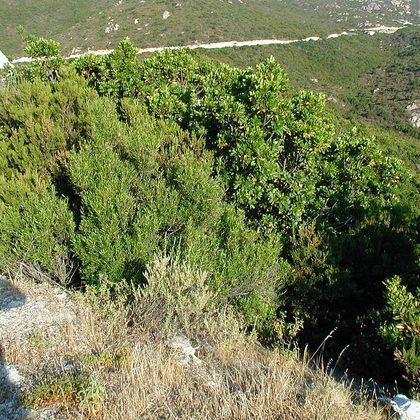
Karst areas with broad, slow-flowing rivers, large lakes and limestone rivers, as well as wetlands and scrub, always with open water free of vegetation, up to about 1200 m. The species lives mainly in regions with a Mediterranean climate. Green corridors and linear features such as edges and tracks are used to commute between roost and foraging area; woodland and scrub away from water are sometimes also used for foraging. Roosts are in caves and mines.
Where the animal is most at home, classified with EUNIS — the European standard for habitats.





Distribution
Mediterranean countries south of about 46°N, from the east of the Iberian Peninsula, with North Africa and the large islands (Balearics, Corsica, Sardinia, Sicily, Crete); the form M. c. bureschi in western and southern Turkey, Cyprus, Syria, Lebanon, Israel, Iraq and western Iran. Genetic data point to two subspecies, but not all populations have been studied. The species has disappeared from southern Switzerland and northern Italy, and in many parts of its range hibernation sites are unknown.
- Native
- dark = core range, pale = thinly spread
Way of life
The long-fingered bat hunts over open, calm water by trawling: it flies in wide circles just above the surface and takes prey with its feet or tail membrane. The diet consists mainly of flies and caddisflies, as well as moths and hymenopterans; small fish such as mosquitofish are also caught. The bats can detect vibrations on the water surface, and capture success is higher over calm water without vegetation. At night they travel more than 20 km to their foraging areas, sometimes over the sea. Maternity colonies of 30 to 600 bats occupy caves and mines, in the east of the range sometimes more than 2000. The young, one per litter, are born between late May and late June and forage independently from late July. Females are sexually mature in their first year, males in their second. Mating takes place in autumn at swarming sites and in hibernacula. Hibernation takes place at temperatures of 5 to 10 °C; large winter colonies can hold thousands of bats. Movements between summer and winter roosts usually do not exceed 100 to 150 km.
Where and when to look
The species is best seen on summer evenings over a calm lake, reservoir or broad river near known caves: the bats fly low over the water and can be followed from the side in the light of a weak lamp. Because Daubenton's bat hunts at the same places in parts of the range, only the combination of characters of a bat in the hand is conclusive. Caves with colonies are not entered during the maternity period or in winter.
Conservation status
Vulnerable (VU, 2016). The species can be locally common, but populations are declining and strongly fragmented; in Spain a decline of 30 to 50% over ten years has been reported. Reported causes are pollution or the loss of watercourses (especially in karst areas), large-scale use of pesticides in agriculture, degradation of riparian woodland, urban development, tourism and disturbance in caves; the north of the range is most affected. In North Africa the species is collected for traditional medicine. It is listed in Annexes II and IV of the Habitats Directive, which requires the designation of Special Areas of Conservation for it, and is covered by the Bern Convention and the EUROBATS Agreement.
Scientific name
Myotis capaccinii | (Bonaparte, 1837)
Bonaparte described the species in 1837 as Vespertilio Capaccinii; because it was later moved to another genus, the author and year stand in brackets. Myotis is Greek, from mys, genitive myos, 'mouse', and ous, genitive ōtos, 'ear': 'mouse-ear'. capaccinii honours a Capaccini: Bonaparte called the animal 'Vespertilione del Capaccini' in his Iconografia della fauna italica without further comment, and who he meant has not been established. The specimen the first description was based on came from Italy, Sicily.