All species › Bats › Vesper bats › Brandt's Bat
Brandt's Bat | Myotis brandtii
Brandts vleermuis | Murciélago De Brandt
Brandt's bat is a small Myotis of wooded regions in northern and central Europe and western Siberia, with isolated populations in central Italy, Turkey and the Caucasus. Externally it closely resembles the whiskered bat, with which it was long treated as one species; genetic studies, however, place the two in different groups within the genus. The species holds the highest known age record for a bat in the wild: 41 years, in Siberia.
No photograph of a living wild animal of this species with a suitable Creative Commons licence exists. Do you have one that meets the rules? Send it in.
Tracks
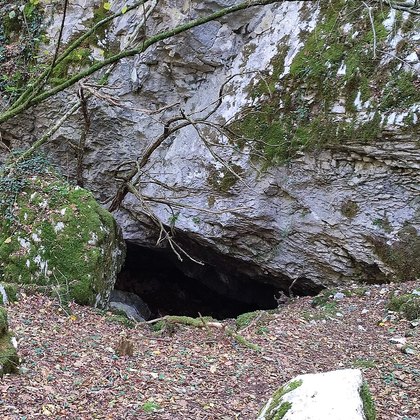
Summer roosts are in tree holes, cracks in trunks, between timbers and behind loose bark; maternity colonies also in attics, cavities under roofs and bat boxes. Beneath such a roost there are sometimes a few droppings: small, dark pellets that crumble into insect fragments. Boxes rarely hold more than 20 bats, sometimes together with pipistrelles. In winter the bats hang singly or in small groups in caves, mines and cellars. In late summer, from early August, males appear at swarming sites in front of cave entrances, where many bats fly around the entrance at night.
Identification
A small bat with a forearm of 33 to 38 mm and a weight of 5 to 7 g. The fur is brown or blackish with golden hair tips; the underside is only slightly paler than the back. With age the brown tone becomes more evident; juveniles are almost entirely black. The ears are long and set wide apart, and the bare skin is dark, though on average less dark than in the whiskered bat. There is no post-calcarial lobe on the tail membrane. Echolocation consists of broadband, strongly modulated calls of about 4 to 7 ms between 20 and 100 kHz, in the pattern of the small Myotis species.
Similar species
The species belongs to the 'whiskered bats', which are barely separable externally. The whiskered bat (M. mystacinus) is on average slightly smaller (forearm 32 to 36.5 mm), has a darker face and a dark ear base. Myotis alcathoe is smaller still and has paler, browner facial skin. In males the shape of the penis is a useful character; in addition, the small upper premolars of Brandt's bat are relatively tall and robust. In females and juveniles identification without dental characters or DNA is often not conclusive. Daubenton's bat (M. daubentonii) has paler facial skin, a grey, slightly paler underside and large feet. The exact range of Brandt's bat is not known everywhere because of confusion with the whiskered bat.
Habitat
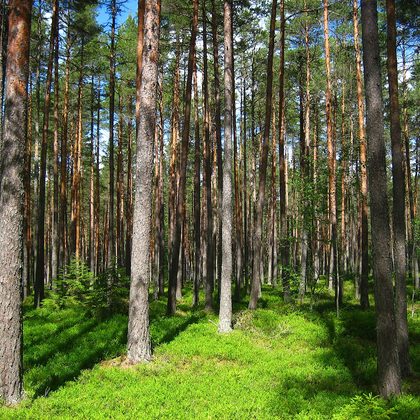
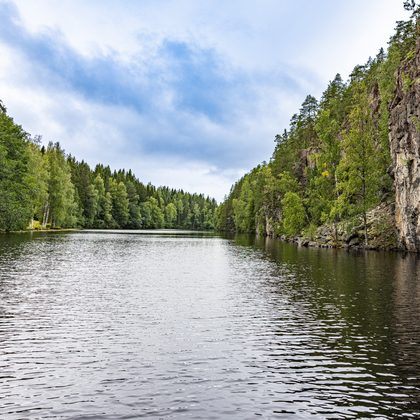
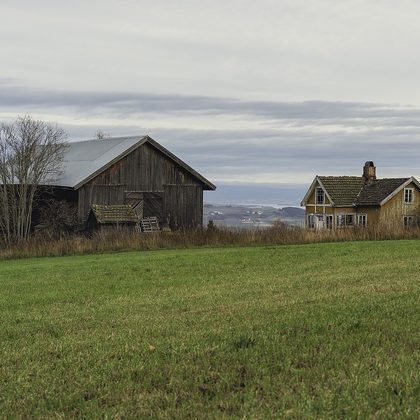
Mixed, coniferous and broadleaf forest, usually near water: swamps, lakes, moors and damp ground. The species occurs from sea level to about 1800 m; in the southernmost part of the range mainly in mountains. It forages along forest edges, tree lines and above the canopy, and in open riparian, beech and oak woodland. Summer roosts are often far from human settlement; winter roosts in caves, mines and cellars.
Where the animal is most at home, classified with EUNIS — the European standard for habitats.



Distribution
Northern and central Europe, from southern Fennoscandia and Great Britain to south-eastern Europe and east to western Siberia, with isolated populations in central Italy, Turkey, the Caucasus and Central Asia. The exact limits of the range are uncertain because the species is confused in the field with the whiskered bat. In the north of the range it is locally common.
- Native
- dark = core range, pale = thinly spread
Way of life
Brandt's bat hunts flying insects in agile flight (aerial hawking), and although it lives near water it feeds on terrestrial insects: mainly moths, non-biting midges and mosquitoes, as well as spiders, harvestmen and earwigs. One colony studied used up to 13 separate foraging areas of 1 to 4 ha in summer, together more than 100 ha. Maternity colonies in natural roosts number several tens of females, sometimes up to 200. The young, usually one and sometimes twins, are born in June, depending on latitude. Females breed only from their second year. The bats disperse from July, earlier than other species, and males visit swarming sites from early August. The species can be locally sedentary or move up to about 300 km between summer and winter roosts. The maximum known age in the wild is 41 years.
Where and when to look
In the field Brandt's bat cannot be told from the whiskered bat without the bat in the hand, nor with a bat detector; record an observation as Myotis mystacinus/brandtii. In summer the species is best seen at emergence from a known roost or hunting along woodland edges near water. Identification is made during licensed trapping studies, based on teeth, penis shape and, where needed, DNA. Hibernation sites are not entered in winter.
Conservation status
Least Concern (LC, 2020). The species is widespread and occurs at high densities over much of its range, especially in the north. A decline has been reported only from northern Turkey, at the edge of the range. Reported concerns are the loss of tree holes and other roosts and disturbance of hibernation sites. The species is listed in Annex IV of the Habitats Directive and is covered by the Bern Convention and the EUROBATS Agreement.
Scientific name
Myotis brandtii | (Eversmann, 1845)
Eversmann described the species in 1845 as Vespertilio Brandtii; because it was later moved to another genus, the author and year stand in brackets. Myotis is Greek, from mys, genitive myos, 'mouse', and ous, genitive ōtos, 'ear': 'mouse-ear'. brandtii honours Johann Friedrich von Brandt (1802–1879), the German-born zoologist who directed the zoological museum in St Petersburg. The specimen the first description was based on came from Russia, Orenburgsk.