All species › Lagomorphs › Hares and rabbits › Mediterranean Hare
Mediterranean Hare | Lepus mediterraneus
Lepus mediterraneus | Lepus mediterraneus
Lepus mediterraneus is a hare of Sardinia and North Africa without an established Dutch, English or Spanish name. Wagner described the species in 1841 from an animal from Sardinia; it was then treated for a century and a half as a subspecies of the Cape Hare. In 2019 molecular and morphometric studies separated it from that complex again as a distinct species, together with the Moroccan Hare and the West Sahara Hare, and the Mammal Diversity Database has recognised it as a species since then. Because it long appeared in the literature only as a subspecies, it has no vernacular name. Hares on Sardinia and in, for example, Kabylia belong to this species under the current arrangement, but are still often called Lepus capensis in the field and in databases.

Tracks
The species does not dig and leaves the same surface signs as other hares, here in maquis soil and dry dust. The form is a shallow scrape under a cistus, mastic or broom bush or in the furrow of a fallow field, worn down to bare earth and with the opening away from the wind. The droppings are flattened spheres of 15 to 20 mm, hard, ochre and coarse-fibred, scattered singly on open patches and along runs, never in heaps; the rabbit deposits its droppings on fixed latrines. The print is long and narrow, with four toes, and blurred at the edge by the furred sole; in the bounding trail the two long hind feet land in front and the small fore feet behind, usually one behind the other in a line. On sandy roads between vineyards, dusty field tracks and in the ash of a burnt area, this group of four prints is easily seen. Feeding signs are clean, oblique cuts of about 45 degrees on young shoots; in winter also stripped bark on vine, olive and almond regrowth up to about sixty centimetres. On Sardinia the species feeds by preference in freshly burnt or cut macchia, where new shoots come up.
Identification
A small, slender hare: head-body 40 to 50 cm and one and a half to two and a half kilograms, clearly lighter and shorter than the hare of the European mainland. The coat is fawn to reddish brown with black markings on the back, the flanks ochre, the underparts white; the head is elongated with large, protruding eyes. The ears are long and black-tipped; the hind legs are long and powerful, the tail black above and white below. North African animals are generally paler and sandier than Sardinian ones. The build is lighter than that of the Brown Hare, as is usual in hares of warm, dry and open areas.
Similar species
On Sardinia and the smaller islands confusion is possible only with the Rabbit, which is common there: much smaller, greyer, with ears shorter than the head and lacking a black tip, a raised tail showing white when fleeing, and a burrow to flee into. The species is absent from mainland Italy, where the Corsican Hare and the Brown Hare occur, and on Corsica both. Sardinia and Corsica are separated by the Strait of Bonifacio. In the Maghreb this is the only hare over large distances; at the southern edge of the range the West Sahara Hare (Lepus saharae) occurs, and in the mountains of central Morocco the Moroccan Hare. These three species were split from the same complex in 2019 and cannot be told apart in the field by appearance; identification rests on locality, and where the ranges meet, identification by appearance is not possible. From the Cape Hare of the Levant the species is separated only geographically; the ranges do not meet.
Habitat
The dry mosaic landscape of the Mediterranean and North Africa: macchia and garrigue, cistus and broom stands, open holm oak woodland with a grassy understorey, cereal fields and fallow, vineyards and olive groves, dry steppe grassland, dunes and coastal plains. As in other hares, transitions from scrub to open ground are most important, since they combine cover and food. On Sardinia the species occurs from sea level into the hills, in the Maghreb from the coastal strip to the southern plateaux, where its range grades into that of the desert hares.
Where the animal is most at home, classified with EUNIS — the European standard for habitats.
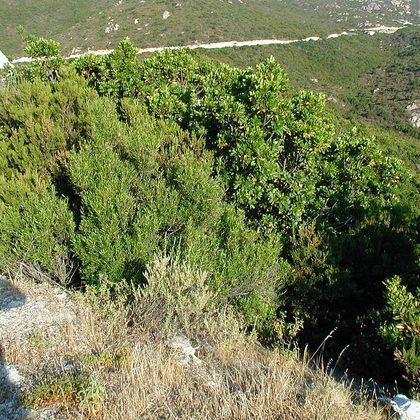

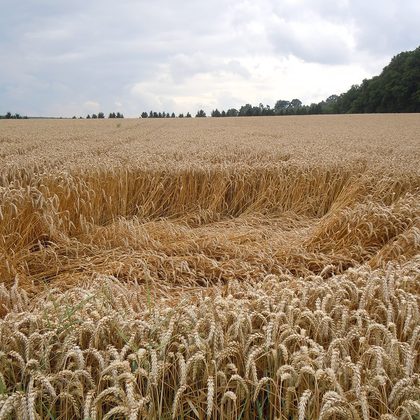


Distribution
According to the Mammal Diversity Database: Morocco, Algeria, Tunisia, Libya, Egypt and Italy, Italy meaning only Sardinia and its satellite islands; the mainland and Sicily belong to the range of the Corsican Hare. On Sardinia the species is widespread: it has been reported from 258 municipalities over an area of about 18,500 km², at densities of one to five animals per square kilometre over about half of the suitable ground and five to ten over more than a third of it. It also occurs on Asinara, La Maddalena, Sant'Antioco and San Pietro. Morphometric and molecular studies indicate that the Sardinian population was introduced by people from North Africa in historical times. GBIF holds fewer than forty records under Lepus mediterraneus for the Mediterranean and North Africa, against thousands under the old name.
- Native
- dark = core range, pale = thinly spread
Way of life
Nocturnal, with a peak in the first hour after sunset and again around dawn; by day the animal lies in a form under a bush. The diet consists of grass, herbs, young cereals, shoots, roots and tubers, and fruit in late summer; like all hares the species re-ingests its caecal pellets. Solitary; it digs no burrow but rests in shallow hollows among the bushes. Gestation is about forty days; litters are small, on Sardinia usually one or two young, but there are several litters a year, mainly from January to summer. The leverets are born furred and with open eyes, lie hidden separately and are suckled briefly once a day. No winter dormancy.
Where and when to look
On Sardinia the chance is best in the last hour of daylight and the first hour of darkness on fallow fields, in vineyards or along freshly cut strips of macchia. After dark one can drive slowly along country roads in the Campidano plain, the Marmilla or the Nurra, looking for eyeshine on the verges; in protected areas such as the Oasi di Capo Nieddu densities are highest. In the Maghreb the same applies to the coastal farmland and the plateaux of the Tell Atlas. The species is shy and flees early; from a car a much closer approach is possible than on foot. Many recording schemes still list the species under Lepus capensis; state the current name Lepus mediterraneus with a record.
Conservation status
Not Evaluated (NE): the IUCN has not yet assessed the species under this name, because the 2019 split is more recent than the last assessment of the complex. On Sardinia the species is a quarry species and has declined sharply in places through the loss of the small-scale farming mosaic, large fires and poaching. In addition, hares from elsewhere have been released for generations, from mainland Italy and from eastern Europe, which threatens the genetic distinctiveness of the island population. Sardinian researchers therefore regard the island population as a separate evolutionary unit that should be treated as such in management. In North Africa the species is common but heavily hunted. As long as the species is not included under this name in Red Lists and legislation, it is not treated separately in monitoring and protection.
Scientific name
Lepus mediterraneus | J. A. Wagner, 1841
J. A. Wagner described the species in 1841 and placed it straight away in the genus where it still stands. Lepus is the Latin word for 'hare'. mediterraneus is Latin for 'inland, in the middle of the land', from medius, 'middle', and terra, 'land'; through the name of the sea it came to mean 'Mediterranean', which is how Wagner used it. The specimen the first description was based on came from Italy, Sardinia.