All species › Even-toed ungulates › Bovids › Mouflon
Mouflon | Ovis gmelinii
Moeflon | Ovis orientalis musimon
The mouflon (Ovis gmelinii) is the wild sheep of Anatolia, the Caucasus and Iran and is regarded as the ancestor of all domestic sheep. The species also includes the mouflons of Cyprus, Corsica and Sardinia, which according to current views descend from early domestic sheep brought to the islands in the Neolithic. From the early twentieth century the European mouflon has been released for hunting at many places in central and western Europe.

Tracks
The track is two-toed and pointed and resembles that of a domestic sheep. The droppings are black pellets in small heaps and in the field cannot be told with certainty from those of sheep, goat, chamois and ibex. In winter mouflon strip bark from young broadleaved and coniferous trees; this damage is a familiar sign in central European forests. At regular resting places under rocks and in dense scrub lie droppings and loose hair.
Identification
A small, short-haired wild sheep with a shoulder height of about 90 cm, a head-body length of up to 120 cm and a weight of 35 to 55 kg in rams and 25 to 40 kg in ewes. In summer the ram is fox-red to reddish-brown, usually with a whitish saddle patch on the flank; the belly, lower legs, muzzle and rump patch are white, and a dark line along the flank separates back and belly. The ewe is plain brown and lacks the saddle patch. Both sexes are darker in winter. The ram carries heavy, ridged horns that form almost a full turn, up to 80 cm long; the ewe is usually hornless or has short horns.
Similar species
A ram with saddle patch and curled horns cannot be confused with any other wild ungulate in Europe. Ewes and young animals can resemble domestic sheep at a distance; these have a longer woolly coat and a long tail. In the Alps and Pyrenees the chamois and the Pyrenean chamois differ in their hooked horns and facial pattern; the Spanish ibex and the Barbary sheep are larger, the first with a beard and black patches on the legs, the second with a long throat fringe and no saddle patch.
Habitat
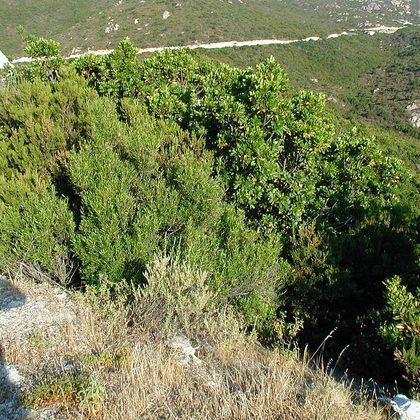
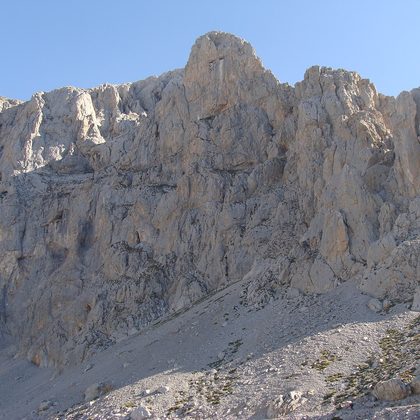
On Corsica, Sardinia and Cyprus the mouflon lives in stony mountain country with maquis, evergreen oak woodland and pine forest, up to above the treeline. In central Europe it occupies dry broadleaved and mixed woodland on hills and in low mountain ranges with stony soils and clearings. It copes poorly with wet, soft soils and deep snow: hoof problems occur in such areas.
Where the animal is most at home, classified with EUNIS — the European standard for habitats.




Distribution
The natural range covers Armenia, Azerbaijan, Iran and Turkey, where two separate populations live: in eastern Anatolia and around Konya. On Cyprus the Cyprus mouflon (O. g. ophion) lives in the Paphos forest. The mouflon reached Corsica and Sardinia around the fifth millennium BC; in 2015 Sardinia held about 6,000 animals and around 2010 Corsica about 800. From these islands the European mouflon was taken to the mainland: in Austria to the Lainzer Tiergarten, in Germany in 1903 to the Göhrde and in 1906 to Harzgerode, and further to the Czech Republic, Hungary, Slovakia and Luxembourg (1970), among others; in the early 1980s mouflon moved from France into the Swiss Valais. Around 2005 central Europe held about 90,000 mouflon.
- Native
- Established introduction
- dark = core range, pale = thinly spread
Way of life
The mouflon is active mainly at dusk and dawn, and also at night where it is hunted. It grazes mainly on grasses and herbs and also eats twigs, buds, bark and acorns. Outside the rut, ewes with lambs and young animals live in groups and rams live apart. The rut falls in October and November; gestation lasts about five months, and one or two lambs are born in March or April. Mouflon are sexually mature at two to four years. In central Europe mouflon are easy prey for the wolf: in Lusatia the populations disappeared after the wolf returned, and in the Harz numbers fell after the reintroduction of the lynx and hard winters.
Where and when to look
On Cyprus mouflon can be seen at the Stavros tis Psokas forest station in the Paphos forest, where a fenced group is kept; free-living animals there can be found on open slopes in the early morning. On Corsica mouflon live in the high mountains of Asco and Bavella; at sunrise scan the rocky slopes with a telescope. In central Europe wood edges and clearings in hill country at dusk are the best places; in a group, look first for the pale saddle patches of the rams.
Conservation status
Near Threatened (NT, 2020), for the species as a whole and on the basis of the Asian populations. The IUCN does not assess the European mouflon, which it treats as a feral descendant of ancient domestic stock. The Cyprus mouflon is strictly protected on Cyprus and has been listed in CITES Appendix I since November 2019. In central Europe numbers have fallen sharply in places through predation by wolf and lynx; in addition, intestinal disease and foot rot on damp soils cause mortality.
Scientific name
Ovis gmelinii | E. Blyth, 1841 (GBIF: Ovis gmelini)
E. Blyth described the species in 1841 and placed it straight away in the genus where it still stands. Ovis is the Latin word for 'sheep'. gmelinii almost certainly honours the German naturalist Samuel Gottlieb Gmelin (1744–1774), who travelled through Persia in Russian service and reported the wild sheep there; Blyth gives no explanation. The specimen the first description was based on came from Türkiye, Erzurum.