All species › Bats › Vesper bats › Mountain Long-eared Bat
Mountain Long-eared Bat | Plecotus macrobullaris
Berggrootoorvleermuis | Orejudo Alpino
The Mountain Long-eared Bat is tied to mountains: the Pyrenees, the Alps, the Dinaric Alps, the Pindus, the mountains of Anatolia, the Caucasus and the mountains of Syria and Iran, and also Corsica and Crete. It was described by Kuzyakin in 1965 from North Ossetia as a subspecies of the Brown Long-eared Bat, and in 2001–2002 two research groups simultaneously rediscovered it in the Alps and described it under two new names, P. alpinus and P. microdontus. In 2003 DNA showed that these were the same species, and the oldest name took precedence. Forearm 37 to 46 mm, weight 6 to 10 grams; recorded from sea level to 2800 m.
No photograph of a living wild animal of this species with a suitable Creative Commons licence exists. Do you have one that meets the rules? Send it in.
Tracks
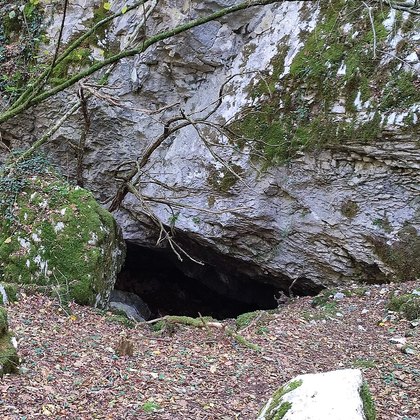
In the Alps maternity colonies have almost always been found in church lofts and old houses; it is one of the bats most often found in church lofts there. In the Pyrenees, radio-tracking of 51 bats led mainly to rock crevices and scree slopes between 1450 and 2430 m, where males and non-breeding females roosted under stones and changed site almost every day; only three pregnant or lactating females were in buildings. In the south-east of the range the species has also been found in caves, together with horseshoe bats and Myotis species. The pulses attenuate so quickly that most detectors fail to record the bat even at 5 m; acoustic surveys therefore under-record the species, and researchers report low capture rates at drinking sites.
Identification
A medium-sized long-eared bat with ears of 34 to 38 mm. The dorsal fur is long and dense, brown to pale grey, with hairs black at the base; the underparts are densely furred and whitish, most clearly on the throat, often with pale yellow highlights on the sides of neck and shoulders. A brown mask runs from the mouth to behind the eyes; the muzzle is robust and the lower jaw pink. The character most individuals show is an inverted triangular chin pad below the lower lip (95 per cent of bats in the Swiss Alps). Ears and tragus are light brown; the tragus averages 17.2 mm long (14.2–20.0) and 5.8 mm wide (5.0–7.0). The thumb is long (6.9 mm on average) with long, slender claws, as in the Brown Long-eared Bat, and the feet are hairy. The wings are light brown and translucent. The penis is cylindrical. Echolocation consists of descending frequency-modulated pulses with several harmonics; the first runs from about 46 to 23 kHz with a peak around 35 kHz, the second starts around 67 kHz. Close to vegetation or rock the pulses are short (up to 0.8 ms), over open meadows long (up to 7.3 ms) and lower in frequency.
Similar species
The Mountain Long-eared Bat shares its mountains with the Brown Long-eared Bat (P. auritus), the Grey Long-eared Bat (P. austriacus) and, in the Balkans, Kolombatovic's Long-eared Bat (P. kolombatovici). The chin pad is the first character: inverted triangular in the Mountain, rounded or banana-shaped in the others; in young bats it is sometimes darker and its shape varies, so on its own it is not always conclusive. From the Brown, which has an equally long thumb and long claws, it differs in the brown mask, the whitish throat and belly and the cylindrical penis (narrowing towards the tip in the Brown). From the Grey and Kolombatovic's, which have a club-shaped penis, it differs in thumb length: over 6.2 mm against under 6.6 mm where the three species occur together. A combined analysis of eight body measurements assigned 97.5 per cent of Plecotus bats in Switzerland correctly. The call does not separate it from the other long-eared bats: although it belongs genetically to the auritus group, its signal most resembles that of the Grey Long-eared Bat. All species can be separated with certainty by short mitochondrial DNA markers.
Habitat
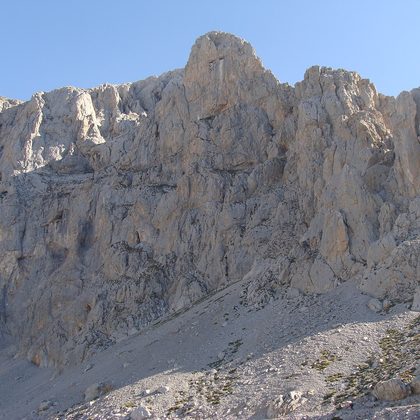
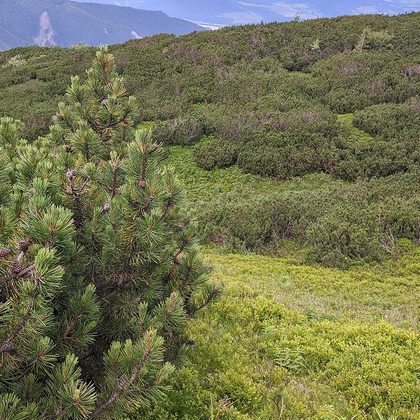
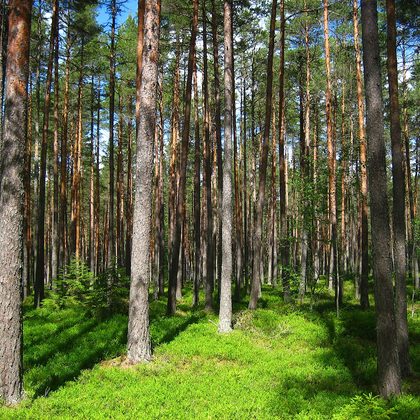
Mountains with steep slopes, rock and open ground; at a large scale topography explains the distribution better than climate, which ranges from the cold, wet Alps to the warm, dry mountains of the Middle East. The species is not confined to high elevations and also occurs low down in Croatia and Italy. In the Pyrenees it forages in open terrain above the treeline, between 1500 and 2500 m, over alpine and subalpine grassland and in Black Pine forest, preferably on limestone; in the Swiss Alps it avoids grassland and selects structurally rich vegetation; in Croatia it has been linked with deciduous woodland, and in the Italian Alps it avoids woodland. These conflicting results may reflect regional differences or differences in method.
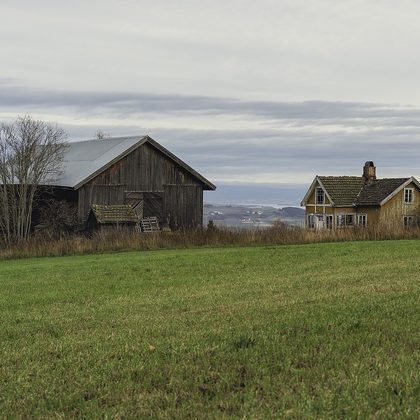
Where the animal is most at home, classified with EUNIS — the European standard for habitats.


Distribution
The Pyrenees (France, Spain), the Alps (Austria, France, Italy, Liechtenstein, Slovenia, Switzerland), the Dinaric Alps (Albania, Bosnia and Herzegovina, Croatia, North Macedonia, Montenegro, Serbia), the Pindus in Greece, the mountains of Turkey, the Greater and Lesser Caucasus, the Anti-Lebanon in Syria and the Alborz and Zagros in Iran; also Corsica and Crete. There are two mitochondrial lineages that diverged more than a million years ago (3.4 per cent difference): a western one in the Pyrenees and Alps and an eastern one from the Dinaric Alps onwards. They meet between the Eastern Alps and Croatia. Whether they should be treated as subspecies (P. m. alpinus and P. m. macrobullaris) has not been established without nuclear genetic data.
- Native
- dark = core range, pale = thinly spread
Way of life
About 98 per cent of the diet consists of moths, mainly noctuids of open country; 96 per cent of prey species identified by DNA can hear bat calls. A few flies and beetles are also taken. The prey species come from subalpine to alpine elevations, which suggests that the bats commute across large differences in altitude at night: in the Pyrenees movements of up to 7 km and more than 1000 m in altitude have been recorded in a single night, with foraging usually within 4 km. The species probably hunts both in flight and by gleaning. Females form maternity colonies of 5 to 25, sometimes up to 50; pregnant and lactating females are highly roost-faithful, males are not. There are no confirmed data on hibernation: the only indications are two observations of hibernating long-eared bats in ice caves above 2000 m in the Pyrenees and the Slovenian Alps, made before the species was described. Distribution, diet and call point to competition between the Mountain and the Grey Long-eared Bat: in Switzerland the Grey occupies the lowlands and the Mountain the mountains, and in the Pyrenees they are separated by altitude.
Where and when to look
In the Alps a church loft in a mountain village is where the species has been found most often; in the Pyrenees it is the scree slopes and rock faces above the treeline. A photograph of the chin of a bat in the hand, showing the triangular pad, is the best field evidence; leave the handling to a licence holder. With a bat detector alone the record stays at ‘Plecotus sp.’.
Conservation status
Least Concern (LC) on the global Red List, assessed in 2016. Because the species has only been separated from the other long-eared bats since 2002, its actual status is uncertain. The many captures in high mountains and the many roosts in buildings in the Alps and Dinaric Alps indicate that it is relatively common in mountain areas. In the Alps most known maternity colonies are in church lofts, so the management and renovation of those buildings directly affect the colonies. Whether populations in widely separated mountain ranges are genetically isolated is unknown. The species is listed in Annex IV of the Habitats Directive and is covered by the Bern Convention and the EUROBATS Agreement.
Scientific name
Plecotus macrobullaris | Kuzyakin, 1965
Kuzyakin described the species in 1965 and placed it straight away in the genus where it still stands. Plecotus is Greek, from plekein, 'to plait, twist together', and ous, genitive ōtos, 'ear', after the huge ears joined across the forehead. macrobullaris means 'with large bullae', from Greek makros, 'large', and Latin bulla, 'bubble', after the conspicuously large auditory bullae of the skull. The specimen the first description was based on came from Russia, Ossetia.