All species › Rodents › Voles and hamsters › Norway Lemming
Norway Lemming | Lemmus lemmus
Berglemming | Leming De Tundra
The Norway Lemming is a boldly patterned rodent of the Scandinavian mountains whose numbers fluctuate so strongly that peak years have their own name: lemming years. In such years the species is very numerous on the fells and Snowy Owl, stoat and Long-tailed Skua feed largely on lemmings; a few years later the species may be almost absent from the same area. These cycles largely determine the functioning of the tundra ecosystem.

Tracks
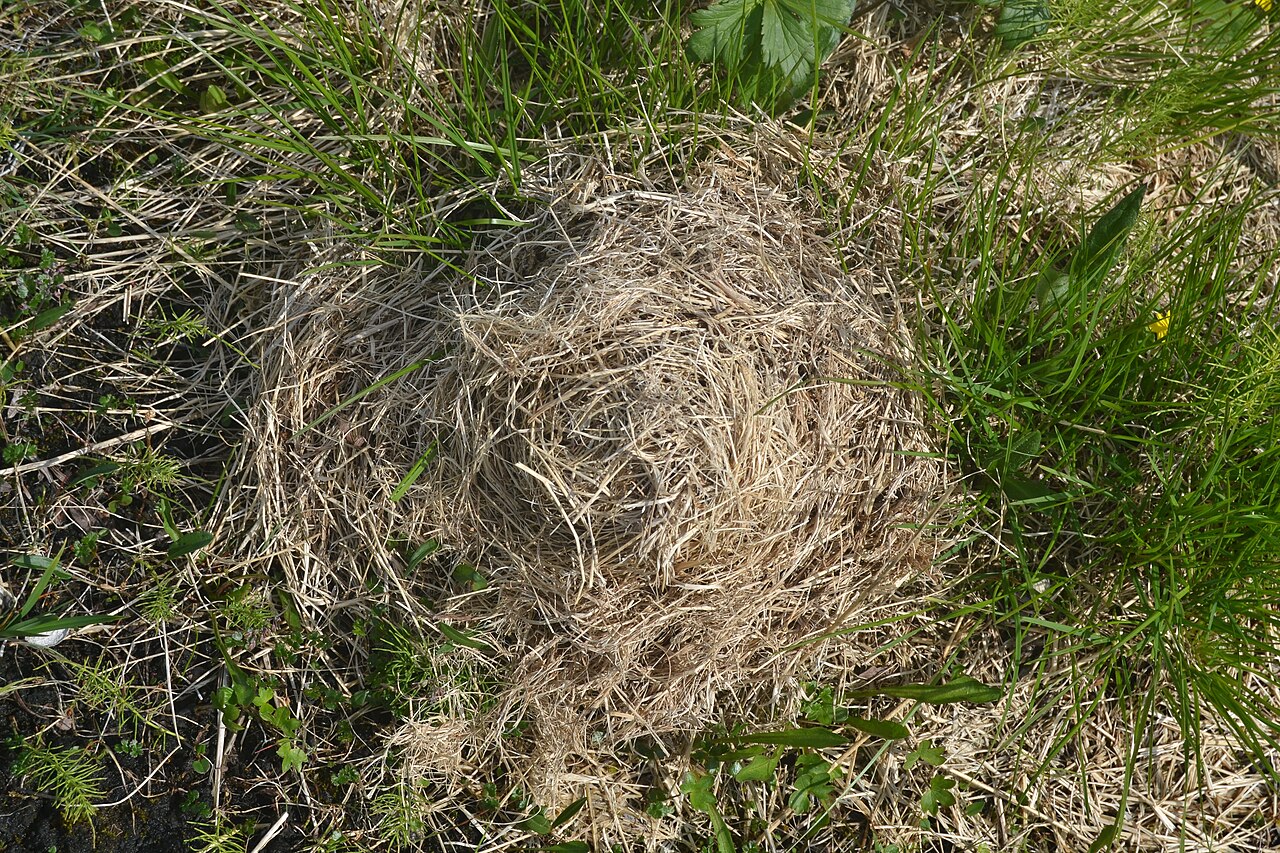
On tundra that has just become snow-free in June, the winter's signs are easier to find than the animal itself. Most conspicuous are the winter nests: loose, woven balls of gnawed grass blades and sedges, twelve to twenty centimetres across, with one or two side entrances. They are built under the snow, on the ground in the space between snowpack and soil, and remain on the moss or tussock after the melt until the wind pulls them apart. Ten nests per hectare in a good year indicate high winter densities. There are also the winter runs: a network of ribbed, grazed channels four to five centimetres wide at the base of the snowpack, which after the melt become visible as pale tracks pressed into the vegetation, often with heaps of droppings at a junction. In summer summer runs run as sharply cropped paths through sedge and moss, with a latrine of droppings every few metres: dark green to black, oval, three to six millimetres long, blunter and greener than a mouse's, in dozens together. Fresh feeding can be recognised by obliquely cut grass stems and stripped twigs of willow and dwarf birch. Breeding birds also give an indication: where Snowy Owl, Rough-legged Buzzard and Long-tailed Skua breed in a given summer and stoats are numerous, it is almost certainly a lemming year.

In its habitat

Head close-up

Identification
A stocky, short-legged rodent 8 to 14 cm long with a tail of barely one and a half centimetres, hidden in the long fur. The pattern is unusually sharp for a European mammal: a jet-black head with a yellowish-white cheek patch running from the muzzle to behind the eye, a black shoulder patch or saddle, and rusty-yellow to ochre back and flanks. The belly is yellowish white. The ears are small and hidden in the fur, the eyes black and small, the feet broad and furred. In autumn the fur is denser and the animal looks rounder. Young animals are duller and greyer but already have the black-and-yellow pattern. A Norway Lemming that feels threatened sits up, raises its fur, gives a shrill call and bites; it does not flee, and this behaviour is also an identification character.
Similar species
The pattern of black, yellow and rust is unique; no other European rodent resembles it. The Wood Lemming overlaps in the coniferous forest of northern Sweden and Finland: it is smaller, uniformly slate-blue to blackish grey with a rusty patch on the back, and entirely lacks the black-and-yellow head. Bank Vole and Grey Red-backed Vole are slimmer, have a distinct tail of a third to half the body length, and are red-brown without black. On a dead animal or in pellet remains, the very short tail combined with the size is sufficient: no other Scandinavian vole reaches a hundred grams with a tail under two centimetres. In the far north-east the range borders that of the Siberian Lemming (Lemmus sibiricus), which is more uniformly red-brown and lacks the black head.
Habitat
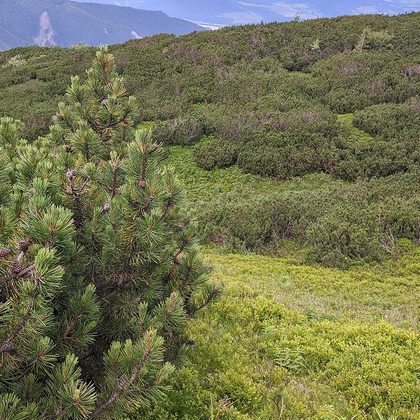
Damp tundra and fell heath above the treeline: sedge flats, mossy hollows, dwarf birch and willow scrub, wet slopes below snowfields and the edges of palsa mires. In winter the snowpack is the habitat: an insulating layer of at least twenty to thirty centimetres under which the animals live and breed on the ground. At high density they move down in autumn into birch woodland and even into coniferous forest and settlements, where they otherwise do not occur. From sea level in Finnmark to above 1,500 m in southern Norway.
Where the animal is most at home, classified with EUNIS — the European standard for habitats.



Distribution
The Scandinavian mountains and Fennoscandia: Norway from the south to Finnmark, the Swedish fells, Finnish Lapland and the Kola Peninsula. The species is endemic to this area and one of the few mammals confined to Fennoscandia. To the south the range reaches Hardangervidda and Dovrefjell, with an isolated area in southern Norway. Elsewhere in Europe, including the British Isles, the Low Countries and southern Europe, the species has not occurred since the last glaciation. Fossil remains are known from deposits of the cold phases of the Pleistocene in central and western Europe, including British cave and river deposits and Dutch river deposits. In lemming years the population spreads far beyond its usual area, into the valleys and to the coast.
- Native
- dark = core range, pale = thinly spread
Way of life
Active spread over day and night, in alternating periods of about three hours feeding and three hours resting, and therefore also seen in the middle of the day on summer tundra. The diet consists almost exclusively of moss, supplemented with sedges, grasses and leaves of dwarf birch and willow; this food is of such low quality that large quantities are required. Breeding continues in winter, under the snow, and this explains the strong fluctuations in numbers: with a favourable snowpack a female produces five to eight young every three weeks, and the young females are themselves sexually mature at about three weeks, sometimes even at two. A population can thus increase a hundredfold in a single winter. Peaks occur on average every three to five years. In a peak year a mass dispersal follows in late summer: animals leave the overcrowded area, travel for days in one direction, swim across lakes and rivers and drown in tens of thousands. This is not suicide, as an old myth holds, but the result of lack of space. The population then crashes and it takes years until the next peak. Predators follow these cycles: stoat, Arctic Fox, Snowy Owl, Rough-legged Buzzard and Long-tailed Skua produce large litters and clutches in a lemming year and skip breeding the following year. The Norway Lemming is regarded as the clearest example of a prey species driving an entire ecosystem. In the wild an animal seldom lives beyond one year.
Where and when to look
Go to the fells of northern Sweden, northern Norway or Finnish Lapland in July or August and find out in advance whether it is a lemming year; national parks and birdwatchers have this information. In a lemming year the animals are easy to find: they cross paths and sit in the sedge along streams and in the dwarf birch. Walk slowly and look for small, moving brown-and-black animals. They allow a close approach and are more likely to attack than flee, so an ordinary lens is sufficient; keep enough distance not to disturb the animal. If it is not a lemming year, search in early June for winter nests where the snow has just gone, in hollows and along streams. A Snowy Owl on a boulder is a strong indication that lemmings are present.
Conservation status
Least Concern (LC, 2016), and numerous across the range. An important risk is change in the snowpack. Breeding under snow requires a thick, dry, airy layer; with thaw and rain in midwinter the base of the snowpack freezes to ice and the space in which the animals live disappears. Since the 1990s the peaks have become weaker and less regular in large parts of Fennoscandia, and researchers identify warmer, wetter winters as the cause. The absence of peaks also affects the species that depend on lemmings: Snowy Owl, Long-tailed Skua and Arctic Fox have had a poor decade in Fennoscandia, and in the Arctic Fox this is attributed directly to the absence of lemming years. The species itself is not threatened; the regular cycles to which the tundra ecosystem is attuned are, however, declining.
Scientific name
Lemmus lemmus | (Linnaeus, 1758)
Linnaeus described the species in 1758 as Mus Lemmus; because it was later moved to another genus, the author and year stand in brackets. Lemmus is formed on Norwegian lemende, 'lemming', which goes back to Old Norse lómundr; its further origin is unknown. The specific name repeats the genus name. The specimen the first description was based on came from Sweden, Lapland.