All species › Even-toed ungulates › Deer › Red deer
Red deer | Cervus elaphus
Edelhert | Ciervo
The red deer (Cervus elaphus) is the largest deer in Europe after the elk and occurs from Ireland and Portugal to the Caucasus and Iran. In North Africa lives the subspecies barbarus, the Barbary stag, the only deer native to Africa. The species is easiest to observe in September and October, when the stags roar, especially at dusk.

Tracks
At about 9 cm long and 7 cm wide, the slot is the largest deer slot in western Europe apart from that of the elk. The droppings are larger than those of other deer, black and cylindrical, and lie in heaps. Characteristic signs are wallows, in which stags roll especially during the rut, with mud rubbed off on tree trunks around them; bark stripping, where in winter and spring bark is pulled from trunks in broad strips with the lower incisors; fraying stocks on young trees; and tufts of hair on barbed wire. During the rut the roaring of the stags carries for kilometres.
Identification
A large deer of 160 to 250 cm head-body length and 95 to 130 cm shoulder height. Weight varies greatly between regions: according to the usual figures stags weigh 160 to 240 kg and hinds 120 to 170 kg; stags of up to 500 kg are known in the Carpathians, whereas the Corsican red deer weighs 80 to 100 kg and Scottish animals on open moorland also remain clearly smaller. The summer coat is reddish brown, the winter coat greyish brown and thicker; adults are unspotted, calves spotted for the first months. The rump patch is cream to pale yellow, without a black border, and the tail of 12 to 19 cm is buff. In autumn the stag has a dark neck mane. Only the stag carries branched antlers, on average 71 cm long and 1 kg in weight, in large animals up to 115 cm and 5 kg; they grow by up to 2.5 cm a day in summer.
Similar species
The fallow deer is smaller, usually spotted, with a white, black-bordered rump patch, a longer tail with a black stripe and palmate antlers. The sika deer is smaller, spotted in summer, with a white, black-bordered rump patch and antlers with fewer tines; in the British Isles it hybridises with red deer, and hybrids often cannot be recognised in the field. The roe deer is much smaller. The elk is larger, dark brown to blackish, with long pale legs, an overhanging muzzle and palmate antlers.
Habitat
Broadleaved, mixed and coniferous woodland with clearings, woodland edges and grassland, but also open landscape: heather moorland and bog in Scotland, alpine grassland above the treeline in summer, and dehesa and Mediterranean scrub on the Iberian Peninsula. In western Europe red deer have largely been pushed back into forest areas; where it is quiet they also graze in the open.
Where the animal is most at home, classified with EUNIS — the European standard for habitats.


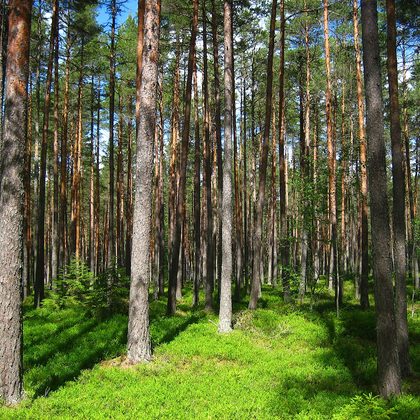


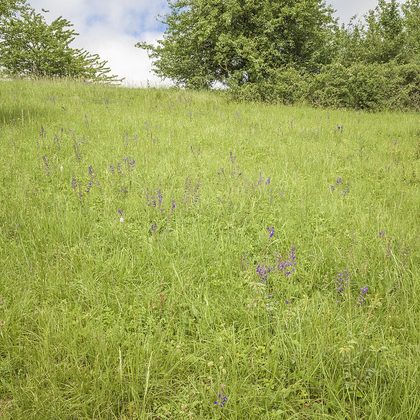
Distribution
Most of Europe, the Caucasus, Anatolia and Iran, with regional forms: the Iberian red deer (hispanicus) on the Iberian Peninsula, the Corsican red deer (corsicanus) on Corsica and Sardinia, the Norwegian red deer (atlanticus) and the Barbary stag (barbarus) in Morocco, Algeria and Tunisia. In many countries of western and central Europe the distribution is fragmented; in Britain the largest population lives in the Scottish Highlands, and numbers are increasing in Portugal and the United Kingdom. Genetic research has shown that the wapiti of North America and East Asia is a separate species, Cervus canadensis.
- Native
- dark = core range, pale = thinly spread
Way of life
Red deer are active mainly at dusk and at night; in quiet areas and on open moorland also by day. Food consists of grasses, herbs, heather, leaves, twigs and bark. Hinds live in groups around a leading hind with her offspring and adult daughters with their calves; outside the rut stags form loose, changing groups. In the rut, in September and October, stags defend a harem of up to twenty hinds and lose up to a fifth of their body weight. After a gestation of 240 to 262 days a single calf, rarely two, is born from mid-May to early June; it is weaned after about eight months.
Where and when to look
The rut is the best time: listen on clear evenings in September and the first half of October at sunset at the edge of an open area in the forest. Well-known areas are the Scottish Highlands and the Isle of Rum, Richmond Park in London, the Veluwe, the Oostvaardersplassen, Jægersborg Dyrehave near Copenhagen, and in Spain Monfragüe and Cabañeros, where the berrea can be followed on a large scale. Stay on the paths and keep well away from roaring stags.
Conservation status
Least Concern (LC, 2018). In large parts of Europe red deer are increasing, and high densities lead to bark stripping and browsing damage in forests and to road collisions. In the British Isles hybridisation with sika deer is the main threat to the species as such: in the southern Lake District and the Wicklow Mountains in Ireland the populations consist almost entirely of hybrids, and pure red deer are expected to survive there only on Scottish islands. The Corsican red deer is classed as Near Threatened. The return of the wolf is changing the behaviour and distribution of red deer in central Europe.
Scientific name
Cervus elaphus | Linnaeus, 1758
Linnaeus described the species in 1758 and placed it straight away in the genus where it still stands. Cervus is the Latin word for 'deer, stag'. elaphus is Greek elaphos, 'deer'; the name thus says deer twice, first in Latin and then in Greek. The specimen the first description was based on came from Sweden.