All species › Carnivores › True seals › Saimaa ringed seal
Saimaa ringed seal | Pusa saimensis
Saimaazeehond | Foca de Saimaa
The Saimaa Seal is a freshwater seal that lives only in Lake Saimaa in south-east Finland. When the land rose at the end of the last ice age and the lake was cut off from the Baltic, a group of seals remained in fresh water; the present population descends from them. It numbers a few hundred animals.

Tracks
In winter the female, as in the Ringed Seal, makes a snow lair. In February she digs a hollow chamber in a snowdrift against a rocky shore or an island bank, above a hole in the lake ice, and gives birth there. From outside the lair is a low bulge; a collapsed lair is a bowl with an open hole in its floor. In mild winters without lasting snow there is no lair and the pup lies unsheltered on the ice. For this reason volunteers from WWF Finland and the University of Eastern Finland have for some years been piling up artificial snowdrifts along the shores with snow shovels, in which the females then build their lairs. In summer the species hauls out on the smooth granite boulders of the islets and leaves wet drag marks and a worn patch there. Fishermen find damaged nets and drowned animals.
Identification
A small, stocky seal with a small round head and a very short muzzle, averaging 130 to 145 cm long and 50 to 90 kg. The coat is dark grey, brownish or nearly black, with pale rings and circles on back and flanks that often stand closer together and merge more than in the Arctic Ringed Seal, so that the pattern forms a pale marbling rather than a set of separate rings. The pattern differs between individuals and stays the same for life; Finnish researchers use it to recognise individuals. The fore flippers carry heavy claws. The pup is entirely white at birth.
Similar species
No other seal occurs in Lake Saimaa; every seal in the lake is a Saimaa Seal. The species does not occur outside the lake. From the Baltic Ringed Seal it cannot be distinguished in the field. The Mammal Diversity Database has ranked it as a species since 2025 on genetic evidence showing that its closest relatives are not the Baltic and Ladoga seals but the ringed seals of the North American Arctic. The Ladoga Seal in the neighbouring Russian Lake Ladoga is the third freshwater seal of the region and numbers a few thousand animals; it too cannot be distinguished by appearance.
Habitat
The Saimaa system in south-east Finland: about four thousand square kilometres of water with thousands of islands, narrow straits and deep basins. The species prefers steep rocky shores and small bare islets with little disturbance, and parts of the lake where ice lasts long in winter. The diet consists mainly of small fish: small perch, roach, smelt and ruffe.
Where the animal is most at home, classified with EUNIS — the European standard for habitats.
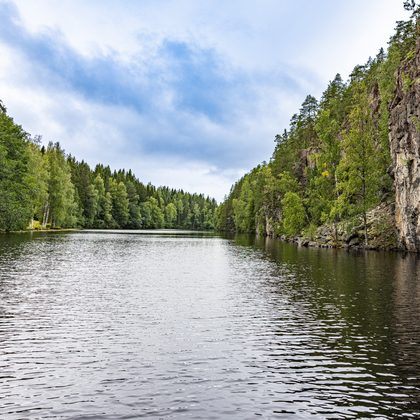


Distribution
Lake Saimaa in south-east Finland only. Within the lake the species is unevenly distributed: the core lies in Pihlajavesi, Haukivesi and Puruvesi, with smaller groups in Kolovesi and the southern basins. No animal is known to have left the lake and reached the Gulf of Finland by way of the Saimaa Canal.
Way of life
Largely solitary and diurnal, and best seen when the animals haul out on rocks in spring and summer. Dives are short and shallow (nowhere is the lake much more than eighty metres deep); hunting takes place throughout the day. The female gives birth in late February or early March to one pup in the snow lair; the pup is born in a white woolly coat and suckled for eight to ten weeks. Females breed on average every second year, which slows population recovery. In 2025, 114 pups were born. Life span is twenty to twenty-five years.
Where and when to look
The best period is May to July, by kayak or small boat along the rocky shores of Linnansaari or Kolovesi, or from a viewpoint on land: on sunny mornings the animals lie on the boulders and can be found at hundreds of metres with a telescope. Never approach a hauled-out animal; it enters the water at once and loses the warmth it needs for the moult. In winter the breeding areas are closed and it is forbidden to go onto the ice near the known lair sites.
Conservation status
Endangered (2016); the IUCN still assesses the form as a subspecies of the Ringed Seal, Pusa hispida saimensis. The population fell to about a hundred and fifteen animals in the 1980s and has grown slowly since: the estimate for January 2025 is 530 animals, with 114 pups born. The main threats are fixed nets, in which mainly young animals drown (since 2016 a net ban has therefore applied from April to the end of June over large parts of the lake, supplemented by voluntary agreements with thousands of shore owners), and lack of snow: in mild winters without snowdrifts the female cannot build a lair and a large share of the pups die. Further factors are the small population size, the low genetic variation and shoreline building that reduces quiet at the lair sites.
Scientific name
Pusa saimensis | (Nordqvist, 1899)
Nordqvist described the species in 1899 as Phoca foetida var. saimensis; because it was later moved to another genus, the author and year stand in brackets. Pusa was given by Scopoli in 1771 without a word of explanation; the word cannot be placed and its origin is unknown. saimensis means 'of Saimaa', the Finnish lake system in which the species is landlocked. The specimen the first description was based on came from Finland, Lake Saimaa.