All species › Even-toed ungulates › Bovids › Scimitar-horned oryx
Scimitar-horned oryx | Oryx dammah
Algazel | Órix de cuernos de cimitarra
The Scimitar-horned Oryx is a large antelope of the Sahel and the Saharan margins that was classified as Extinct in the Wild by the IUCN in 2000. Into the 1980s the species moved through the Sahel in herds of hundreds. The animals in Tunisia and Morocco are reintroduced and live in fenced reserves; since 2016 there has again been a free-living population in Chad.
Tracks
In the reserves the Scimitar-horned Oryx is often detected by its signs before the animal itself, because the herds move a great deal and keep their distance. The print is that of a large antelope: a cloven hoof mark eight to ten centimetres long, broader and rounder than a gazelle's, the two halves splayed wide at speed, with a clear broad tip. On loose sand the hoof registers shallow and broad, an adaptation that keeps the animal from sinking into dune sand; on hard reg only the rim of the hoof wall remains. The trail of a herd is a bundle of parallel paths fanning out from a water point or a shade tree, which after years of use form worn runs. The droppings lie in heaps of tens to hundreds of pellets about a centimetre across, oblong with a point at one end, glossy black when fresh and soon fading to dull grey; they lie at fixed latrines. In late summer there are lying-up scrapes: shallow bowls dug out with the forehooves in the shade of an acacia or below a sand bank, where the animals spend the hottest hours, and on tree trunks the rubbing patches and horn scores of bulls.
In its habitat
The young

Identification
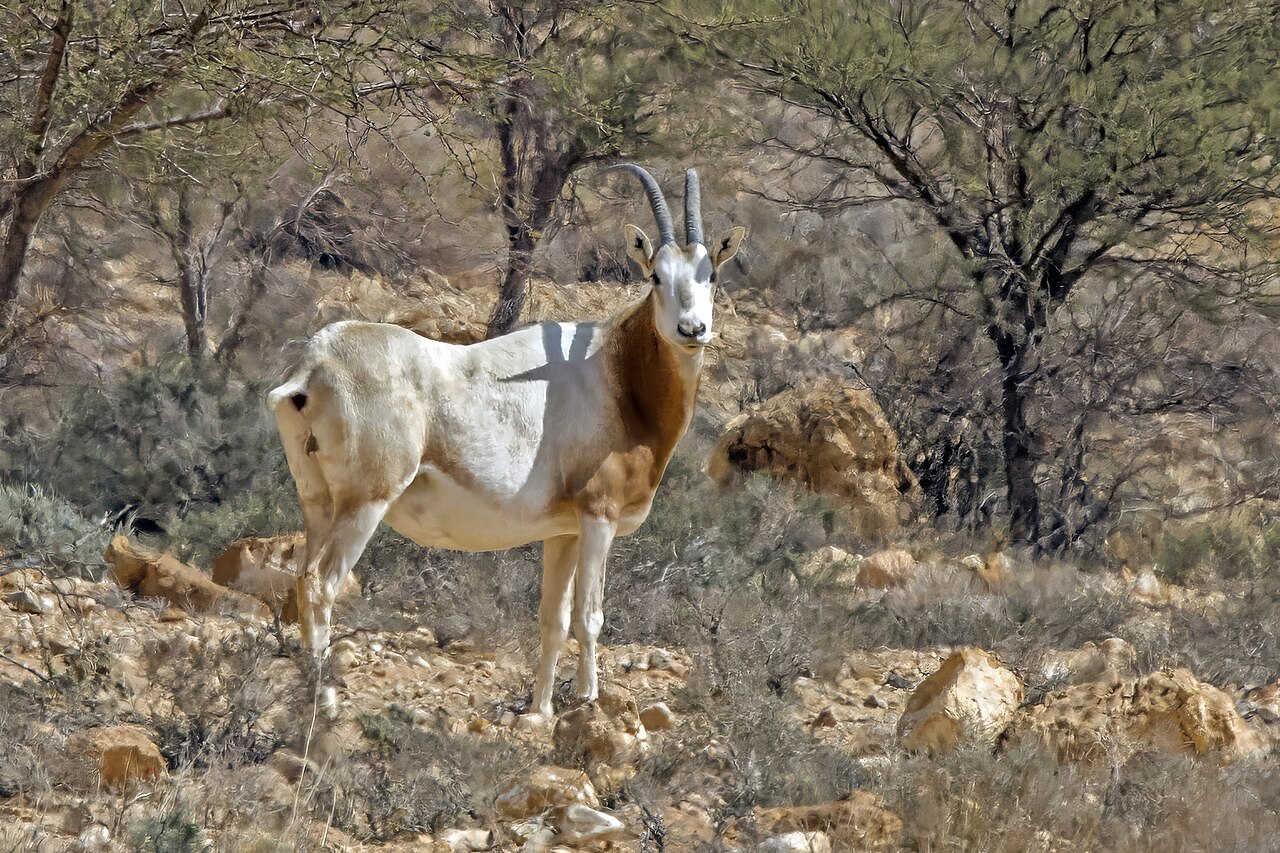
A large, long-legged antelope with an almost white body and a sharply contrasting chestnut neck and chest. The head is white with chestnut stripes running through the eye to the cheek and a broad russet band down the nose; together these form a mask. Both sexes carry long, slender, backward-curving horns in an even arc of one to over one and a quarter metres, ringed across the lower part. The horns are brittle and often broken in old animals; animals with one horn or with stumps occur regularly. The tail is long with a dark brown tuft at the tip. The hooves are broad and splayed, adapted to loose sand. Calves are plain sandy-buff without markings, with short straight horns.
Similar species
In North Africa there is no other white antelope with long, curved horns; confusion is only possible with species reintroduced into the same fenced reserves. The Addax (Addax nasomaculatus), which lives in the same parks in Tunisia, is stockier and shorter in the leg, has a brown shoulder mane and spirally twisted horns instead of a smooth arc, and a white patch on the nose rather than a russet band. The Arabian Oryx is smaller with straight, barely curved horns and does not occur in North Africa. The Dorcas and Rhim Gazelles of the same reserves are much smaller and sand-coloured. A pale feral cow or a light dromedary can cause confusion at a distance, but not once the horns are visible.
Habitat
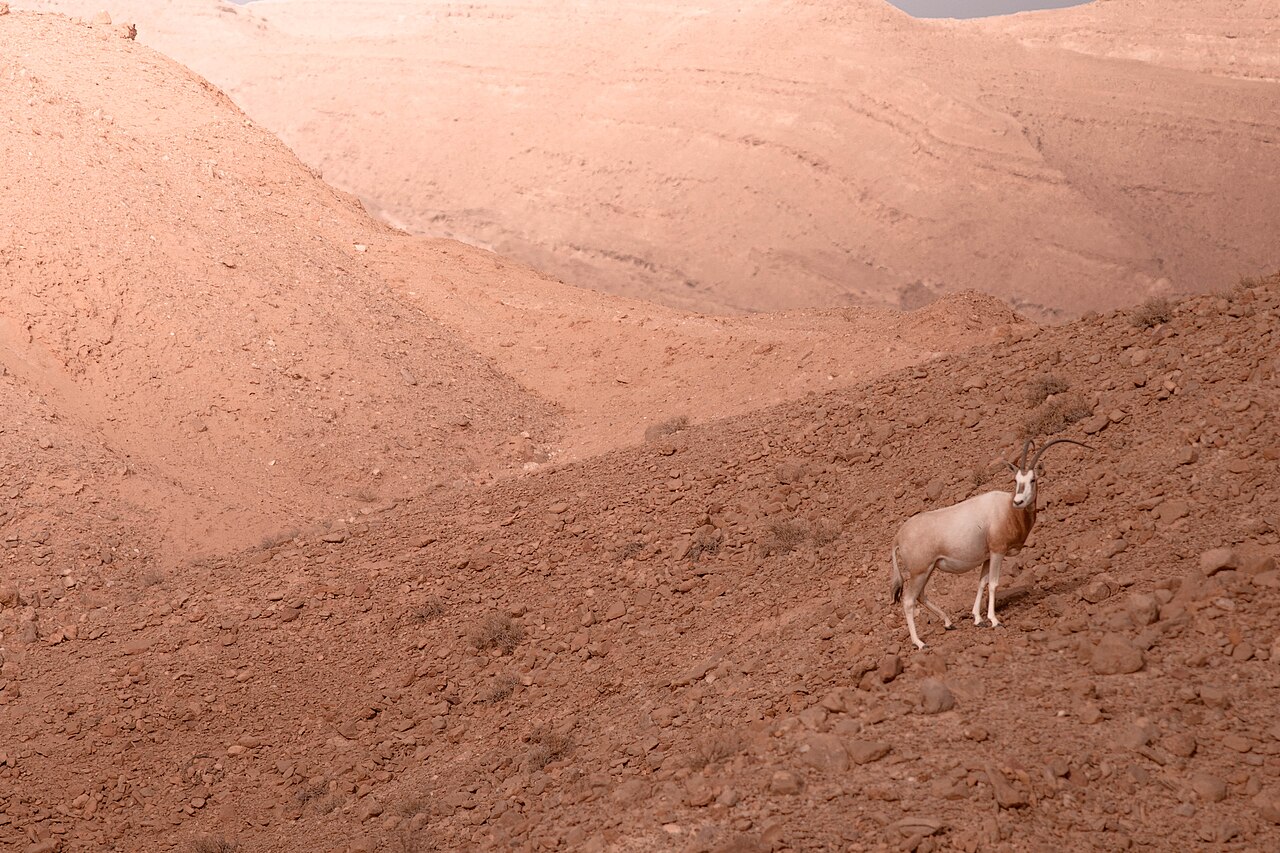
Open semi-desert grass plains and steppe on the edge of the Sahara: arid grasslands with sparse steppe grass, salt steppe, gravel plains and the margins of dune fields, with scattered acacias providing shade. The species is adapted to extreme drought and heat: its body temperature rises during the day, reducing water loss, and it can go months without drinking by taking in moisture from grass, melons and tubers. In Tunisia the Scimitar-horned Oryx lives in the fenced national parks on the Saharan margin, in a landscape of steppe grass, jujube and degraded acacia savanna.
Where the animal is most at home, classified with EUNIS — the European standard for habitats.


Distribution
Originally the whole Sahel and Saharan belt from Morocco and Senegal to the Nile, in herds that moved north and south with the rains. These original populations no longer exist: the last reliable records of free-living Scimitar-horned Oryx come from Chad and Niger in the 1980s, and in 2000 the species was classified as Extinct in the Wild. In North Africa all current animals are reintroduced and fenced: in Tunisia since 1985, with herds in the national parks of Bou Hedma, Sidi Toui, Dghoumes and Oued Dekouk totalling about three hundred animals, and in addition a herd in Morocco. In Chad a reintroduction project has been running since 2016 in the Ouadi Rimé–Ouadi Achim Faunal Reserve, where 285 zoo-bred animals have been released; the free-living population there exceeded six hundred in 2023.
- Native
- dark = core range, pale = thinly spread
Way of life
Active in the early morning and late afternoon; the hottest hours are spent lying in shade. Strongly social: originally in mixed herds of up to seventy, with rainy-season groups of hundreds to thousands that moved hundreds of kilometres north into the Sahara and returned in the dry season. The diet consists of steppe grasses, herbs, acacia pods and the fruits of wild melons. Gestation is eight and a half months; usually one calf is born, which follows the herd after a few days. Lifespan is fifteen to twenty years.
Where and when to look
In North Africa the Scimitar-horned Oryx can only be seen in the Tunisian national parks, with a guide and a four-wheel drive. Bou Hedma at the foot of the Djebel Bou Hedma and Dghoumes on the edge of the Chott el Djerid are the best sites, early in the morning when the herds graze the open plains. The animals there live within a fence. The reserve in Chad with free-living animals is not set up for visitors and the region is unsafe. In Europe the species can be seen in zoos; all reintroduced animals descend from that population.
Conservation status
Endangered (EN, 2023), an improvement from Extinct in the Wild. The Scimitar-horned Oryx had been listed as Extinct in the Wild since 2000, as a result of hunting for meat and horns, displacement by livestock and prolonged drought. The remaining animals lived in zoos and on private ranches and descended from a small group captured in the 1960s and 1970s. From that captive stock, herds were built up in Tunisian reserves from 1985, and from 2016 285 animals were released into the wild in Chad. On 11 December 2023 the IUCN downlisted the species from Extinct in the Wild to Endangered. The animals in Tunisia and Morocco live in fenced reserves and not free; they receive supplementary feeding and are managed, and their genetic variation goes back to a small number of founders.
Scientific name
Oryx dammah | (Cretzschmar, 1827)
Cretzschmar described the species in 1827 as Antilope dammah; because it was later moved to another genus, the author and year stand in brackets. Oryx is Greek oryx, 'pickaxe', from oryssein, 'to dig'; the Greeks already used the word of a North African antelope, after its pointed horns. dammah belongs with Latin damma, 'fallow deer, antelope-like game', but has an ending that suggests a local name; Cretzschmar does not explain the form. The specimen the first description was based on came from Sudan.