All species › Even-toed ungulates › Oceanic dolphins › Short-beaked common dolphin
Short-beaked common dolphin | Delphinus delphis
Gewone dolfijn | Delfín común
The Common Dolphin is a slender dolphin with a long beak and a yellow-and-grey hourglass pattern on the flank. In Europe it is the most numerous dolphin of Atlantic waters between Iberia and the Faroes, with its centre in the Bay of Biscay, the western Channel, the Celtic Sea and around Ireland. Since the 1990s it has also occurred in the northern North Sea. In the Mediterranean the species has declined strongly and is now common mainly in the west, around the Alboran Sea.
Tracks
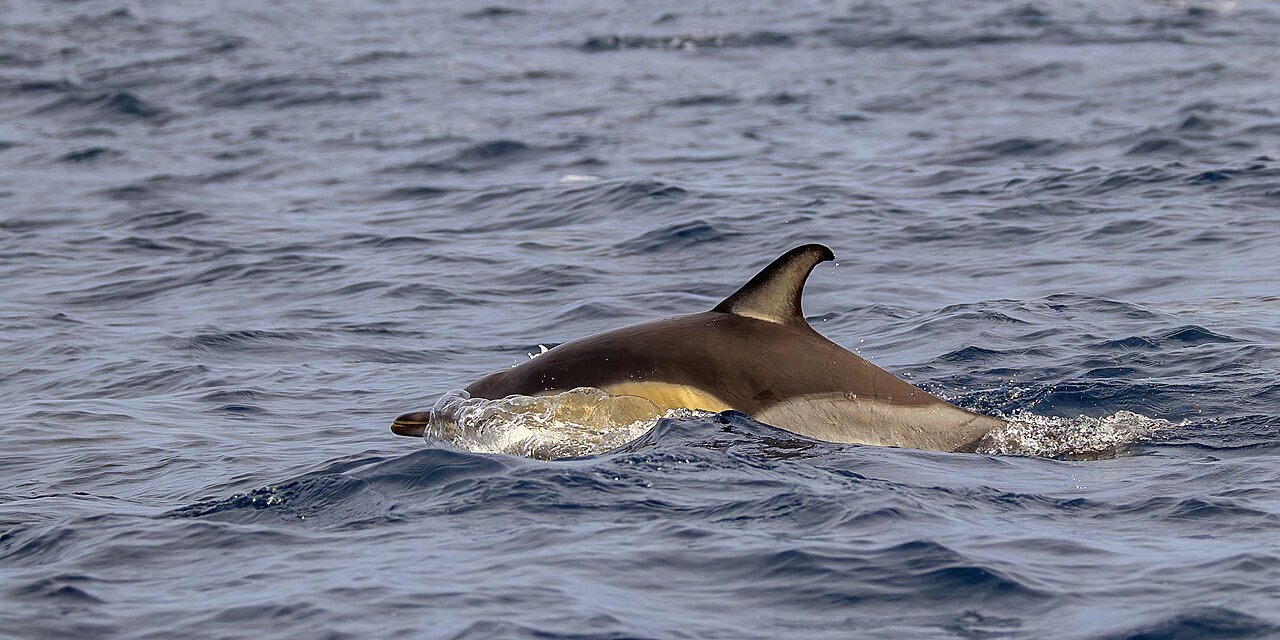
A group of Common Dolphins can often be seen from afar by the splashing water: the animals swim fast, surface in low leaps and throw up a white fringe of foam. The blow is not visible. The species leaps a great deal, including somersaults and side leaps, slaps the tail and readily rides the bow wave of ships, sometimes for minutes. At close range you can hear the whistles and squeaks the animals also make above water. On the continental shelf groups usually number six to fifteen animals, sometimes over a hundred; further offshore groups of several hundred are known. Where they hunt schooling fish, Gannets and gulls gather above the group; diving Gannets are often the first sign.
Identification
Slender and streamlined, with a long, narrow beak separated from the melon by a crease. The key feature is the hourglass pattern on the flank: below the dorsal fin two panels cross in a V, the front one yellowish to ochre, the rear one pale grey; the back is dark grey to black and the belly white. The dorsal fin is tall, pointed and slightly curved, often with a pale central patch. Adults are 1.9 to 2.5 m long; males are about six per cent larger than females. At a distance it is mainly the pale flank that catches the eye, flashing with every leap.
Similar species
The Striped Dolphin is the same size and also long-beaked, but lacks the yellow flank: a dark stripe runs from eye to anus, and a pale blaze sweeps up from the flank towards the fin. In the western Mediterranean and the Bay of Biscay the two species live side by side and cannot always be separated at a distance in fast, leaping groups. The Bottlenose Dolphin is larger, plain grey and has a short, thick beak. The White-beaked Dolphin of northern waters is heavier, with a short pale beak and pale panels behind the fin. The Harbour Porpoise is small, beakless, with a low triangular fin, and rarely leaps. The yellow front panel is the deciding feature; if you see it, you have a Common Dolphin.
Habitat
Open sea over the continental shelf and its slope, in temperate to warm water; the species also enters coastal waters and deep bays, but rarely shallow estuaries. The diet consists of schooling fish such as hake, horse mackerel, mackerel, sardine and anchovy, and of squid; the animals hunt in groups and herd a shoal together.
Where the animal is most at home, classified with EUNIS — the European standard for habitats.


Distribution
In Europe from the Iberian Peninsula to the Faroes. The centre lies in the Bay of Biscay, the western approaches to the Channel, the Celtic Sea, the Irish Sea (especially the Celtic Deep), west of Ireland and around the Hebrides. The summer survey of 2016 estimated about 480,000 Common Dolphins in the eastern North Atlantic. Since the 1990s the species has also occurred in the northern North Sea and has occasionally been seen as far as the Baltic; in the southern North Sea it is rare. In the Mediterranean it is common mainly in the Alboran Sea and the Strait of Gibraltar, and has declined strongly elsewhere. The Black Sea holds a separate subspecies, D. d. ponticus.
- Native
- dark = core range, pale = thinly spread
Way of life
Active by day and night; the groups travel fast and often hunt in the evening and at night on fish and squid that then rise towards the surface. Mating and births take place mainly between May and September; gestation is ten to eleven months, and a female calves once every two to four years or longer. The newborn is about a metre long. Females mature at eight to ten years, males at eleven to twelve. The species can live to thirty.
Where and when to look
The ferries from Plymouth and Portsmouth to Santander and Bilbao cross the Bay of Biscay and pass over the continental slope; from the upper deck Common Dolphins can be seen there for most of the year, often in groups that come to the ship to ride the bow wave. From land the headlands of Cornwall, western Ireland and Galicia are good in calm seas in summer and autumn. In the Strait of Gibraltar boats leave from Tarifa and Gibraltar. Watch for diving Gannets: where many of them plunge into the water, a group of dolphins is often hunting below.
Conservation status
Least Concern (LC, 2021). The Mediterranean population is listed separately as an Endangered (EN) subpopulation. The largest threat in Atlantic waters is fisheries bycatch: in spring 2019 more than a thousand dead Common Dolphins washed up on the French Biscay coast, and in winter 2024 part of the French fishery in the Bay of Biscay was closed for a month to reduce bycatch. Mercury and other pollutants and underwater noise from seismic surveys and sonar also play a part. The species is protected under the Habitats Directive and is covered by the ASCOBANS and ACCOBAMS agreements.
Scientific name
Delphinus delphis | Linnaeus, 1758
Linnaeus described the species in 1758 and placed it straight away in the genus where it still stands. Delphinus is the Latin word for dolphin, borrowed from Greek delphis. delphis is the Greek word for dolphin: the specific name repeats the genus name in Greek.