All species › Even-toed ungulates › Rorquals › Humpback whale
Humpback whale | Megaptera novaeangliae
Bultrug | Ballena jorobada
The Humpback Whale is a large baleen whale with very long, largely white flippers, which occurs in all oceans and migrates between high-latitude feeding grounds and tropical breeding grounds. The humpbacks of the guide area feed around Iceland, in Norway and the Barents Sea, and in smaller numbers around the British Isles; they breed in the West Indies and off Cape Verde. Since the end of commercial whaling the species has increased in the North Atlantic.
Tracks
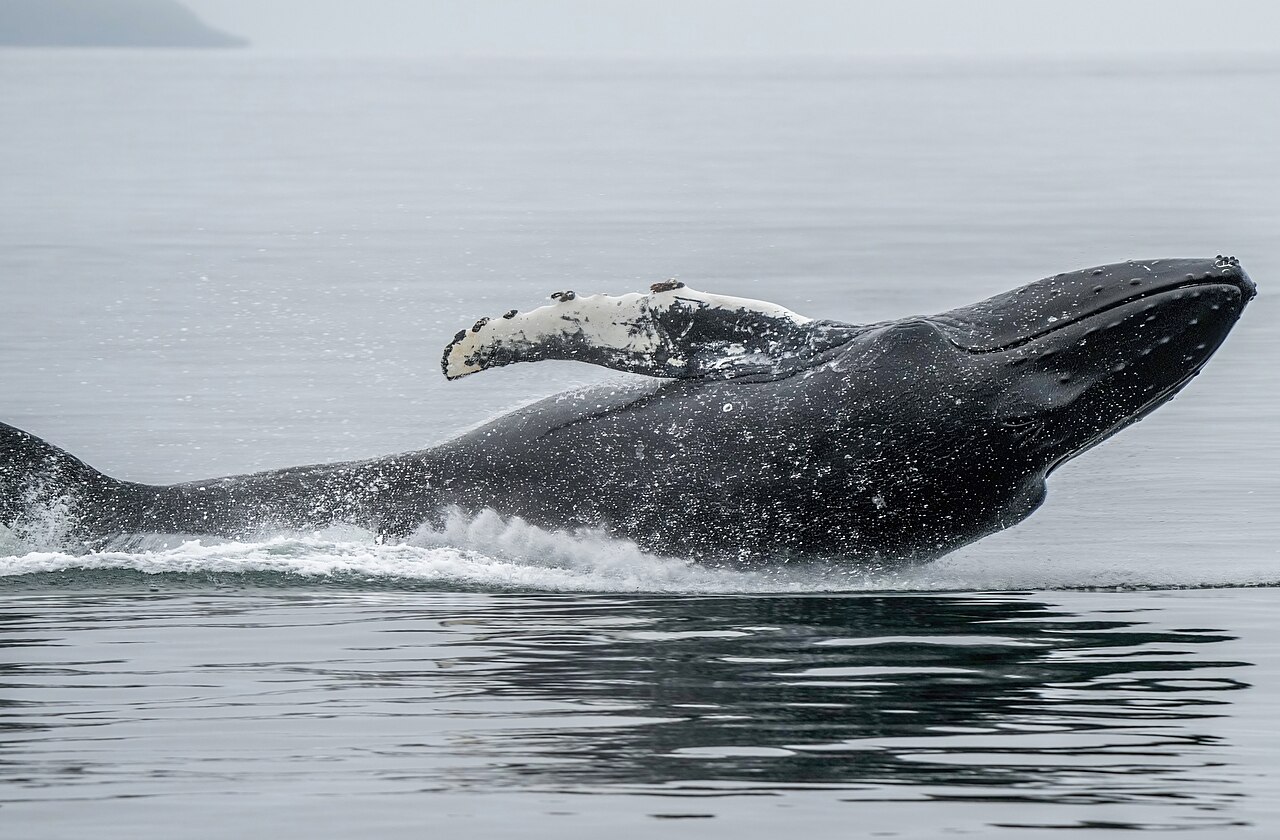
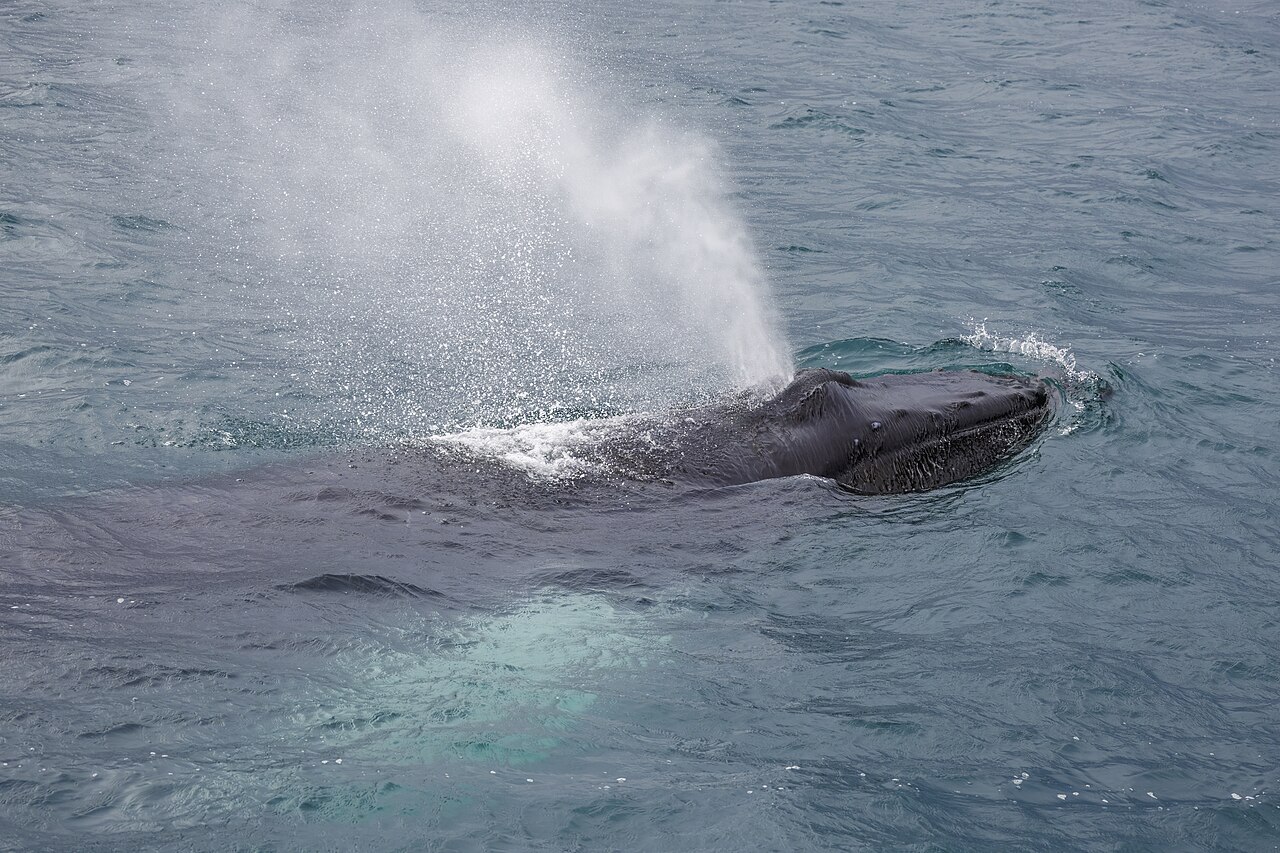
The blow is low and bushy, up to about three metres, sometimes taller and columnar and sometimes V-shaped. Before a deep dive the humpback arches its back strongly, so that hump and fin stand high, and raises its flukes vertically out of the water ('fluking'), underside towards the observer. Of the rorquals of the guide area only the Blue Whale does the same. Humpbacks are very active at the surface: they leap clear of the water ('breaching'), slap the long flippers or the tail on the water and raise the head. They live alone or in small, changing groups, but at food concentrations twenty or more gather. When feeding they sometimes blow a ring of bubbles round a school of fish and then surface open-mouthed in the middle of the ring.
Head close-up
Identification
A stocky, black to dark grey whale, up to about seventeen metres long; females are one to one and a half metres longer than males. The flippers are nearly one third of the body length and largely white on the underside and often on the upper side too, with knobs along the leading edge. The head and lower jaw carry rows of round knobs. The dorsal fin is very variable, from a small triangular knob to a distinctly curved fin, and sits on a hump about two thirds of the way along the back. The flukes are very broad, deeply notched, with a wavy, scalloped trailing edge; the underside has a black-and-white pattern that differs in every animal and by which researchers recognise individuals.
Similar species
The Humpback Whale is the only large baleen whale in the guide area with long white flippers. The Fin Whale and the Minke Whale have a long, streamlined back with a distinct fin and do not show the flukes when diving. The Sperm Whale also raises its flukes before a deep dive, but they are dark underneath, triangular and with a straight trailing edge, and the Sperm Whale's blow is directed forwards and to the left. At long range the low, bushy blow of a humpback can resemble that of a Sperm Whale; the direction of the blow and the hump with its fin then decide.
Habitat
Food-rich coastal waters, fjords and bays and the shallower parts of the continental shelf. The humpbacks of the guide area eat krill and small schooling fish, including herring, sprat, capelin, sandeel and mackerel. In northern Norway they follow the herring that overwinters in the fjords; in summer they feed around Iceland and in the Barents Sea.
Where the animal is most at home, classified with EUNIS — the European standard for habitats.


Distribution
In the guide area in summer around Iceland and in the Barents Sea to Svalbard and Bear Island, and in winter in the fjords of northern Norway, where they follow the overwintering herring: between 2012 and 2017 mainly in the fjords outside Tromsø, then around Skjervøy and Kvænangen fjord. Where the herring overwinters varies from year to year, and the whales shift with it. Around the British Isles three areas are known: from the Northern Isles (Shetland and Orkney) south along the east coast to eastern England, from the northern Irish Sea to western Scotland, and the Celtic Sea between southern Ireland, south-west Wales and south-west England. In the southern North Sea, the Wadden Sea and the Channel single animals are an irregular occurrence, and in the Mediterranean the species is seen now and then. The breeding grounds lie outside the guide area, in the West Indies and off Cape Verde.
- Native
- dark = core range, pale = thinly spread
Way of life
Active by day and night. Humpbacks migrate each year between high-latitude feeding grounds and warm-water breeding grounds, where they calve in winter; gestation is eleven to eleven and a half months and a female usually calves once every two to three years, occasionally annually. A newborn calf is four to 4.6 metres long and weighs about 680 kilos. On the breeding grounds males sing long, repeated songs. Groups are small and short-lived; only the bond between mother and calf lasts through the first year.
Where and when to look
In northern Norway boats go out between November and January to the fjords where the herring overwinters, in recent years mainly from Tromsø and Skjervøy; where the animals are depends on the herring and differs from season to season. Humpbacks can then sometimes also be seen from the shore. In Iceland boats leave in summer from Húsavík, from Akureyri on Eyjafjörður and from Reykjavík. Around the British Isles humpbacks are seen mainly in autumn and winter, among other places off the south coast of Ireland. Flukes rising above the water mean a deep dive: keep watching the surroundings, because the animal often resurfaces only after several minutes, and sometimes hundreds of metres away.
Conservation status
Least Concern (LC, 2018). The Humpback Whale was heavily depleted by commercial whaling and has been protected worldwide since 1966; the North Atlantic population has grown since. Current threats are entanglement in fishing gear, especially in the ropes of pots and traps, ship strikes and underwater noise. The species is listed on Annex IV of the Habitats Directive and is legally protected in British and Irish waters.
Scientific name
Megaptera novaeangliae | (Borowski, 1781)
Borowski described the species in 1781 as Balaena Novae Angliae; because it was later moved to another genus, the author and year stand in brackets. Megaptera is formed from Greek megas, 'great', and pteron, 'wing': the great-wing, after the long flippers. novaeangliae is Latin for 'of New England', after the New England coast where the type locality lies. The specimen the first description was based on came from United States, New England.