All species › Rodents › Squirrels and marmots › Tamias sibiricus
Tamias sibiricus | Eutamias sibiricus
Siberische grondeekhoorn | Eutamias sibiricus
The Siberian Chipmunk is the only striped squirrel in Europe and is an introduced species here. Its native range lies in the taiga between the Urals and Japan; it reached Europe as a cage animal. Between 1960 and 1980 more than two hundred thousand animals were shipped from South Korea to Europe, and escaped or released animals have become established at a small number of sites, the largest in the Forêt de Soignes outside Brussels. Since 2016 the species has been on the EU list of invasive alien species of Union concern.

Tracks
The sign of this species is not a spoil heap but a store and a hole. The burrow entrance is small, three to five centimetres, about the size of a mouse hole but rounder, and lies under a stump, among roots, beneath a stone, in a bank or under a shed. Unlike the steppe ground squirrels there is no fan of earth in front: the spoil is carried away and scattered, so the entrance is inconspicuous. More useful are feeding signs: hazelnuts with a rough, ragged opening, beech mast and acorns with gnaw marks, and above all stripped pine and spruce cones at a fixed feeding place on a stump, stone or fallen trunk, with a heap of scales and kernels beneath. In autumn fixed runs along trunks and beside paths are used, and the animal itself, running back and forth with full cheek pouches, is then easiest to find. Droppings are very small, dark and grain-shaped. The species calls a great deal, with a loud repeated chuk-chuk-chuk and a sharp trill, sounds made by no native European woodland animal.
In its habitat

Head close-up

Identification
Small and slim, head-body 12 to 17 cm, with a long, flat, bristly tail of 8.5 to 13 cm, almost as long as the body, and a weight of 55 to 135 g, at most a third of a Red Squirrel. The character is the pattern: five blackish-brown and four pale stripes run down the back from shoulders to rump, and narrower dark lines run through and above the eye. The ground colour is buff to greyish brown, the belly white, the flanks rusty. The ears are small, rounded and untufted. The cheek pouches are capacious and often visibly full; an animal with bulging cheeks is collecting food. The species runs on the ground with the tail held low, climbs well but does not leap from tree to tree, and when alarmed escapes into a hole in the ground rather than upward.
Similar species
No native European mammal of this size has stripes running down the back. The Red Squirrel is two to three times heavier, plain red to black, with a thick bushy tail and ear tufts in winter, and lives in the canopy. The Garden Dormouse has a black mask through the eye instead of stripes along the back, is nocturnal, and has a black-and-white tail tassel. The Hazel Dormouse is orange, much smaller and nocturnal. The ground squirrels of the genus Spermophilus are stockier, unstriped and short-tailed, and live on open steppe and grassland. The only species with a real risk of confusion is the American Eastern Chipmunk (Tamias striatus), kept as a pet in Europe but nowhere established; it is larger and redder, and its stripes stop on the flanks instead of continuing onto the head.
Habitat
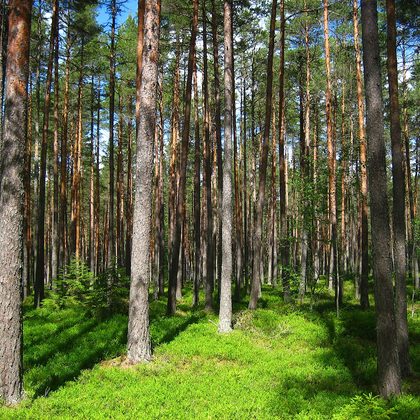
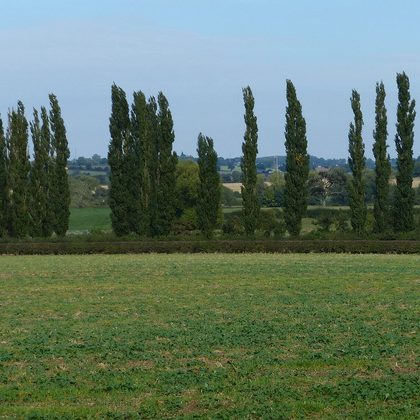
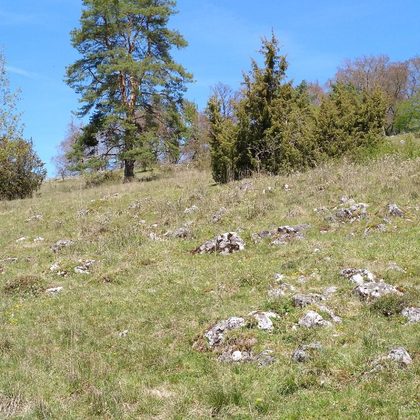
In the native range, coniferous and mixed taiga forest, with a preference for an understorey of fallen trunks, root plates and scrub. In Europe mainly mixed broadleaved and coniferous woodland with a dense shrub layer, woods with plenty of dead timber, urban forests, old cemeteries, parks and allotments. It requires diggable soil and a generous and reliable seed crop of hazel, beech, oak or spruce, because it survives the winter on stored food. In the Forêt de Soignes density is highest where beech, hazel and a dense shrub layer come together.
Where the animal is most at home, classified with EUNIS — the European standard for habitats.



Distribution
The native range runs from the Urals across Siberia to Kamchatka, Mongolia, northern China, Korea, Hokkaido and the Kurils; it is the only chipmunk species outside North America. In Europe the species is introduced. The largest and oldest European population lives in the Forêt de Soignes outside Brussels, present since about 1970 and now spread over thousands of hectares; the park at Rouge-Cloître is the best-known site. In France the species has lived in the woods around Paris since the 1970s, with the Forêt de Sénart in Essonne as the best-known colony and about ten other sites in the Île-de-France. In Germany populations have become established in cemeteries and city parks (Freiburg, Münster, Aschaffenburg), some of which have since disappeared; in Italy near Belluno, Verona and Rome, and there are small settlements in Switzerland, Austria and the Netherlands. In the Netherlands these are escaped and released animals and small local settlements, without a large continuous population. The species is not established in the British Isles or on the Iberian Peninsula. Virtually every European population derives from released or escaped cage animals from the pet trade. From a nucleus the species spreads slowly, at about two hundred to two hundred and fifty metres a year.
- Established introduction
- dark = core range, pale = thinly spread
Way of life
Diurnal, with a peak shortly after sunrise and a second in the late afternoon. Unlike the Red Squirrel it is a ground animal that can climb: it forages on the ground, uses trunks as lookouts and feeding places, and sleeps in a self-dug tunnel system with a nest chamber and one or more larders. The diet consists of seeds and nuts, such as pine and spruce seed, hazelnuts, beech mast and acorns, and also buds, fungi, berries, insects, snails and occasionally a bird's egg. Food not eaten at once is carried in the cheek pouches to the larder: up to two kilos, exceptionally six kilos of seed have been found in a single burrow. The animal lives on this in winter, because the species does not truly hibernate but keeps a winter dormancy: from October or November to March or April it stays in the burrow and cools to a few degrees, but wakes every few days and eats from its store. In this it differs from the sousliks, which store no food and live on their fat reserves. The animals are territorial and solitary; one animal uses seven hundred to four thousand square metres. Mating follows dormancy in March or April; after 28 to 35 days three to eight young are born, independent at about seven weeks. Life span in the wild is three to four years.
Where and when to look
In the Forêt de Soignes outside Brussels, the area around the ponds of Rouge-Cloître in Auderghem is easily reached by tram and on foot. Go in September or October in the early morning, when the animals spend the whole day laying in stores and react little to walkers; April and May are the second-best months. Walk the broad rides slowly and watch for movement on the ground and on fallen trunks; the loud chuk-chuk is often heard before the animal is seen. Do not feed the animals; it is an introduced species, and they are already very tame there. The same advice applies to the Forêt de Sénart near Paris. Records outside the known populations can be reported to the national invasive species reporting schemes.
Conservation status
Least Concern (2016) in the native range, where the species is common from the Urals to Japan. In Europe it has been on the EU list of invasive alien species of Union concern since 3 August 2016: trade, keeping, breeding and release are prohibited, and member states must manage established populations. There is little evidence that it displaces the Red Squirrel. The main objection is its role as a host for ticks: work in the Forêt de Sénart near Paris showed that the species carries far more larvae and nymphs of the sheep tick than the native Wood Mouse and Bank Vole, and that it transmits the Lyme disease bacterium effectively. Where density is high, the infection risk for walkers increases. The species also takes seed, buds and the eggs of woodland birds. Eradication of an established population such as that in the Forêt de Soignes is not considered feasible; policy aims at preventing new establishments, all of which result from escaped or released cage animals.
Scientific name
Eutamias sibiricus | (Laxmann, 1769) (GBIF: Tamias sibiricus)
Laxmann described the species in 1769 as Sciurus Sibiricus; because it was later moved to another genus, the author and year stand in brackets. Eutamias is Greek, from eu, 'well, true', and tamias, 'steward, one who stores up': the true chipmunk. sibiricus means 'Siberian'; Laxmann described the animal from southern Siberia. The specimen the first description was based on came from Russia, Barnaul.