All species › Carnivores › Cats › Wildcat
Wildcat | Felis silvestris
Wilde kat | Gato Montés
With the wildcat the difficulty is not the sighting but its confirmation. The species resembles a large, heavily built tabby cat, lives where feral domestic cats also live, and interbreeds with them. In field identification the tail matters more than the colour; some animals cannot be identified on field characters alone.

Tracks
The print is round, 3.5 to 4.5 cm long and wide, with four toes and a three-lobed rear edge to the pad, and no claw marks, because the claws are retractile. This separates it at once from fox and martens, which always register claws. From a house cat's print it differs only in size, by about half a centimetre; that difference is too small for identification. The trail is an almost straight line in which the hind foot is placed in the fore print, with a stride of 25 to 35 cm. Scratch marks are the most durable sign: vertical parallel grooves 10 to 25 cm long in the bark of a standing or fallen trunk, at 30 to 60 cm above the ground, made repeatedly on the same trees along a fixed route — dead wood, a leaning trunk over a path, or soft bark such as elder or young oak. Grey hairs are often caught in the torn bark. The scat is 4 to 8 cm long and 1.5 cm thick, segmented, blunt or slightly twisted at both ends, and packed with the hair and bone splinters of voles; it smells far less sharply than a fox's. At the edge of the territory it is left in plain view — on a molehill, a tussock or in the middle of a forest ride — while in the core of the territory it is buried or scraped under leaves. There are also lying-up places: dry day beds in a hollow tree, under a root plate, in a disused fox earth or badger sett, in a rock crevice, and in winter in a haystack or a brash pile, recognisable by flattened material and loose hairs. Prey remains are scarce because voles are eaten whole; a bird that has been caught is plucked with the shafts bitten through, as with a fox.
In its habitat
Identification
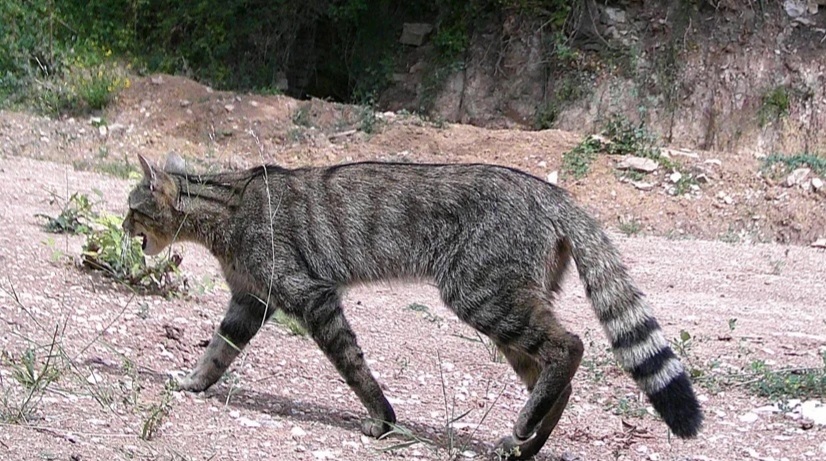
A cat of 50 to 75 cm head-body with a tail of 21 to 35 cm, and at 3.5 to 8 kg noticeably heavier-built than a house cat: broader head, shorter and thicker muzzle, longer legs and a long, shaggy coat that makes it look bulkier; in winter it looks almost twice as large as in summer. The ground colour is greyish-buff to ochre-grey with a faint, blurred pattern: the striping on flank and legs is present but soft-edged, and there is no crisp row of spots on the belly. A black dorsal stripe runs down the back and stops at the root of the tail, without continuing into it. The head carries four dark lines running back over the nape, the cheek stripes are clear, the nose leather is pink and the chin pale buff. The decisive character is the tail: thick, cylindrical and bluntly rounded at the end, without tapering, with three to five black, clearly separated rings and a solid black, blunt tip. White occurs at most on chin and throat; white socks, a white chest patch or white toes do not belong to the species.
Similar species
Some records cannot be identified in the field. The feral domestic cat (Felis catus) is the only real confusion species: a striped tabby has the same colour, the same size and the same habitat. There are differences, but there are seven small ones rather than one large one. A domestic cat's tail tapers and its rings run together, break up or merge into a longitudinal stripe; the wildcat's tail is thick, with separate rings and a blunt black tip. The domestic cat is more sharply marked, often with distinct belly spots and with white on feet, chest or muzzle; the wildcat is faintly marked and has no white on the feet. In the domestic cat the dorsal stripe continues into the tail. The wildcat is heavier and longer in the leg and has a coarser, longer coat. Wildcat and domestic cat do, however, interbreed, and the offspring show those characters in every combination. Hybrid rates are low in Germany, Italy and Luxembourg and high in Hungary; in the Iberian Peninsula introgression is generally lower than in central Europe, but it occurs and increases near villages. In Scotland introgression had gone so far by 2019 that the free-living population was declared functionally extinct. Some animals cannot be named with certainty on field characters alone; then only a good photograph of the tail, a score across several characters at once, or genetic testing settles it. Where the identification remains uncertain, this should be stated in the record. The lynx is two to three times the size, with ear tufts, a cheek ruff and a short, blunt tail, and is therefore not a serious confusion.
Habitat
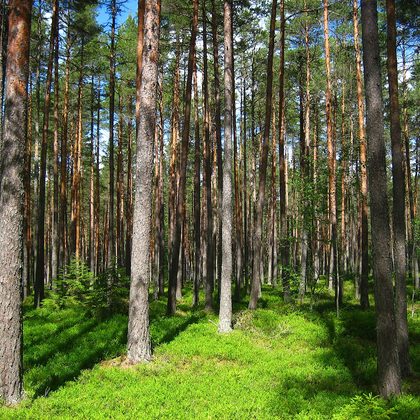
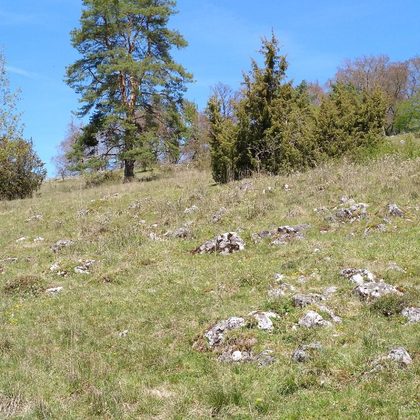
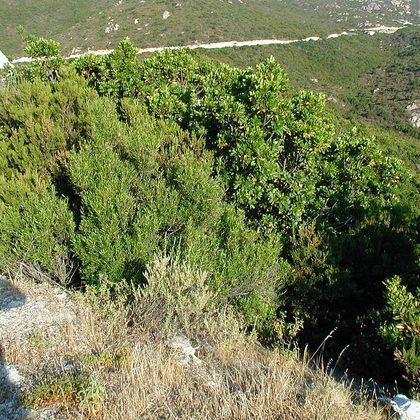
The wildcat inhabits large, unbroken broadleaved and mixed woodland with plenty of structure: glades, clear-fells, rough edges, windthrow and dead wood, preferably with a vole-rich margin onto farmland. Conifer woodland is also used, provided there is a shrub layer and open ground. In southern Europe the habitat shifts to Mediterranean scrub, maquis and the edges of holm-oak and cork-oak woodland, where rabbits are the main food. Hedgerows, shelterbelts and stream valleys are the corridors along which the species moves; large open arable areas and villages are avoided, which is related to the domestic cats living around buildings. Deep, lasting snow limits the range to the north: where more than twenty centimetres of snow lie for more than a hundred days, the species is absent.
Where the animal is most at home, classified with EUNIS — the European standard for habitats.




Distribution
The wildcat is distributed across central, western and southern Europe in a series of separated populations: the Iberian mountains, France, the Ardennes, the Eifel, central Germany, the Alps, Italy, the Carpathians and the Balkans, with the Caucasus and Anatolia beyond. In the Iberian Peninsula it occurs over almost all of mainland Spain, but always at low densities and fragmented: the Cantabrian coast and the Pyrenees, the Iberian System, the Central System, the Montes de Toledo and the Sierra Morena, and the mountains of Cádiz and Málaga. It is most numerous in closed mountain woodland with rabbits and is absent from the large dry cereal plains and intensively farmed valleys; it is absent from the Balearic and Canary Islands, where the cats living in the countryside are feral domestic cats. The Iberian population is little studied; most data come from camera traps and road casualties. In Germany the species has increased strongly since the 1990s as woodlands were reconnected by green bridges and planted corridors; from there it has spread west into Belgium, Luxembourg and the Netherlands. In the Netherlands the wildcat was absent for centuries; from the 1990s isolated records came from southern Limburg, and since about 2015 it has been resident in the Vijlenerbos and the woods of southern Limburg, with proven breeding. The number of animals and the occupied area are small. In Belgium it is common in the Ardennes and the Gaume; in Flanders only wandering animals occur, mainly in Voeren and the Sonian Forest. In Britain the wildcat survived only in the Scottish Highlands; after two centuries of persecution and a century of interbreeding with feral cats, that population was assessed in 2019 as no longer viable and functionally extinct in the wild. In Ireland the species has never occurred in historical times.
- Native
- dark = core range, pale = thinly spread
Way of life
The wildcat is nocturnal and crepuscular; on a cold sunny morning after a frost it sometimes lies in the open on a brash pile or at the edge of a clear-fell to sun itself, and most sightings are made at that time. It is solitary, with a territory of two to ten square kilometres in the male and smaller in the female; a male's range overlaps those of several females. The diet is narrow: voles and mice make up three-quarters to nine-tenths of the prey in central Europe, with birds, leverets, lizards and insects besides; in the Iberian Peninsula the rabbit is the main food, with birds, dormice, lizards and insects in addition. Prey is stalked or waited for and then pounced on, as a house cat does, mainly along woodland edges and in rough ground. Mating runs from January to March, with nocturnal caterwauling; after 63 to 68 days two to four kittens are born in April or May in a hollow tree, a rock crevice or a disused earth. They begin hunting with the mother at about six weeks, are independent at four to five months and look for their own range in autumn. The species does not rest in winter; in hard weather it loses condition quickly and moves to the shelter of haystacks and outbuildings, which increases the chance of contact with domestic cats. In the wild the wildcat lives seven to ten years.
Where and when to look
A sighting takes patience and usually camera traps. The best chance on foot is a sunny, frosty morning in February or March along a wide forest road or a clear-fell, for example in the Eifel, the Ardennes, southern Limburg, the Cairngorms, the Sierra Morena, the Montes de Toledo and the Cantabrian Mountains: the animals then lie in the sun and can remain visible for half an hour. Dusk is also suitable along a wood edge that opens onto grassland, where the wildcat hunts voles. In Spain, Cabañeros, the Sierra de Andújar and the mountains of Galicia and León are the best-known areas. Tracking yields more: in winter, along a forest ride, scratch marks on the same trunks and scats on molehills can be found. A record can only be assessed with a photograph of the tail; without an image of the tip and the rings it cannot be checked.
Conservation status
Least Concern (LC, 2023) globally; that assessment says little about Europe, where the problem is not numbers but genetic integrity and fragmentation. Interbreeding with feral and roaming domestic cats dilutes the population genetically, and those cats also transmit disease. In addition, traffic on forest roads and motorways through woodland, the loss of hedges and margins between woods, and disturbance play a part. The species is listed in Annex IV of the Habitats Directive and strictly protected everywhere. In the Iberian Peninsula the main problem besides hybridisation is the decline of the rabbit through viral diseases, which has removed the principal prey from much of the Mediterranean hill country. In Germany and France the reconnection of woodland has demonstrably worked and the range is expanding; the colonisation of southern Limburg is a direct consequence. In Scotland, where the free-living population was declared functionally extinct in 2019, captive-bred wildcats have been released in the Cairngorms since 2023, the first reintroduction of a felid in Britain. The released animals are monitored and collared, and the programme is combined with neutering of feral cats. The project is to show whether a wildcat population can be rebuilt after extensive hybridisation.
Scientific name
Felis silvestris | von Schreber, 1777
Von Schreber described the species in 1777 and placed it straight away in the genus where it still stands. Felis is the Latin word for 'cat'; the Romans also used it of martens and polecats. silvestris is Latin for 'of the woods', and so 'wild', from silva, 'wood, forest'. The specimen the first description was based on came from Germany.