All species › Passerines › Honeyeaters › Blue-faced Honeyeater
Blue-faced Honeyeater | Entomyzon cyanotis
Blauwwanghoningeter | Mielero cariazul
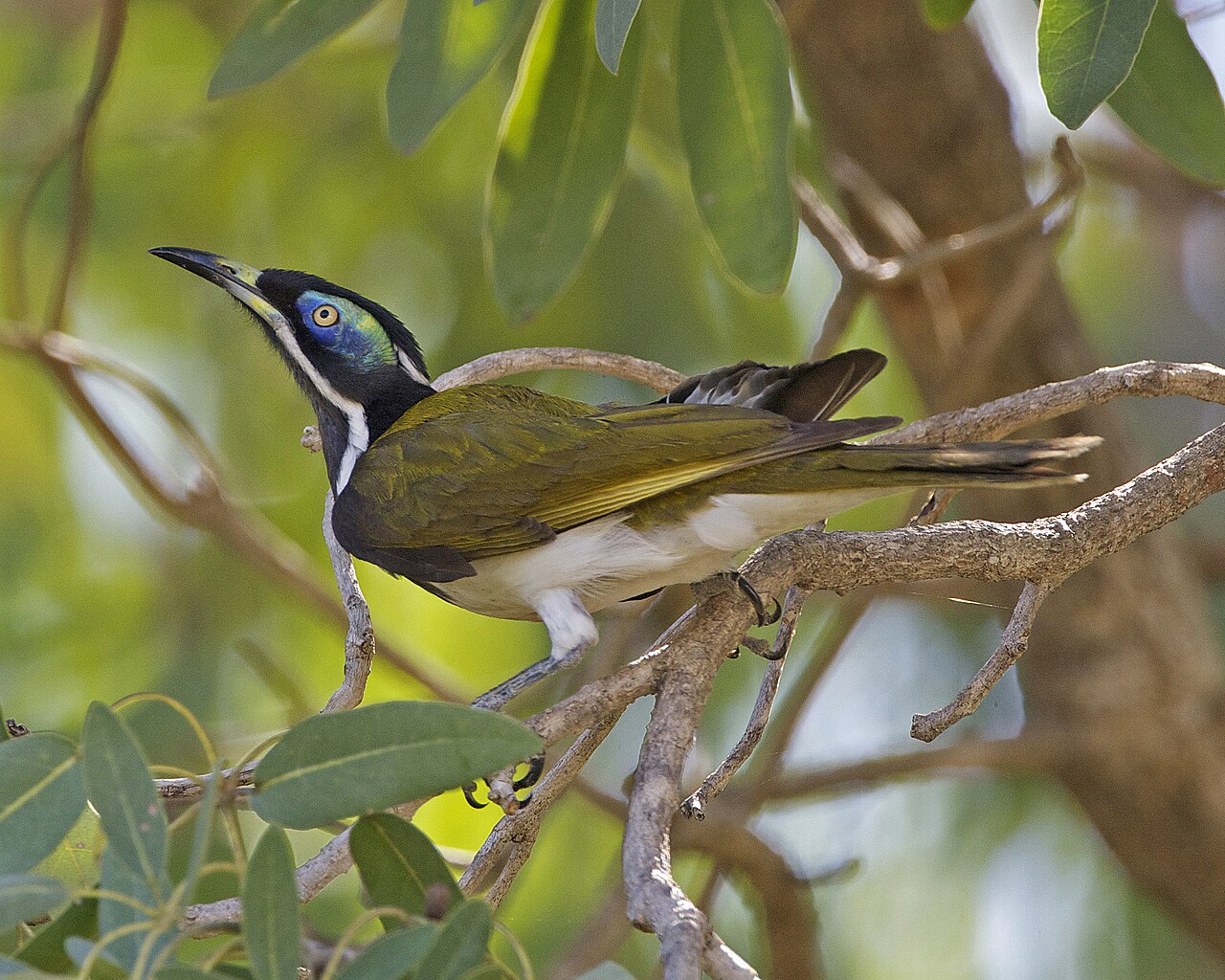
The Blue-faced Honeyeater is one of the few Australian honeyeaters nobody has to identify: a big olive-green and white bird with a black head carrying a large patch of bare, vivid blue skin around the eye, as though paint had been spilt. It is loud, bold and gregarious, drives smaller birds off a flowering tree and comes close without hesitation in gardens, parks and banana plantations. In the north it is among the earliest voices of the day: a clear, penetrating call that starts half an hour before sunrise.
Voice
A loud, varied and scarcely musical bird. The best-known sound is a hard, far-carrying woik, repeated in a slow series and often taken up by several birds. At first light — often a full half hour before sunrise, while it is still almost dark — comes a piping weet weet weet that travels over the gardens and woodland as one of the first voices of the day. There is also a sharp, rasping alarm with which a party will collectively try to drive an owl, a snake or an intruding honeyeater out of a tree.
No freely licensed recording has been found for this species yet; what to listen for is described below.
Identification
A large honeyeater of twenty-six to thirty-two centimetres with a wingspan of about forty-four centimetres and a weight of over a hundred grams, which places it among the heaviest of the family. Head and throat are black, separated from the olive-green back by a white nape band and a white stripe behind the cheek; the upperparts are golden olive-green, the underparts pure white. The mark is the large patch of bare skin around the eye, bright cobalt blue in adults and visible from a distance. Young birds have yellow or yellow-green skin in the same place, which shifts through green to blue during the first year, and are otherwise duller with a greyer bib. The bill is stout and black, the flight slow and powerful, and the birds are usually in parties of three to a dozen.
Confusion species
Adults are unmistakable: no other Australian bird combines golden-green upperparts, pure white underparts and a blue face. Confusion lies in size and silhouette, which brings in the large, noisy honeyeaters it shares woodland with. The friarbirds (Philemon corniculatus and relatives) are equally large and equally loud, but have a bare black head without blue and dull brown rather than green upperparts; Philemon corniculatus additionally carries a knob on the bill. The wattlebirds (Anthochaera) are streaked and long-tailed with no white nape band. The miners (Manorina) share the bold party behaviour and also have bare facial skin, but theirs is yellow, and they are much smaller and grey rather than green and white. Young Blue-faced Honeyeaters with yellow facial skin occasionally cause doubt, but the white nape band and pure white underside remain decisive even then.
Habitat
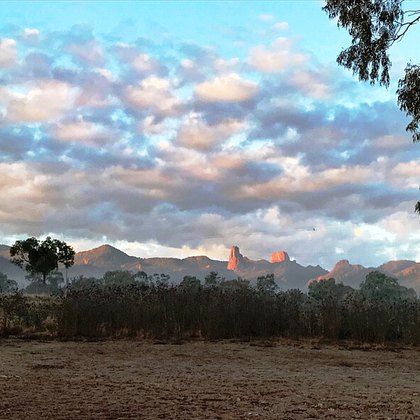
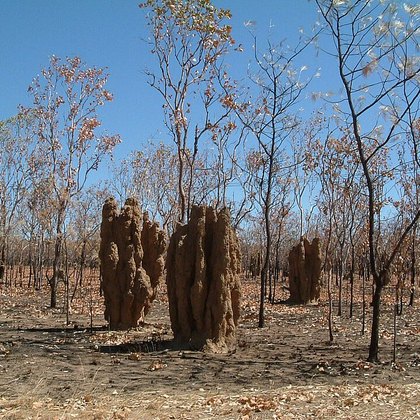
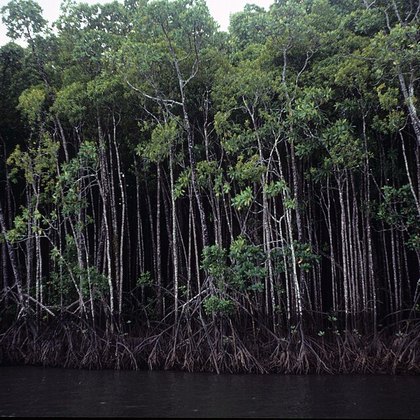
Open forest and woodland with eucalypts, savanna, monsoon forest and vine thicket, paperbark swamp and mangrove, coastal heath and riverine woodland, usually near water. It is also a familiar sight in planted country: parks, gardens, orchards, cane fields and above all banana plantations, from which it takes its vernacular name 'banana bird'. The diet is chiefly insects and other invertebrates, gleaned from trunk and branch and prised out from under loose bark, with nectar and fruit alongside; in orchards it is locally regarded as a pest for that reason. It breeds in pairs, sometimes with helpers, and generally takes over the abandoned nest of a Grey-crowned Babbler (Pomatostomus temporalis) or a friarbird, rebuilding it to its own taste. There are two, rarely three eggs; incubation lasts about sixteen days.
Where the bird is most often found, arranged by main group and formation.


Range and movements
Northern and eastern Australia plus southern New Guinea. In Australia the range runs from the Kimberley in Western Australia across the Top End and the Gulf country to Cape York and from there south along the east coast into Victoria, with outliers into south-eastern South Australia around Adelaide. It becomes steadily more numerous towards the north. It occurs from sea level to about eight hundred and fifty metres and is largely sedentary, although some populations wander. It does not occur in New Zealand.
- Resident
- dark = core range, pale = thinly spread
Where and when to look
This bird requires no searching, only attention to sound: if in northern or eastern Australia you wake in the dark to a hard, piping call beginning half an hour before sunrise, it is almost certainly this species. By day you find it in gardens and picnic grounds, where it is strikingly unshy and will feed off tables. In a party, watch for the young birds: a yellow or green face instead of a blue one means a bird from the past season, and that is a fair hint that breeding has taken place nearby. In the north-west and the Top End, look as well for the white wing panel of the northern form.
Conservation
Least Concern (LC) and common to numerous throughout its range, with a population that gains from human presence rather than suffering from it: gardens, parks, plantations and stock waters have favoured the species in many places, and it penetrates to the centre of northern towns. Locally it has a reputation as a pest in orchards and banana crops, which can lead to control, and as an aggressive visitor to blossom it can drive smaller honeyeaters off good flowering patches. Loss of hollow trees and of old woodland affects it less than many other species, because it uses other birds' nests rather than a hollow.
Scientific name
Entomyzon cyanotis | (Latham, 1801)
John Latham described the species in 1801 as Gracula cyanotis, from a bird near Sydney — he initially took it for three different birds. Because William Swainson placed it in the new genus Entomyzon in 1825, author and year stand in parentheses. Entomyzon is formed from Greek entomon, 'insect', and myzo, 'to suck' or 'to drink'; cyanotis means 'blue-eared', from kyanos, 'dark blue', and ous, 'ear'. The English name, the Dutch blauwwanghoningeter and the Spanish mielero cariazul all point at that same blue facial skin; in Australia the vernacular names 'banana bird' and 'blue-eye' are also current. The genus is monotypic, but not uncontested: the northern form albipennis, with a white panel in the wing, is split off by some authoritative lists as a separate species, the White-quilled Honeyeater, while AviList retains it as a subspecies of Entomyzon cyanotis.