The habitats of Australasia
Every species in this guide is tied to the habitats where it occurs most in Australia, New Zealand and their surrounding islands. They are arranged below by main group, from sea to city. A bird carries at most seven: not everywhere it has ever been seen, but where it truly belongs.
Select a habitat to read its description.
Sea A
Every habitat governed by open sea water, from the surf line out beyond sight of land. The subdivision follows water mass and seabed: the warm water over the continental shelf, the cold ocean south of the subtropical convergence, and, as the only bottom-bound formation, kelp forest on shallow rock. Ground that dries out at low tide belongs to the coast, not here. For birds the range runs from species that dive just behind the breakers to species that come ashore only to breed.
-
 Shelf and coastal sea A1
Curtis Island, Bass Strait · Gibbo51 · CC BY-SA 3.0
117 species
Shelf and coastal sea A1
Curtis Island, Bass Strait · Gibbo51 · CC BY-SA 3.0
117 species
The water from the surf line to the edge of the continental shelf, where the bottom falls away at some two hundred metres; beyond that lies the ocean, and south of the subtropical convergence the cold subantarctic sea. Rock with kelp within diving reach is counted separately, and ground that dries at low tide belongs to the coast. The shelf is broad in the Gulf of Carpentaria and inside the Great Barrier Reef, narrow off New South Wales and eastern North Island, with upwelling off the Bonney Coast and Kaikoura. Parasitic jaegers rob terns of their catch, Red-tailed tropicbird and Blue-billed white tern hang over the warm water near Norfolk, and Yellow-eyed penguin feeds on the Otago shelf.
-
 Subantarctic ocean A2
Macquarie-eiland · M. Murphy · Public domain
57 species
Subantarctic ocean A2
Macquarie-eiland · M. Murphy · Public domain
57 species
The cold ocean south of the subtropical convergence, over the Campbell Plateau and around Macquarie, the Antipodes, Campbell, the Auckland Islands and the Snares. The front itself is the boundary with the shelf: temperature and salinity drop within a few nautical miles. The islands themselves belong to the coast. This is a world with nothing in common with the Australian seaboard: the forties and fifties, a westerly swell that never lies down, water of five to twelve degrees, and food in the shape of krill, squid and lanternfish. Wilson's storm petrels patter over the troughs, Pintado petrels follow the wake, Northern royal albatross quarters the front, and Yellow-eyed penguin stays within reach of its island.
-
 Kelp forest and shallow rocky seabed A3
Taieri Island, Otago · IcknieldRidgeway · CC BY-SA 4.0
7 species
Kelp forest and shallow rocky seabed A3
Taieri Island, Otago · IcknieldRidgeway · CC BY-SA 4.0
7 species
Bedrock below the low-water mark carrying large brown seaweeds, down to the depth where light gives out, usually between twenty and thirty metres. The same rock where it dries at low tide belongs to the rocky shore; water over sand or greater depth belongs to the open sea. Exposed edges carry bull kelp, Durvillaea antarctica, thrown over by every wave; sheltered cold water holds the Macrocystis pyrifera forests of Fiordland, Stewart Island, Otago and Tasmania, and along the whole southern coast Ecklonia radiata forms the low understorey. Sea urchins graze whole stretches bare. Among the stipes diving birds take fish, crustaceans and shellfish, and at low water the exposed weed belt is itself a feeding ground.
Coast B
The narrow strip where land and sea meet, from the storm line down to the low-water mark, together with the vegetation that lives on salt. The subdivision follows the substratum: loose sand, hard rock, and fine sediment that dries out at low tide. Alongside these stand two salt-tolerant vegetations, mangrove and saltmarsh, and finally, kept apart, the coast of the subantarctic islands, whose tussock and breeding birds have nothing in common with the Australian shore.
-
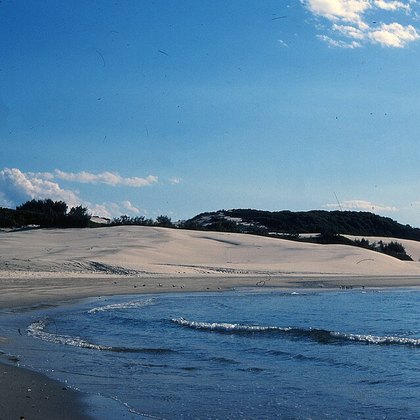 Sandy beach and dune B1
Sandy Cape, K'gari (Fraser Island), Queensland · John Robert McPherson · CC BY-SA 4.0
88 species
Sandy beach and dune B1
Sandy Cape, K'gari (Fraser Island), Queensland · John Robert McPherson · CC BY-SA 4.0
88 species
Loose, mobile sand above the ordinary tideline: the dry beach, the foredune and the blowouts behind it. Where the sediment turns fine and stays wet the tidal flats begin, hard rock belongs to the rocky shore, and once the sand is fixed and shrubs take over it grades into coastal heath. The foredunes carry spinifex, and in New Zealand pingao; marram is introduced almost everywhere. Long ocean beaches run at Eighty Mile Beach, the Coorong, Ninety Mile Beach and Farewell Spit. Beach stone-curlew walks the tropical strand, Masked lapwing and Sooty oystercatcher breed above the tideline, Silver gulls sit on the shell banks and Grey plovers wait out the tide there.
-
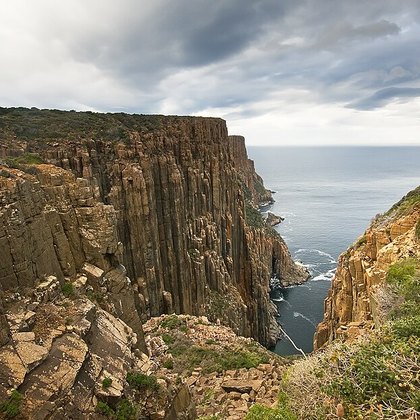 Rocky shore and sea cliff B2
Kaap Raoul, Tasman National Park, Tasmanië · JJ Harrison · CC BY-SA 3.0
89 species
Rocky shore and sea cliff B2
Kaap Raoul, Tasman National Park, Tasmanië · JJ Harrison · CC BY-SA 3.0
89 species
Hard rock at the sea, from the splash zone to the low-water mark, with the cliff above and the turf along its rim. Below water the same rock becomes kelp forest; where sand takes over the beach begins, and where mud dries out the tidal flats. It covers the basalt of Victoria and Otago, the sandstone around Sydney, the granite of Tasmania and Fiordland and the limestone wall of the Bunda Cliffs, with Poa turf on the headlands. Northern royal albatross nests on the cliff edge at Taiaroa Head, Yellow-eyed penguins come ashore, Sooty oystercatchers work the wet rock, Welcome swallows nest under overhangs, and gannets hold the flat tops, where the odd Cape gannet joins them.
-
 Tidal flats, estuaries and lagoons B3
Inglis River, Wynyard, Tasmanië · Gary Houston · CC0
127 species
Tidal flats, estuaries and lagoons B3
Inglis River, Wynyard, Tasmanië · Gary Houston · CC0
127 species
Mud, muddy sand and sand that dry out at low tide, with the brackish water behind them: estuary, harbour and coastal lagoon. Loose dry sand belongs to the beach, where salt plants root the saltmarsh begins and where trees stand the mangrove; above the tidal limit it passes into inland water. The great flats lie at Roebuck Bay and Eighty Mile Beach, around the Gulf of Carpentaria, in Moreton Bay, on the Firth of Thames and the Manukau and behind Farewell Spit, often with seagrass along the upper edge. Little curlew and Grey plover take worms and crabs, Banded stilts swim the shallow brine, and Australian pelican, White-faced heron and Black-necked stork fish the channels.
-
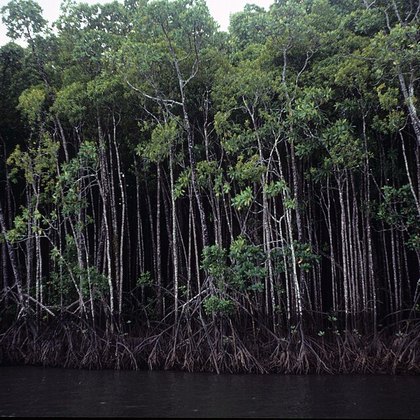 Mangrove B4
Daintree River, Queensland · Iraphne R. Childs · CC BY 4.0
108 species
Mangrove B4
Daintree River, Queensland · Iraphne R. Childs · CC BY 4.0
108 species
Trees and shrubs rooted in the tidal zone, from the seaward belt of Avicennia and Sonneratia to the landward edge where saltmarsh or dry ground takes over. The bare flat in front and the creeks between belong to the tidal flats. Here it is a northern phenomenon: Cape York and the Kimberley carry closed forest with dozens of species, thinning southward to low Avicennia scrub at Western Port. New Zealand has a single species, reaching its southern limit at Ohiwa and Kawhia. Northern fantail and Sahul sunbird work the canopy, Spangled drongo and Australasian figbird keep to the edges, Little pied cormorants dry off on the roots, and Osprey and Black-necked stork hunt the creeks.
-
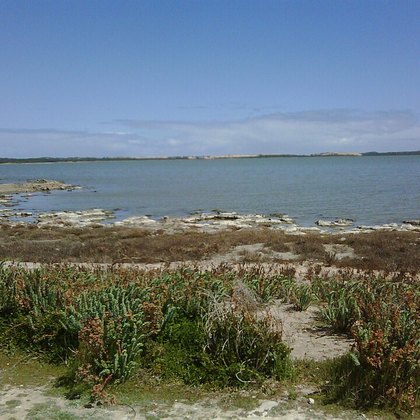 Samphire and saltmarsh B5
Salt Creek, de Coorong, Zuid-Australië · Hullwarren · CC BY-SA 3.0
51 species
Samphire and saltmarsh B5
Salt Creek, de Coorong, Zuid-Australië · Hullwarren · CC BY-SA 3.0
51 species
Low, fleshy salt plants on clay and silt above the ordinary high-water line, flooded only on spring tides. Below lies the bare tidal flat, seaward stands the mangrove wherever trees can hold, and inland it passes into grassland or scrub. The same vegetation around the inland salt lakes is counted here, the plants being the same. These are swards of Tecticornia and Sarcocornia, with saltwater couch and sea rush in the wetter southeast; large expanses lie behind the Gulf of Carpentaria and along the Spencer and St Vincent gulfs. Banded stilt and Grey plover feed on the open patches, Zitting cisticola and Lewin's rail keep to the dense sward, and Neophema chrysogaster winters on the southern marshes.
-
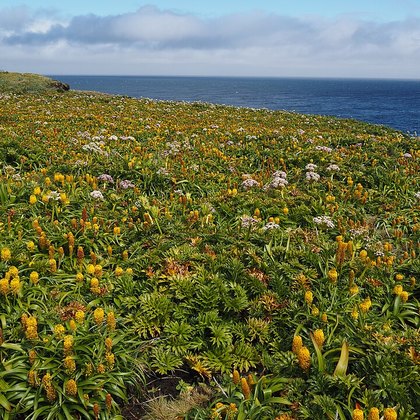 Subantarctic island coast and tussock B6
Enderby Island, Aucklandeilanden · Marshelec · CC BY-SA 4.0
49 species
Subantarctic island coast and tussock B6
Enderby Island, Aucklandeilanden · Marshelec · CC BY-SA 4.0
49 species
The shore of Macquarie, the Snares, the Auckland Islands, Campbell, the Antipodes and the Bounties: rocky coast, boulder beach and the belt of tussock and megaherbs above it, up to where scrub or rata forest begins. There is no mangrove here, no saltmarsh and no tidal flat, and the water around is the subantarctic ocean. Poa foliosa and Poa litorosa build pedestals shoulder high, with Stilbocarpa polaris, Pleurophyllum and Bulbinella rossii between them, and Campbell blows hard on two hundred and eighty days a year. The peat is riddled with burrows. Pintado petrels nest on ledges, Yellow-eyed penguins walk through the tussock, Northern royal albatross holds a few pairs on Enderby, and the Dunnock is an introduction.
Inland water C
All open water of the interior, standing or flowing, fresh or saline, provided it lies beyond the tide; saltmarsh, mangrove and estuary belong to the coast. The subdivision follows the water regime: permanent standing water (C1), running water with a vegetated bank (C2), the gravel rivers of New Zealand (C3), and basins that fill only after rain (C4). Where emergent plants close over the surface, the wetlands begin. What marks Australia is unpredictability: the stock of water shifts from year to year and the birds move with it.
-
 Lakes, ponds and reservoirs C1
Barmah National Park, Victoria · AcaciaFlowstone · CC BY-SA 4.0
100 species
Lakes, ponds and reservoirs C1
Barmah National Park, Victoria · AcaciaFlowstone · CC BY-SA 4.0
100 species
Permanent standing water with an open surface: crater lakes, glacial lakes, cut-off river bends, reservoirs, farm dams and town ponds, fresh to brackish. Water that stands only after rain is an ephemeral lake; once reed or cumbungi closes the surface it becomes marsh; and moving water is a river. Appearances vary widely: the maar lakes of Victoria's Western District, the volcanic lakes of Rotorua and Taupo, the glacial lakes of Otago, the farm dams of the pastoral country. Black swan, coot, Pacific black duck, maned goose and grey teal ride the open surface, Australasian grebe and little pied cormorant dive along the shallow margin, and osprey and silver gull patrol above.
-
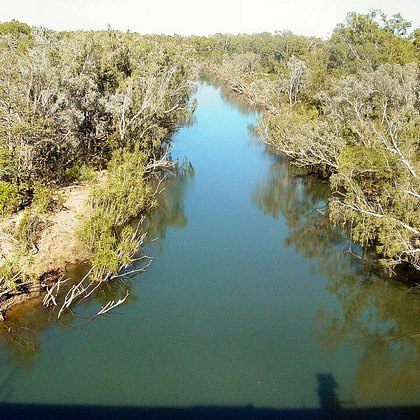 Rivers and creeks C2
Katherine River, Noordelijk Territorium · Yewenyi · CC BY-SA 3.0
73 species
Rivers and creeks C2
Katherine River, Noordelijk Territorium · Yewenyi · CC BY-SA 3.0
73 species
Running water in a fixed channel with a vegetated bank: permanent lowland rivers, seasonal creeks that break into waterholes in the dry, and mountain streams. A river that braids across bare gravel belongs with the braided rivers; water stilled behind a weir counts as a lake; the billabongs beside the channel belong with the marshes. Along the Murray and Darling, Eucalyptus camaldulensis stands with its feet in the water; in the Top End the creeks are lined with pandanus and melaleuca. Australian pelican, Australasian darter and little pied cormorant fish the deep bends, white-faced heron and black-necked stork work the shallow margin, and the white-backed swallow digs its nest burrow in a sandy bank.
-
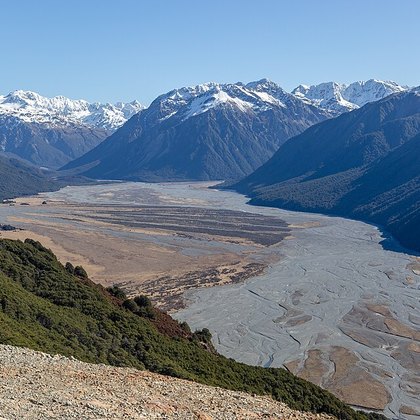 Braided river C3
Waimakariri, Canterbury · Michal Klajban · CC BY-SA 4.0
14 species
Braided river C3
Waimakariri, Canterbury · Michal Klajban · CC BY-SA 4.0
14 species
Broad shingle beds where the water spreads over many shallow channels and cuts a fresh course at each flood. Most of the bed lies dry: bare bars, low islands and thinly vegetated terraces, without bank forest. The type is largely confined to New Zealand, where the rivers of the Southern Alps (Waimakariri, Rakaia, Rangitata, Waitaki) fan out across the Canterbury Plains, with outliers in the Mackenzie Basin. The bed yields little plant food but many invertebrates, and offers bare nest sites with open sightlines. The birds of this ground lay camouflaged eggs on the shingle and lose clutches to floods, to introduced predators, and to the lupin, broom and crack willow closing the bars over.
-
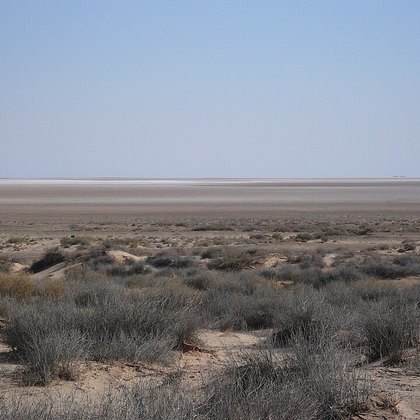 Claypan and ephemeral lake C4
Kati Thanda–Lake Eyre, Zuid-Australië · eyeintim · CC BY 2.0
47 species
Claypan and ephemeral lake C4
Kati Thanda–Lake Eyre, Zuid-Australië · eyeintim · CC BY 2.0
47 species
Shallow basins with a tight clay or salt floor that holds water, bone dry most of the time: claypans, gilgai, playas and the great inland salt lakes. What separates them from a lake is duration, not size: Kati Thanda-Lake Eyre in flood is the largest lake on the continent, yet it has filled completely only a few times in 160 years. The water comes from far off: Queensland rain reaches the basin weeks later down Cooper Creek and the Diamantina. Food then explodes with brine shrimp, insects and fish: Australian pelican, banded stilt, grey teal and glossy ibis appear in tens of thousands; magpie goose, brolga, Australian pratincole and little curlew work the drying margin.
Wetlands and mires D
Wet ground carrying rooted vegetation, as against the open water of group C: the plant cover, not the water surface, defines the habitat. Three formations, ordered by substrate and fertility: mineral marsh with reed, cumbungi and rushes (D1), acid peat and sedgeland on turf or leached gravel (D2), and swamp forest under melaleuca (D3). Tidal saltmarsh and mangrove belong to the coast, and dry swards to the grasslands. The boundary with open water shifts with the season, since much of this ground is flooded for only part of the year.
-
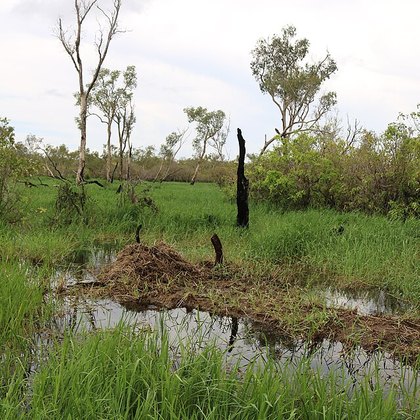 Freshwater marsh and reedbed D1
Kakadu National Park, Noordelijk Territorium · Warren Poole · CC BY-SA 4.0
99 species
Freshwater marsh and reedbed D1
Kakadu National Park, Noordelijk Territorium · Warren Poole · CC BY-SA 4.0
99 species
Shallow, fertile fresh water carrying rooted emergent plants: reed, cumbungi, rushes and Eleocharis, with open pools and floating-leaved beds between. Where the surface stays open it is a lake; under a tree canopy, paperbark swamp forest; on acid, infertile peat, bog and sedgeland. The main examples lie on the Murray-Darling floodplains, among them the Macquarie Marshes and Barmah, in the billabongs of the north, and in New Zealand at Whangamarino and Lake Wairarapa. Australasian bittern and dusky moorhen keep to the dense margin, the Australian reed-warbler sings from the reed, comb-crested jacana and Australasian swamphen walk the floating leaves, and magpie goose and Australian white ibis nest colonially when the water is high.
-
 Peat bog, pakihi and sedgeland D2
Ōkārito, westkust van het Zuidereiland · Mike Dickison · CC BY 4.0
19 species
Peat bog, pakihi and sedgeland D2
Ōkārito, westkust van het Zuidereiland · Mike Dickison · CC BY 4.0
19 species
Permanently wet, acid and infertile ground where peat forms or where leached gravel blocks drainage. Unlike the reedbed it lacks a fertile silt floor, and unlike grassland the soil never truly dries out. South-west Tasmania carries extensive buttongrass moorland with blanket bogs and string bogs; sphagnum mires lie in the Australian Alps and the Tasmanian highlands; on the North Island restiads such as Empodisma build the raised bogs of the Waikato; and on the West Coast of the South Island the pakihi sit on old outwash gravels under manuka and wire rush. Food is sparse but cover is dense; its birds are thinly spread and silent, and nest low in the sedge tussocks.
-
 Paperbark swamp forest D3
Wyrrabalong National Park, Nieuw-Zuid-Wales · Doug Beckers · CC BY-SA 2.0
63 species
Paperbark swamp forest D3
Wyrrabalong National Park, Nieuw-Zuid-Wales · Doug Beckers · CC BY-SA 2.0
63 species
Closed forest or open tree layer of melaleuca on ground flooded for part of the year: Melaleuca leucadendra and M. cajuputi along the northern floodplains, M. viridiflora on wet sand sheets, M. quinquenervia in the coastal swamps of Queensland and New South Wales. What separates it from reedbed is the tree layer, and from ordinary forest the annual inundation. In the wet the water stands a metre against the trunks; in the dry, damp mud remains beneath a thick, peeling bark. Australasian darter, Australian white ibis and black-necked stork nest above the water, Australian painted-snipe and comb-crested jacana work the wet ground and the floating leaves, and the rufous owl hunts here at dusk.
Grasslands E
Country where grass sets the structure and trees stand scattered at most. The group runs from the black clay plains of Queensland and the spinifex fields of the red interior to the tussock uplands of the South Island and the herbfields above the treeline. Where the canopy closes, woodland takes over; where the cover gives out, desert begins; where the ground stays wet all year, it is wetland. For birds what counts is the grass layer itself: height, density and years since the last fire.
-
 Mitchell grass downs E1
Boulia, Queensland · John Robert McPherson · CC BY-SA 4.0
28 species
Mitchell grass downs E1
Boulia, Queensland · John Robert McPherson · CC BY-SA 4.0
28 species
Almost treeless plains of widely spaced Astrebla tussocks on black, deeply cracking clay, from the Barkly Tableland in the Northern Territory far into western Queensland. Unlike spinifex grassland it sits on clay rather than sand, and unlike savanna it has no tree layer: gidgee and coolibah keep to the creek lines. Summer rain lifts the grass and fills the cracks and gilgai hollows; for the rest of the year the plain stands grey and bare. Australian Bustard and Brolga walk the open ground, Ground Cuckooshrike and Australian Pratincole hunt insects over it, Singing Bush Lark and Plains-wanderer keep down in the grass, and Pictorella Mannikin comes in to drink.
-
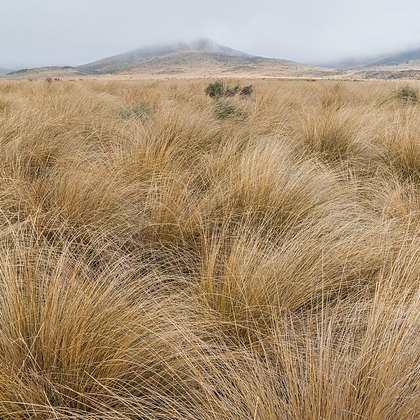 New Zealand tall tussock grassland E2
Burwood Bush, Southland · Krzysztof Golik · CC BY-SA 4.0
23 species
New Zealand tall tussock grassland E2
Burwood Bush, Southland · Krzysztof Golik · CC BY-SA 4.0
23 species
Broad fields of snow tussock (Chionochloa) on the uplands and mountain slopes of the South Island, with shorter Festuca and Poa tussock in the dry interior basins such as the Mackenzie Basin and Central Otago. Alpine herbfield takes over above it; below it beech forest once stood, and much of the short tussock country replaced that forest after centuries of burning and grazing. Matagouri, speargrass and introduced hawkweed grow between the tussocks, and winter brings snow and hard westerly wind. The bird community is small. Kea drop down from the tops onto the open slopes, Kakapo formerly lived in subalpine tussock as well, and introduced California Quail hold the lower, drier ground.
-
 Spinifex hummock grassland E3
centraal Australië, Noordelijk Territorium · Mark Marathon · CC BY-SA 4.0
54 species
Spinifex hummock grassland E3
centraal Australië, Noordelijk Territorium · Mark Marathon · CC BY-SA 4.0
54 species
Hard, spiny Triodia hummocks on sand, gravel and bare rock: covering close to a quarter of the continent, much the largest habitat in Australia, from the Pilbara and the Great Sandy Desert to the Centralian ranges and western Queensland. The hummocks stand apart with bare ground between them. Where spinifex grows on high dune crests the sand dune desert applies; where a stone pavement crowds out the cover, the gibber plain does. Old hummocks break open into rings and burn every few decades, and that fire history steers the birds: Spinifexbird and Crested Bellbird need long-unburnt ground, while Emu, Australian Bustard and Spotted Nightjar use the freshly opened country. Wedge-tailed Eagle hunts across it all.
-
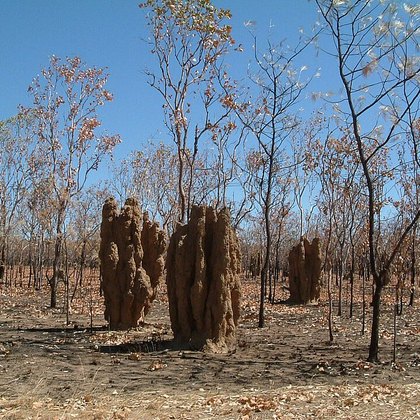 Tropical eucalypt savanna E4
Pine Creek, Noordelijk Territorium · Kaptain Kobold · CC BY 2.0
108 species
Tropical eucalypt savanna E4
Pine Creek, Noordelijk Territorium · Kaptain Kobold · CC BY 2.0
108 species
Scattered open-crowned eucalypts over a continuous grass floor, in the monsoon belt of northern Australia from the Kimberley through Arnhem Land to Cape York. What separates it from forest is the canopy, which never closes here; what separates it from spinifex grassland is the ground layer, of annual sorghum, kangaroo grass and speargrass rather than hard hummocks. Most of this savanna burns every one to three years, hottest late in the dry season. Rainbow Lorikeet and Grey-crowned Babbler keep to the trees, Rainbow Bee-eater and Pheasant Coucal to the edges, Pictorella Mannikin takes grass seed at the waterholes, Little Curlew comes in to freshly burnt ground and Magpie Goose to the floodplains alongside.
-
 Alpine herbfield E5
Kosciuszkoplateau, Nieuw-Zuid-Wales · Thennicke · CC BY-SA 4.0
12 species
Alpine herbfield E5
Kosciuszkoplateau, Nieuw-Zuid-Wales · Thennicke · CC BY-SA 4.0
12 species
The zone above the treeline, on the mainland only above about 1,800 metres, far lower in Tasmania, and in New Zealand above the beech and tussock belt. It is a patchwork of herbfield, sod tussock grassland on damp ground, sphagnum bog, snowpatches and bare, frost-worked rock. On the Australian mainland it amounts to barely a thousandth of the country, split between the Snowy Mountains, the Victorian high plains and the Tasmanian central plateau; in the Southern Alps it runs up to the glaciers. Almost all of it lies under snow in winter, so most birds only breed or forage here through the short summer and drop to lower ground afterwards.
Scrub and heath F
Woody vegetation that never closes into a canopy: crowns stand apart, or the wood stays low. F sits between the grasslands of E, which lack wood, and the forest of G, where a canopy closes. Mallee, mulga and saltbush make it the most extensive vegetation of the interior; it also holds the flower-rich heaths of the southern coasts and the scrub of New Zealand. Birds live low here: honeyeaters follow the flowering, thornbills and fairywrens work the shrub layer, and many species nest in the vegetation itself.
-
 Mallee F1
Hattah-Kulkyne National Park, Victoria · Donald Hobern · CC BY 2.0
75 species
Mallee F1
Hattah-Kulkyne National Park, Victoria · Donald Hobern · CC BY 2.0
75 species
Eucalypts that shoot up in a bundle of slender stems from an underground lignotuber, two to nine metres tall, their crowns shading about half the ground. What separates mallee from dry eucalypt woodland (G2) is habit: there a single straight trunk under a high crown, here many stems from ground level. Where the eucalypt drops out, spinifex grassland (E3) begins. The largest tracts lie in the Murray-Darling basin, on Eyre Peninsula and in the Great Victoria Desert, over spinifex, chenopod or shrubby heath. Fire history governs everything. Malleefowl rake their mounds from leaf litter, Crested Bellbird and Varied Sittella belong to long-unburnt stands, and Red Wattlebirds follow the blossom.
-
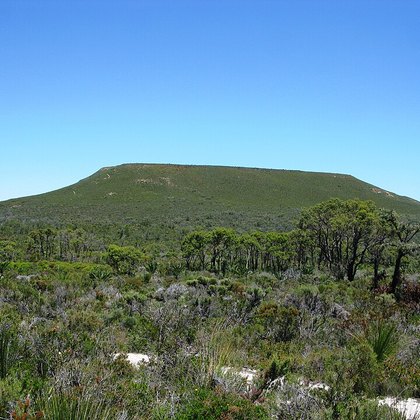 Kwongan heath F2
Mount Michaud, Lesueur National Park, West-Australië · Aussie Oc · CC BY-SA 3.0
30 species
Kwongan heath F2
Mount Michaud, Lesueur National Park, West-Australië · Aussie Oc · CC BY-SA 3.0
30 species
The species-rich sandplain heath of south-west Australia: low dense shrubs on deeply leached, exceptionally infertile sand, with banksia, hakea, grasstree and hundreds of herbaceous species on a single site. Where mallee eucalypts rise above it the stand becomes F1; where jarrah or wandoo form a canopy it is G2. Its eastern counterpart is F3. The core lies on the Geraldton and Eneabba sandplains, at Lesueur, in the Stirling Range, at Fitzgerald River and around Esperance. Fire returns every ten to thirty years. New Holland Honeyeaters follow the banksia flowering, Noisy Scrubbird and Western Bristlebird keep to the oldest thickets, and Malleefowl work the margins.
-
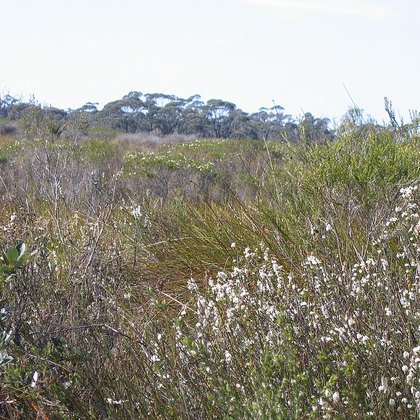 Eastern heathland F3
Barren Grounds Nature Reserve, Nieuw-Zuid-Wales · Babstar · CC BY-SA 3.0
41 species
Eastern heathland F3
Barren Grounds Nature Reserve, Nieuw-Zuid-Wales · Babstar · CC BY-SA 3.0
41 species
Low dense shrub heath on poor sands and sandstone along the east coast, from the wallum of Banksia aemula in Queensland through the sandstone plateaux around Sydney to Croajingolong and Tasmania. It seldom exceeds two metres: banksia, leptospermum, epacris, allocasuarina and grasstree. Where a eucalypt canopy closes above it the stand is G2; where the ground stays wet year-round it belongs with D2; on mobile sand the dune (B1) takes over. Its western counterpart is kwongan (F2). Time since fire again shapes the bird community. New Holland Honeyeaters come to banksia and epacris, while Brown Thornbill, Splendid Fairywren and Grey Fantail keep to the shrub layer.
-
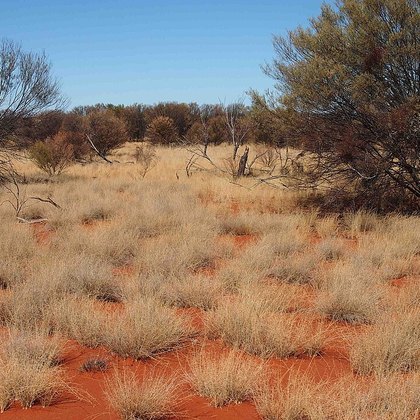 Mulga and acacia shrubland F4
centraal Australië, Noordelijk Territorium · Mark Marathon · CC BY-SA 4.0
87 species
Mulga and acacia shrubland F4
centraal Australië, Noordelijk Territorium · Mark Marathon · CC BY-SA 4.0
87 species
Acacia aneura and related wattles on red loam, three to eight metres tall, with bare ground or thin grass between the stems. Mulga covers roughly a fifth of arid Australia, from the Mulga Lands of western Queensland and New South Wales to the Murchison and Gascoyne. Brigalow on clay soils is a woodland of its own (G4); on sandplains spinifex grassland (E3) takes over, on limestone plains chenopod shrubland (F5) and on stony ground the gibber plain (H1). Mulga often stands in bands that harvest run-off; fire kills it outright. Emu, Australian Bustard and Galah walk the open ground, Wedge-tailed Eagles nest in the tallest crowns and Crested Bellbird stays in the scrub.
-
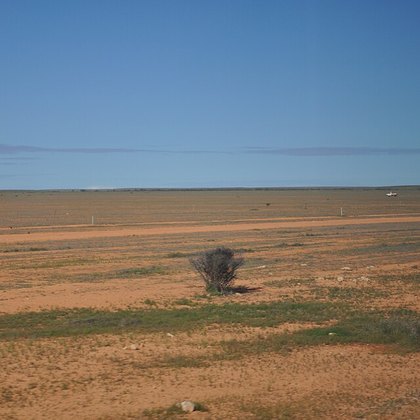 Chenopod shrubland F5
Nullarbor, Zuid-Australië · ross bate · CC BY 3.0
56 species
Chenopod shrubland F5
Nullarbor, Zuid-Australië · ross bate · CC BY 3.0
56 species
Grey-green saltbushes barely a metre high on limestone and clay plains: Atriplex vesicaria and the bluebush Maireana, widely spaced over bare ground. The formation runs across the Nullarbor, the riverine plain of western New South Wales and the country around Lake Eyre, on 150 to 250 millimetres of rain. On red loam with acacia mulga (F4) begins, on cracking clay the Mitchell grass downs (E1), within reach of salt tidewater the samphire (B5) and in the basin floor the salt lake (H4). A century and a half of sheep has thinned the shrub layer. Emu and Australian Pratincole walk the flats, Nankeen Kestrels hover above them and Plains-wanderer keeps to the lowest cover.
-
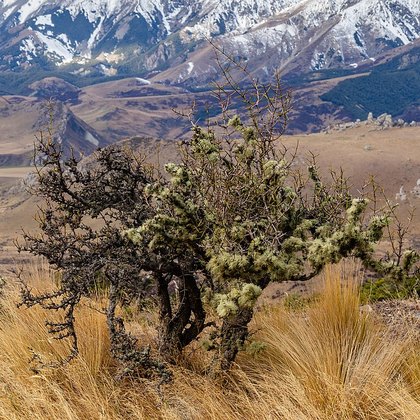 Manuka and matagouri scrub F6
Leith Hill, Canterbury · Michal Klajban · CC BY-SA 4.0
43 species
Manuka and matagouri scrub F6
Leith Hill, Canterbury · Michal Klajban · CC BY-SA 4.0
43 species
New Zealand scrub on infertile ground, reverting pasture and dry terraces. Manuka and kanuka together make up some three million hectares of regenerating shrubland, matagouri stands as a thorny bush among the short tussock of the dry eastern South Island, and gorse and broom take the rougher slopes. Usually this is a stage in transit: once the canopy closes and podocarps push through it becomes G8; once the woody cover fails, tussock grassland (E2) remains. Tui and Silvereye come to the manuka blossom, Tomtit and Whitehead work the branches, and North Island Brown Kiwi forage at night in old kanuka. California Quail, Cirl Bunting and Dunnock are introduced.
Forest and woodland G
Everything with a canopy that closes or nearly closes, from low woodland to forest eighty metres tall; shrubland without a tree layer belongs to scrub and heath. The division runs geographically first. On the Australian side stands eucalypt forest, split by moisture into wet, dry and creek-line types, with brigalow, casuarina and callitris and the closed rainforests of north and east. On the New Zealand side stand three forests of its own: southern beech in the mountains, podocarps over broadleaf in the lowlands, kauri in the far north.
-
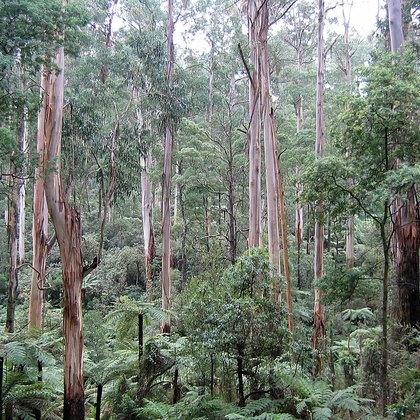 Wet sclerophyll forest G1
Sherbrooke Forest, Dandenong Ranges, Victoria · Patche99z · Public domain
124 species
Wet sclerophyll forest G1
Sherbrooke Forest, Dandenong Ranges, Victoria · Patche99z · Public domain
124 species
Eucalypt forest of thirty metres and more over a soft understorey: tree ferns, broad-leaved shrubs and climbers on deep moist soil with well over a thousand millimetres of rain. It is that understorey, not the canopy, that separates it from dry sclerophyll forest, where the shrubs are small and hard and grass covers the ground; once the eucalypts drop out and a broadleaf canopy closes, the ground belongs to rainforest or beech forest. Mountain ash, alpine ash and messmate carry it in the Victorian highlands and Tasmania, karri in the south-west. Superb lyrebird rakes the litter, Satin bowerbird and Eastern whipbird keep to the understorey, White-throated treecreeper works the trunks, Sulphur-crested cockatoo breeds in old hollows and Sooty owl hunts the gullies.
-
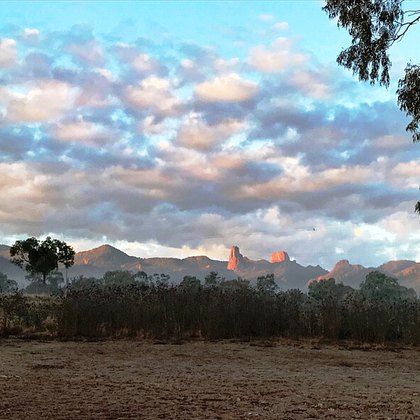 Dry sclerophyll forest and woodland G2
Warrumbungle National Park, Nieuw-Zuid-Wales · Judychristie · CC BY-SA 4.0
247 species
Dry sclerophyll forest and woodland G2
Warrumbungle National Park, Nieuw-Zuid-Wales · Judychristie · CC BY-SA 4.0
247 species
Eucalypt forest of ten to thirty metres and the opener woodland behind it, on poor ground with five hundred to twelve hundred millimetres of rain. The understorey is hard, sclerophyll shrubs or grass and no tree ferns, which sets it apart from wet sclerophyll forest. Against mallee the line is growth form: multi-stemmed stools on a lignotuber there, a single trunk under a crown here. Jarrah and wandoo in the south-west, box and ironbark on the Victorian goldfields soils. A usable hollow takes over a century to form, and Sulphur-crested cockatoo, Eastern rosella and Sooty owl depend on old trees. Red wattlebird and New Holland honeyeater follow the winter blossom, Noisy miner evicts the small species, White-throated treecreeper and Striated pardalote work the bark.
-
 River red gum and creek-line woodland G3
Murrumbidgee, Nieuw-Zuid-Wales · MargaretRDonald · CC BY-SA 4.0
170 species
River red gum and creek-line woodland G3
Murrumbidgee, Nieuw-Zuid-Wales · MargaretRDonald · CC BY-SA 4.0
170 species
Narrow belts of trees along creeks and across floodplains, carried by the water that passes through rather than the rain that falls: river red gum in the south and east, coolibah on the northern plains. That is what separates them from the dry eucalypt forest around them, which lives on rainfall, and from paperbark swamp forest on permanently wet peat; the water itself counts as river and creek. Red gums of two to three centuries carry hollows of every size, in which Galah and Crimson rosella breed and Tawny frogmouth and Australian owlet-nightjar spend the day. White-winged choughs work the ground in small parties, and Grey-crowned babbler builds its stick nest in the crown.
-
 Brigalow G4
Brigalow Belt, Queensland · Mark Marathon · CC BY-SA 3.0
4 species
Brigalow G4
Brigalow Belt, Queensland · Mark Marathon · CC BY-SA 3.0
4 species
Dense Acacia harpophylla forest on heavy cracking clay, nine to twenty-five metres tall and a sombre grey-green from the sickle-shaped phyllodes. It runs from Narrabri in New South Wales to Charters Towers in Queensland, on five hundred to seven hundred and fifty millimetres of rain. Against inland acacia shrubland it is true forest with a canopy above head height; against eucalypt forest it stands on clay rather than sand or stone. Belah, wilga and false sandalwood grow with it. The tree suckers back from its roots after cutting, but most has been cleared for pasture and what is left lies in strips along roads and fences. What breeds here feeds in the litter and on the lowest branches.
-
 Monsoon vine forest G5
Conway National Park, Queensland · John Robert McPherson · CC BY-SA 4.0
98 species
Monsoon vine forest G5
Conway National Park, Queensland · John Robert McPherson · CC BY-SA 4.0
98 species
Small closed patches of rainforest set in a savanna matrix, from under a hectare to a few hundred, on ground that fire does not reach: sandstone scree and gorges, coastal dunes and springs in the Kimberley, Arnhem Land, the Top End and Cape York. Part of the canopy drops its leaves in the dry season. That semi-deciduous habit and the island pattern are what separate it from tropical rainforest, which lies as a continuous evergreen belt along the far wetter east coast. Australasian figbird and Metallic starling come to the figs, Papuan pitta works the floor, Rufous owl hunts at dusk, and Trumpet manucode, Sahul sunbird and Ashy-bellied white-eye belong to the fauna that crossed from New Guinea.
-
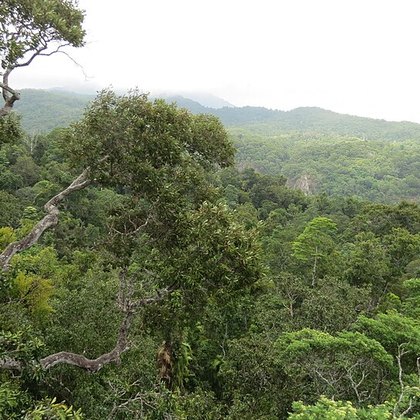 Tropical rainforest G6
Daintree, Queensland · Robert Linsdell · CC BY 2.0
125 species
Tropical rainforest G6
Daintree, Queensland · Robert Linsdell · CC BY 2.0
125 species
Closed multi-layered forest with emergents of twenty to forty metres, woody lianes, epiphytes, palms and gingers on the floor, under well over two thousand millimetres of rain and a short dry season. It forms a continuous belt along the coastal escarpments of the Wet Tropics between Ayton and Mount Spec, with an arm onto the Atherton Tableland, and further south stands as separate blocks at Lamington and Dorrigo. Unlike monsoon vine forest it stays green and depends on rainfall rather than shelter from fire; above a thousand metres it grades into forest of smaller leaves. Australian logrunner rakes litter sideways, Fernwren keeps to the uplands, Satin bowerbird builds its avenue, and Australasian figbird, Metallic starling and Brown cuckoo-dove follow the fruiting trees.
-
 Southern beech forest G7
Nelson, Zuidereiland · Michal Klajban · CC BY-SA 4.0
44 species
Southern beech forest G7
Nelson, Zuidereiland · Michal Klajban · CC BY-SA 4.0
44 species
Forest in which one or two southern beeches fill the whole canopy, over an open understorey of beech saplings and mossy trunks. In New Zealand red, black, hard and silver beech hold the lower ground and mountain beech runs to the treeline; in the beech gaps of Westland, Taranaki and Stewart Island it is simply absent. Against podocarp-broadleaf forest it lies higher, colder and poorer, and lacks the conifers that stand there above the broadleaf canopy. In Tasmania and the south-eastern highlands myrtle beech and Antarctic beech take that role. Rifleman works the bark, Whitehead and Tomtit search the crown, Tui comes for the honeydew of the beech scale insect and Kea drops in from the treeline; Superb lyrebird and Bassian thrush belong to the Tasmanian half.
-
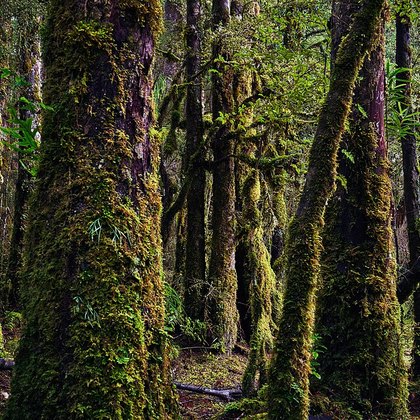 Podocarp–broadleaf forest G8
Pureora Forest Park, Noordereiland · Geoff McKay · CC BY 2.0
48 species
Podocarp–broadleaf forest G8
Pureora Forest Park, Noordereiland · Geoff McKay · CC BY 2.0
48 species
Five layers one above the other: emergent podocarps of thirty to fifty metres, rimu, totara, matai, kahikatea and miro, standing over a closed broadleaf canopy of tawa, kamahi, hinau and rewarewa, then tree ferns, shrubs and forest floor, with epiphytes and northern rata in the crowns. Those conifers rising clear of the broadleaf roof are what separate it from beech forest, where one or two species make the canopy and the understorey stays thin. It once covered the fertile lowlands and hill country; what is left lies mainly on the North Island and the West Coast. North Island brown kiwi works the litter at night, North Island kokako calls from a high branch, Tui and Stitchbird follow the flowering, and Rifleman, Tomtit and Whitehead work the branches.
-
 Kauri forest G9
Waipoua Forest, Northland · Prof.Chen Hualin · CC BY-SA 4.0
11 species
Kauri forest G9
Waipoua Forest, Northland · Prof.Chen Hualin · CC BY-SA 4.0
11 species
Agathis australis, its columnar trunk running branchless far up and its crown clear of everything else, on the poor sandy ridges of Northland, Coromandel and Great Barrier. The tree makes its own soil: a thick mat of slow-rotting litter and gum acidifies the ground and keeps the understorey low, with kauri grass and tanekaha beneath. That separates it from podocarp-broadleaf forest, which holds the richer gullies in the same hills, so the two interlock on a single slope. A fraction of the original 1.2 million hectares remains, Waipoua the largest block, and Phytophthora agathidicida now attacks the roots: there is no cure, only hygiene stations and closed tracks. North Island brown kiwi works the litter at night, Tui and Stitchbird follow the flowering and Rifleman works the bark.
-
 Casuarina and callitris woodland G10
Milbrulong State Forest, Nieuw-Zuid-Wales · B 897 · CC BY-SA 4.0
36 species
Casuarina and callitris woodland G10
Milbrulong State Forest, Nieuw-Zuid-Wales · B 897 · CC BY-SA 4.0
36 species
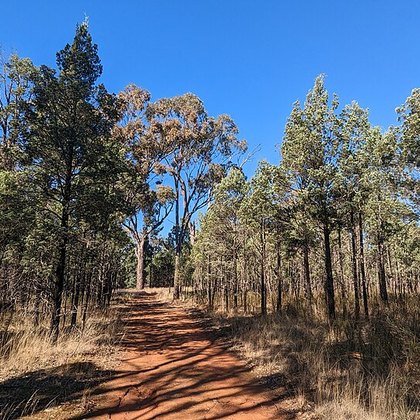
Forest and woodland of needle-leaved trees without eucalypts: white cypress pine on sand and sheltered rocky ridges, belah on clay in the brigalow country, tree casuarinas along the coast. The needle foliage casts deep shade and a dense litter mat in which little grass grows; that marks it off from the eucalypt forest it usually threads through as a strip, and unlike mulga it carries a real canopy. White cypress pine will not tolerate fire and returns after unburnt years in dense even-aged stands, its cones and hard seeds drawing cockatoos that work at them for days. Malleefowl rakes its mound out of the litter, Spotted quail-thrush walks the floor, Varied sittella and Eastern shriketit pick over the bark, and Tawny frogmouth spends the day against a trunk.
Desert and barren land H
Ground where vegetation gives way to stone, sand or salt and the surface itself defines the habitat. It takes in the pebble-paved plains of the south-eastern interior, the red dunefields of the sand deserts, bare rock faces and gorges, and the salt crust of the inland basins. Where a continuous layer of tussock or shrubs still holds on, the site belongs with the grasslands. Birds here live off what wind and chance deliver, and many species are present only in the months that follow rain.
-
 Gibber plain H1
Sturt National Park, Nieuw-Zuid-Wales · Peterdownunder · CC BY-SA 3.0
22 species
Gibber plain H1
Sturt National Park, Nieuw-Zuid-Wales · Peterdownunder · CC BY-SA 3.0
22 species
Plains paved throughout with close-packed silcrete pebbles polished by wind and sun, lying on hard and often saline clay: the Sturt Stony Desert and the country around Kati Thanda-Lake Eyre, reaching into western Queensland. Where hummocks take over the stone pavement, spinifex grassland begins; in the lowest hollows lies the salt lake. Vegetation is limited to scattered saltbush and Sclerolaena in the shallow drainage lines, with a brief carpet of annuals after rain. Australian Pratincole and Australian Bustard follow that flush and are gone again as the plain dries out, while Spotted Nightjar rests inconspicuously on the stone by day.
-
 Sand dune desert H2
Andado, Simpsonwoestijn, Noordelijk Territorium · Christopher Watson · CC BY-SA 3.0
11 species
Sand dune desert H2
Andado, Simpsonwoestijn, Noordelijk Territorium · Christopher Watson · CC BY-SA 3.0
11 species
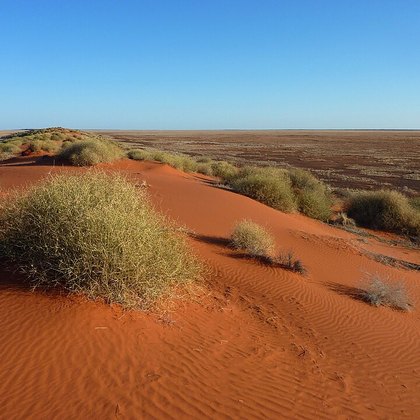
Long parallel ridges of red quartz sand, built by the south-easterly wind holding the same line for tens of kilometres: the Simpson, Great Sandy, Great Victoria and Tanami deserts. In the Simpson the ridges stand twenty to thirty-odd metres high and a few hundred metres apart, with bare, drifting crests. The swales between them carry spinifex, canegrass and scattered desert oak or mulga; once that cover sets the character the ground belongs with spinifex grassland, and where sand gives way to a stone pavement, with the gibber plain. Birds keep mainly to the dune base and the swales, where shade, seed and post-rain water are found; the bare crests are mostly just crossed.
-
 Rock, cliff and scree H3
Karijini National Park, Pilbara, West-Australië · Olivia Garrity · CC BY-SA 4.0
43 species
Rock, cliff and scree H3
Karijini National Park, Pilbara, West-Australië · Olivia Garrity · CC BY-SA 4.0
43 species
Solid rock without continuous cover: faces, gorges, boulderfields and scree. It takes in the dissected sandstone plateaus of the Kimberley, Arnhem Land and the Centralian ranges, the cliffs and gorges of the Pilbara and the South Australian ranges, and the screes and rock flats above the treeline in New Zealand. It differs from the gibber plain in having relief — ledges, crevices and overhangs — and from the sand deserts in being bedrock. Sandstone Shrikethrush and Spinifexbird work the sandstone walls, Spotted Quail-thrush the vegetated scree, Sooty Owl roosts by day in the gorges, and Nankeen Kestrel and Wedge-tailed Eagle nest on ledges. In New Zealand Kea search the boulderfields above the treeline.
-
 Salt lake and salt pan H4
Lake Gairdner National Park, Zuid-Australië · Murray Foubister · CC BY-SA 2.0
17 species
Salt lake and salt pan H4
Lake Gairdner National Park, Zuid-Australië · Murray Foubister · CC BY-SA 2.0
17 species
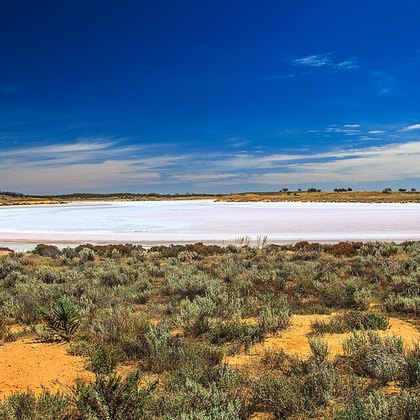
Flat basins floored with hard white salt crust in the lowest parts of the inland drainage systems: Kati Thanda-Lake Eyre, Lake Torrens, Lake Frome and hundreds of smaller lakes in the western deserts. Most years they are dry and wholly bare; a narrow band of samphire rings the shore, grading into shrubland, and where water stands on the lakes become inland water. When one does fill, brine shrimp hatch in millions within days and a breeding wave follows: Banded Stilt covers hundreds and sometimes over a thousand kilometres in a night to nest on the islands, Australian Pelican colonies form in the same places, and Grey Plover feeds on passage along the falling edge.
Farmland, gardens and plantations I
Ground whose vegetation has been replaced by crops, sown grass, planted trees or garden planting. Where pavement and buildings take over the pattern, built land (J) begins; where the original grass layer or canopy still stands, the country belongs to the grasslands (E), the scrub (F) or the forest (G). The group covers most of agricultural Australia and nearly all of lowland New Zealand. For birds everything turns on what was left between the crops: scattered trees, hedges, drain margins, flowering shrubs and drinking water through the dry season.
-
 Cropland and orchard I1
Northam, West-Australië · User:JarrahTree · CC BY 2.5 au
85 species
Cropland and orchard I1
Northam, West-Australië · User:JarrahTree · CC BY 2.5 au
85 species
Ground that is ploughed and harvested, with the standing plantings grown for fruit: cereals, rice, sugarcane, orchard and vineyard. Grazed rather than cut, it becomes pasture (I2); grown for timber, forestry plantation (I3). Dryland cropping covers not quite four per cent of Australia, mostly in the Western Australian wheatbelt; cane runs along the Queensland coast, rice sits in the Riverina, vineyards reach from the Barossa to Marlborough. Galah, Sulphur-crested Cockatoo and Crested Pigeon take spilt grain, Nankeen Kestrel hunts the stubble, and Silvereye, Eastern Rosella and Satin Bowerbird come to ripening fruit. Australasian Bittern and Australian Reed Warbler nest in the rice; Rook and Cirl Bunting hold New Zealand's arable ground.
-
 Pasture and rangeland I2
Southland, Zuidereiland · Ilya Grigorik · CC BY-SA 3.0
145 species
Pasture and rangeland I2
Southland, Zuidereiland · Ilya Grigorik · CC BY-SA 3.0
145 species
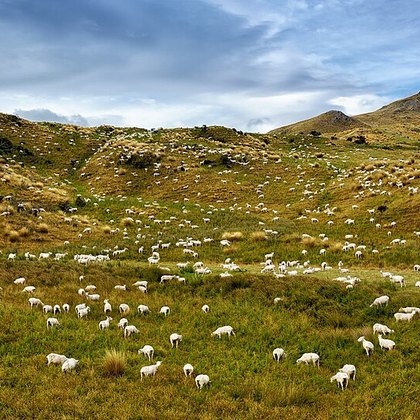
Grassland sown and fertilised for stock, with rougher grazed pastoral country. Where the sward is still native and only grazed, Mitchell grass downs (E1) and New Zealand tussock (E2) keep their place. Much Australian pasture is thinned woodland with paddock trees left standing; the canopy closing marks dry sclerophyll woodland (G2). Sown pasture covers a tenth of Australia against forty-five per cent under grazed native vegetation; New Zealand laid ryegrass and white clover over burnt forest and tussock. Masked Lapwing, Welcome Swallow, Australian Magpie and Magpie-lark work the short grass, White-faced Heron and Little Raven follow the stock, Wedge-tailed Eagle hunts above, and Common Starling, Eurasian Chaffinch and Purple Swamphen fill the New Zealand paddocks.
-
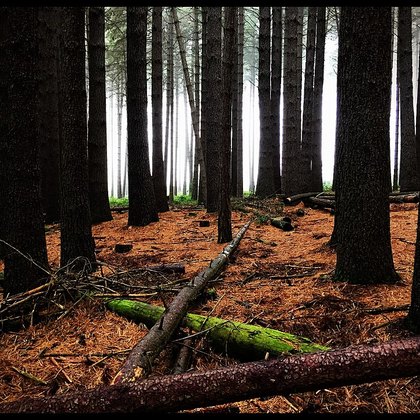 Forestry plantation I3
Bago State Forest, Laurel Hill, Nieuw-Zuid-Wales · Burraburra · CC BY-SA 4.0
28 species
Forestry plantation I3
Bago State Forest, Laurel Hill, Nieuw-Zuid-Wales · Burraburra · CC BY-SA 4.0
28 species
Trees planted in even-aged blocks and harvested for timber, with clearfell, young stands and closed canopy side by side. That separates it from native forest (G7, G8) and from the orchard (I1), which is grown for fruit. New Zealand holds about 1.8 million hectares of productive planted forest, nine tenths of it Pinus radiata and centred on Kaingaroa; Australia planted radiata across the south-east and eucalypt for pulpwood. The birds follow the rotation. Whitehead and Tomtit forage in older stands with a shrub layer, North Island Brown Kiwi hold whole territories inside the Northland pines, Eurasian Chaffinch and Dunnock take the young plantings, and Rook works the clearfell.
-
 Gardens and parks I4
Maleny, Queensland · S. Newrick · CC BY-SA 4.0
198 species
Gardens and parks I4
Maleny, Queensland · S. Newrick · CC BY-SA 4.0
198 species
Ground where planting has the upper hand: gardens, parks, cemeteries, golf courses and street-tree avenues. Once roofs and pavement set the pattern, town and city (J1) begins; unlike forest (G), species, watering and cultivars are chosen. Australian suburbs are low and spacious, with watered lawn, grevilleas, callistemons and exotic trees in nectar almost year round. That favours the larger honeyeaters: where nectar shrubs are thick, Noisy Miner and Red Wattlebird keep smaller songbirds out, and Brown Thornbill and Superb Fairywren hold on where the shrub layer is dense. Rainbow Lorikeet and Sulphur-crested Cockatoo come in flocks, Eurasian Coot and Maned Duck use the ponds, and Common Starling, Common Blackbird, House Sparrow and Common Myna peak here.
Built and industrial J
Ground whose character is set by structures and hard surfaces: houses, streets, quays, quarries, tips and treatment ponds. Where planting takes over, in parks and gardens, I4 begins; beyond that lie cropland and pasture. Australia and New Zealand are among the most urbanised countries on earth, with almost every city on the coast. Buildings serve as cliffs, mown lawn as short grassland and waste as an inexhaustible food supply. Some species have become more numerous here than they ever were before; others vanished with the first street.
-
 Town and city J1
Harrow, Victoria · Mattinbgn · CC BY-SA 3.0
82 species
Town and city J1
Harrow, Victoria · Mattinbgn · CC BY-SA 3.0
82 species
Built-up ground where roofs, walls and hard surfaces set the pattern, with street trees, lawn and back gardens between them. Where planting dominates it passes into gardens and parks (I4); past the edge of town, pasture (I2) begins. Australian cities are spacious and low-built, with flowering eucalypts and figs along the streets and watered grass, so that nectar and water are available all year. Rainbow Lorikeet, Sulphur-crested Cockatoo and Galah roost here in flocks, the Noisy Miner drives smaller birds out of whole suburbs, and Australian Magpie, Magpie-lark, Willie Wagtail and Laughing Kookaburra breed into the centre. Common Starling, House Sparrow, Common Blackbird and Common Myna came with the settlers.
-
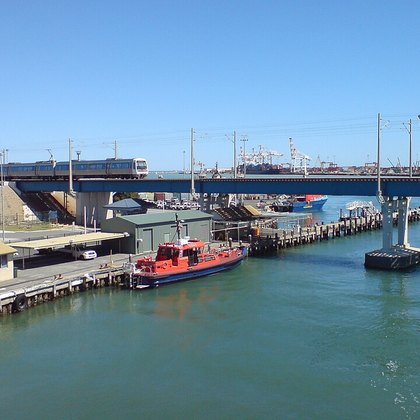 Harbour, industry and quarry J2
Fremantle, West-Australië · Ingolfson · Public domain
16 species
Harbour, industry and quarry J2
Fremantle, West-Australië · Ingolfson · Public domain
16 species
Quays, container yards, breakwaters, tank farms, rock quarries, gravel and sand pits and road cuttings: places where concrete and exposed rock make the surface. Where housing starts, J1 begins; where the natural shore starts, the rocky coast (B2) or the tidal flats (B3) do, and a dredged harbour keeps its mudflats with B3. To birds all this presents itself as something else: a breakwater works as a rocky shore, a stripped quarry floor as stony plain, a cut sand face as a riverbank, and the wet pits left behind as ponds. Little Pied Cormorants dry off on piles and pontoons, and White-backed Swallow and Rainbow Bee-eater dig nest tunnels in the bare sand faces.
-
 Landfill and wastewater J3
Australië · Ropable · Public domain
34 species
Landfill and wastewater J3
Australië · Ropable · Public domain
34 species
Tips and sewage works. The ponds resemble lakes (C1), but they are managed, extraordinarily nutrient-rich and never dry out; any natural marsh alongside belongs with C1 or D1. That is exactly why treatment ponds are among the best places in Australia to watch waterbirds: the Western Treatment Plant at Werribee covers 110 square kilometres, has been a Ramsar site since 1983 and has produced some 270 species, from ducks and waders to the last wintering Orange-bellied Parrots. At the tip itself, thousands of birds come to organic waste. Australian White Ibis and Silver Gull are the most numerous, Australasian Grebes breed on the ponds, and Common Myna and House Sparrow live around the buildings.