All species › Swifts › Swifts › House Swift
House Swift | Apus nipalensis
Grote huisgierzwaluw | Vencejo oriental
The House Swift is an Asian swift that appears in Australia only as a vagrant: small, short and blunt in build, with a broad white rump band and an all but square tail. It almost always turns up in the north and almost always among the hundreds of Fork-tailed Swifts hunting over Darwin and Broome in the wet season — and that is where it has to be picked out.

Voice
In Australia it is practically always silent, and every record has been settled by eye rather than by ear. On its Asian breeding grounds it is the opposite: around the colony comes a fast, high trilling ti-ti-ti-titirrrrr, a rattling scream from a roof edge or a bridge pier where dozens of pairs nest together. Anyone finding it in Australia should not count on voice; wing shape, tail and rump band have to carry the record.
Recording: Greg Irving — CC BY-NC-SA 4.0 · CCT Building, Phayathai Road, Ratchathewi, Bangkok, Thailand · xeno-canto
Identification
A small, compact swift of fourteen to sixteen centimetres, blackish-brown to black and darker than most relatives, with short, relatively broad and bluntly ending wings and a short tail with at most a shallow notch — usually simply square in flight. Across the rump runs a broad, sharply defined white band that reaches onto the flanks, and the throat carries a dirty-white patch. The underparts are otherwise plain dark, without the pale feather fringes that give the Fork-tailed Swift its scaly look. The flight seems shorter, stiffer and more fluttering than that of the big swifts, with faster beats and shorter glides.
Confusion species
Fork-tailed Swift (Apus pacificus) is the species it is always mixed in with and the only real problem: it is longer and slimmer in the body, with longer and more pointed wings, a clearly forked tail often spread on the glide, a narrower white rump band and — the surest mark — white feather fringes below that give a fine scaled pattern at close range. White-throated Needletail (Hirundapus caudacutus) is much larger and barrel-shaped, with no white rump but a white horseshoe under the tail. Fairy Martin (Petrochelidon ariel) also has a pale rump, but is smaller, flies with a flutter and has a rusty head. A vagrant needs careful documentation: the combination of short blunt wings, shallow-forked tail, broad rump band and absence of scaling is what carries the report.
Habitat
In Asia it is a thoroughgoing follower of people, nesting under eaves, on bridges, in stairwells and against rock faces and hunting over towns, villages and farmland. The Australian records fit that picture: the birds are seen over the suburbs and the harbour of Darwin, over Broome and over pasture and savanna in the coastal belt, almost always in company with feeding swifts and martins and usually in the hours before or during a monsoon shower, when insects are lifted aloft.
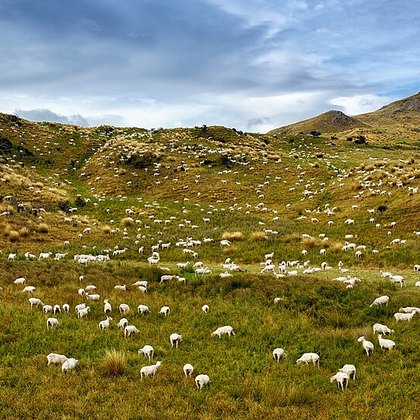
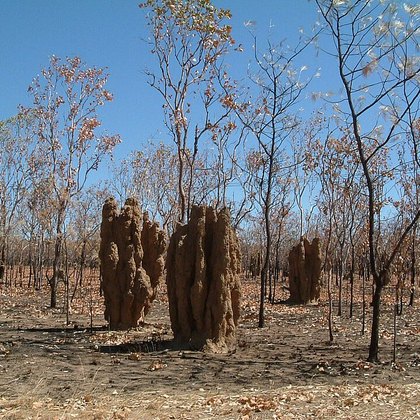
Where the bird is most often found, arranged by main group and formation.

Range and movements
Within the map window of this guide, only as a vagrant to northern Australia, above the Tropic of Capricorn. To 2022 there were thirty-seven accepted Australian records: sixteen in Western Australia (mostly Broome), nine in the Northern Territory, six in Queensland and the remainder in the Indian Ocean territories. The first was an injured bird at Point Stuart, some hundred and twenty kilometres east-south-east of Darwin, in 1979; the number of records per decade has risen since. Sightings fall between November and May with a peak from January to April, that is in the monsoonal wet season. In early 2019 a small influx appeared over Darwin, with six records between 27 January and 13 May and up to seven birds at once, each time among flocks of Fork-tailed Swifts up to six hundred strong. There has never been any evidence of breeding in Australia. The species has not been recorded in New Zealand.
- Breeding (summer)
- Passage
- dark = core range, pale = thinly spread
Where and when to look
Do not look for it on its own; find a large flock of feeding Fork-tailed Swifts in the wet season over Darwin or Broome and work through it. Watch for a bird that looks shorter and blunter, with a faster wingbeat, and that does not spread its tail; then check the width of the rump band and the underparts, which in this species stay plain dark. Take photographs — a vagrant identification hangs on a single good image of tail and rump — and submit the record to the Australian rarities committee.
Conservation
Least Concern (LC): in Asia the species is numerous and expanding, helped by thriving around human buildings, which offer it abundant nest sites. For Australia conservation is not quite the word, since there is no Australian population; what is interesting is the movement the other way. The authors of the Australian review point out that the species is spreading ever closer to Australia through the Indonesian islands and that a first mainland breeding record is conceivable in time.
Scientific name
Apus nipalensis | (Hodgson, 1837)
Hodgson described the bird in 1837 as Cypselus nipalensis; because it was later moved to another genus, author and year stand in parentheses. The genus Apus was introduced by Scopoli in 1777, after Greek apous, 'without feet' — the old notion that swifts had no legs, because they were never seen on the ground. nipalensis means 'from Nepal', after the type locality in the centre of that country. For a long time the bird was treated as a subspecies of the Little Swift (Apus affinis), under the name Apus affinis subfurcatus; the Dutch name 'grote huisgierzwaluw', great house swift, preserves both that relationship and the difference in size.