All species › Waders, gulls and terns › Sandpipers and allies › Little Stint
Little Stint | Calidris minuta
Kleine strandloper | Correlimos menudo
The Little Stint is a vagrant from the western Palearctic: a sparrow-sized wader that reaches Australia in small numbers in most years and New Zealand just three times in all. It is the smallest wader in the region, and it shows up only if you work through the flocks of Red-necked Stints bird by bird.
Voice
A short, sharp, high stit, sometimes in a quick series, stit-stit-stit, on take-off. The call resembles that of Red-necked Stint so closely that in the field it is barely usable as a distinguishing mark.
Recording: Stanislas Wroza — CC BY-NC-SA 4.0 · Soppavann, Finland · xeno-canto
Identification
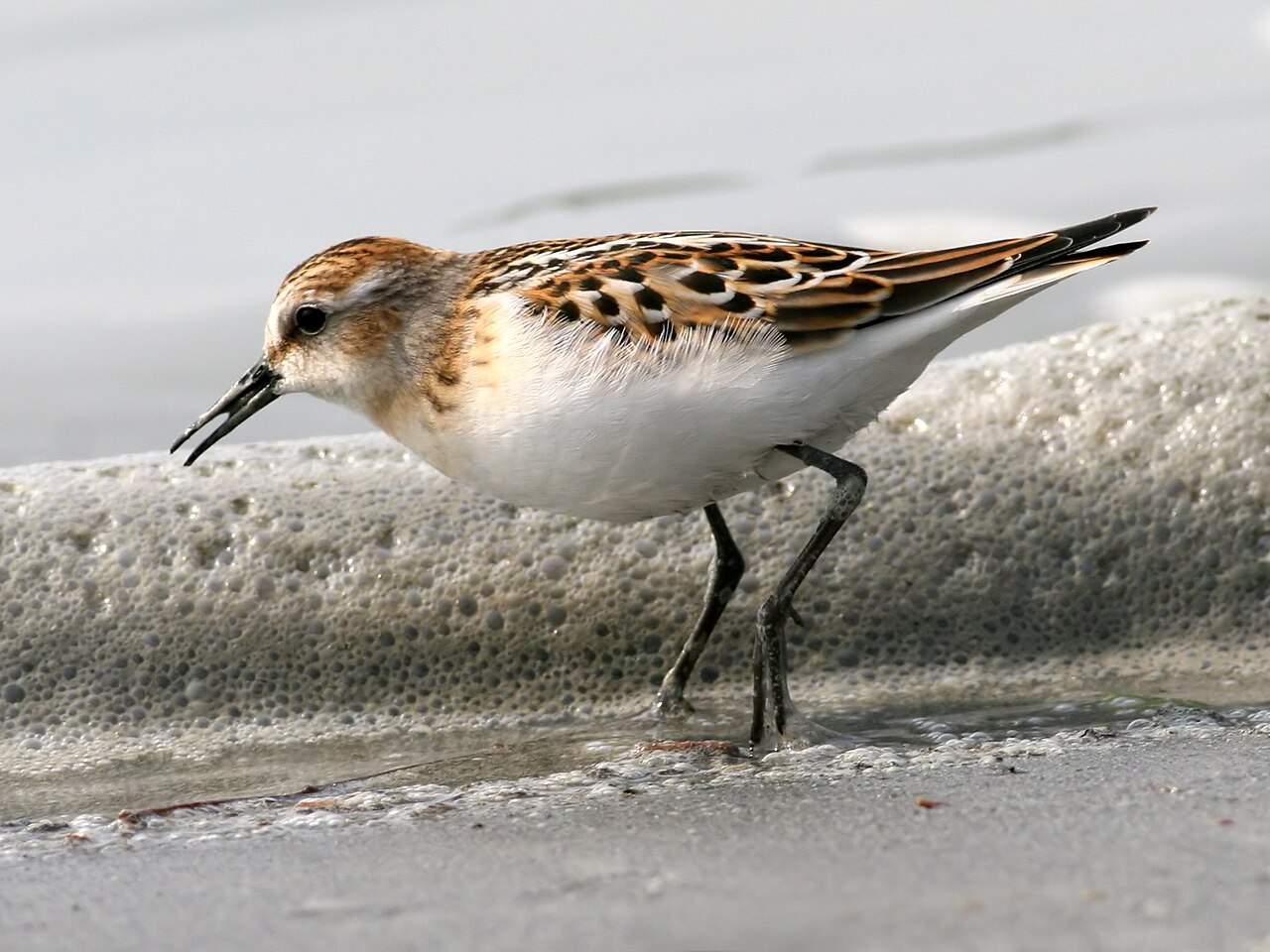
Twelve to fourteen centimetres: with Red-necked Stint the smallest wader in the guide. The bill is black, straight, short and fine, with a clearly pointed tip and no swelling. The legs are black, the toes unwebbed, and the primaries project well beyond the tail. In every plumage the throat is cream-white. Juvenile plumage is brighter and more rufous than on the related species: the mantle and scapular feathers carry pale straw-coloured fringes that together form a clear white V on the back. In breeding plumage head, neck and breast sides turn orange-red, but the throat stays white.
Confusion species
Red-necked Stint (Calidris ruficollis) is the bird it almost always travels with, and the only real look-alike: slightly bigger and longer-bodied, with a blunter bill that thickens a little at the tip, greyer and plainer in non-breeding dress without the pale mantle lines, and in breeding plumage with a brick-red throat and face against the always-white throat of Little Stint. Long-toed Stint (Calidris subminuta) is just as small but has yellow to greenish legs rather than black ones, longer toes, a longer neck and a more upright stance. Broad-billed Sandpiper (Calidris falcinellus) is larger, with a longer bill kinked down at the tip and a split supercilium. Sanderling (Calidris alba) is much bigger, whiter and lacks a hind toe.
Habitat
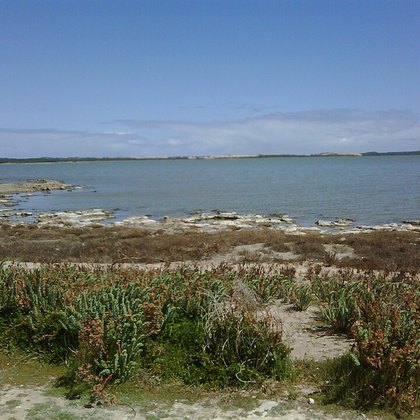
Saltmarsh and samphire flats, shallow brackish pools, the edges of tidal mud and the ponds of saltworks and treatment plants, where it runs along with the Red-necked Stints. Elsewhere in its range it uses fresh water as readily as brackish.
Where the bird is most often found, arranged by main group and formation.


Range and movements
In this map window a vagrant, but one that turns up somewhere in most years. In Australia most records come from the south-east — the Werribee treatment ponds and the bays of Victoria, the Coorong and the South Australian salt pans — and almost always in the southern summer, between November and March. In New Zealand there are three accepted records in all, every one of them from Lake Ellesmere: one bird from November 1992 to April 1993, one from January to April 1995 and one in March 2010.
- Non-breeding visitor
- dark = core range, pale = thinly spread
Where and when to look
Go to a saltworks or treatment pond with a big flock of Red-necked Stints between November and February and take your time. Look for a bird that reads rustier, with pale mantle lines forming a V, and check the throat: cream-white, even when its neighbours are red. Photograph whatever you find — the fine bill tip and the wing-point projection are easier to judge afterwards than through the scope.
Conservation
Least Concern (LC): the species breeds across the Eurasian Arctic and winters in enormous numbers in Africa, the Middle East and southern Asia, far outside this region. What appears here are stray birds off course, so no local trend can be measured. The pressure on the flyways where it is genuinely numerous, above all the loss of wetlands in southern Asia, applies to it all the same.
Scientific name
Calidris minuta | (Leisler, 1812)
Leisler described the species in 1812 as Tringa minuta; the move into Calidris puts author and year in parentheses. The epithet minuta is Latin for 'small', and the genus Calidris goes back to Greek kalidris, Aristotle's word for grey waterside birds. The type locality lies in Germany, at Hanau, the town where Leisler worked as a physician and ornithologist. The Dutch and English names both say simply that this is the smallest of its kind.