All species › Waders, gulls and terns › Sandpipers and allies › Nordmann's Greenshank
Nordmann's Greenshank | Tringa guttifer
Nordmanns groenpootruiter | Archibebe moteado
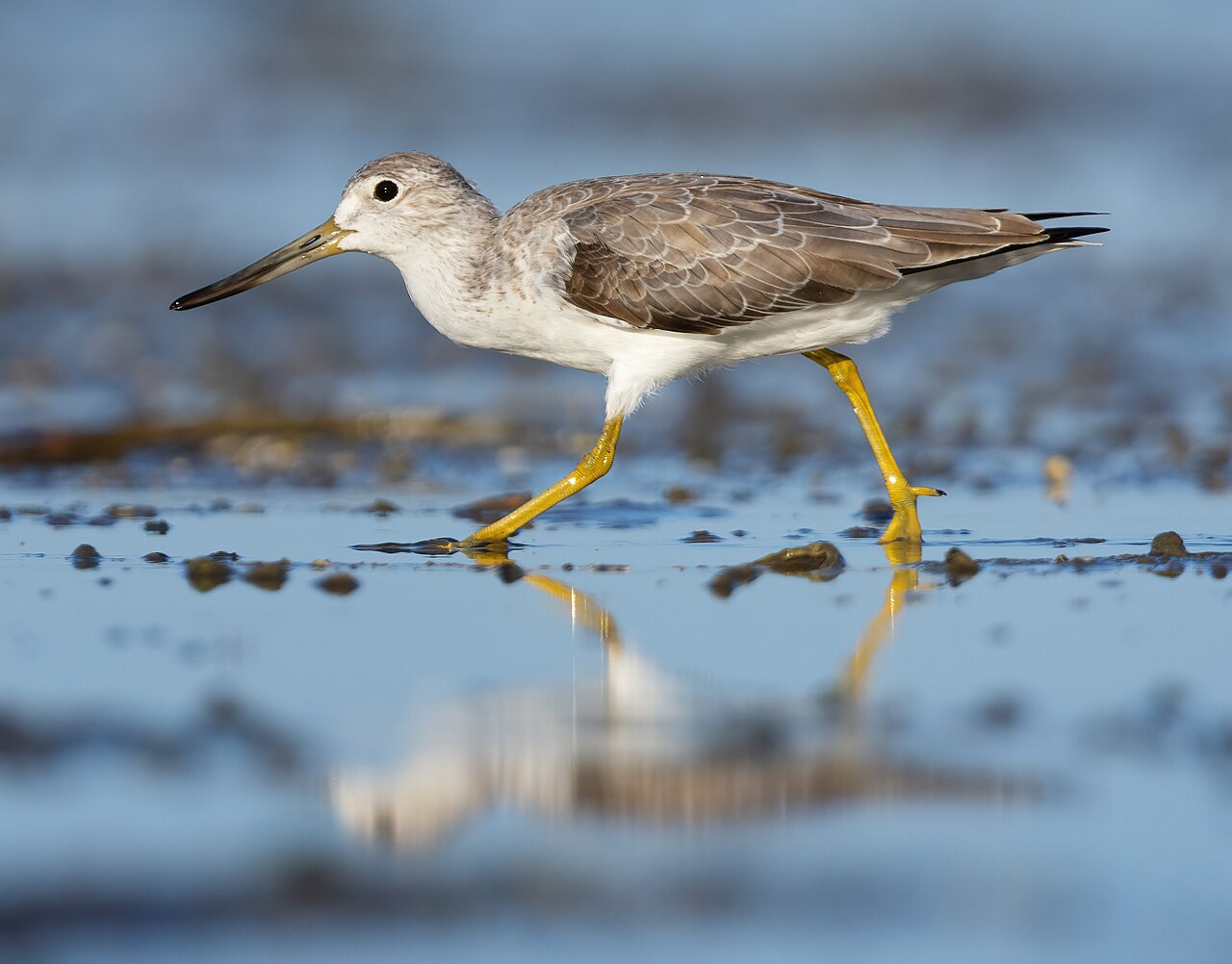
Nordmann's Greenshank is the rarest wader that can turn up in this map window and one of the most threatened shorebirds in the world: only fifteen hundred to two thousand birds remain. It closely resembles Common Greenshank, but is more compact, has strikingly short yellow legs, a thick bicoloured bill and, uniquely among the shanks, webbing between the front toes.
Voice
Calls are sparsely documented, because the species is rare everywhere. The flight call is a sharp, slightly hoarse, two-syllable kyew or kee-yew, lower and rougher than the clear three-note whistle of Common Greenshank and usually given in single notes rather than a series. Birds on the flats are silent. When flushed a short hard alarm note is sometimes heard. Anyone not certain of the difference from greenshank must fall back on appearance — and with this species that is clear enough.
Recording: Rolf A. de By — CC BY-NC-SA 4.0 · Sonadia Island, NW of Cox's Bazar, Chittagong Division, Bangladesh · xeno-canto
Identification
A compact shank of twenty-nine to thirty-two centimetres, grey above with white feather edges and white below. The decisive mark is the build of the legs: short and dull yellow, they barely project beyond the tail in flight, where those of Common Greenshank clearly trail behind it. The bill is heavy, thick and yellow-green at the base, black towards the tip, and rises slightly — a bicoloured, somewhat wedge-shaped affair. Alone among the shanks it has webbing between the front toes, visible in photographs of walking birds. In breeding plumage the neck and breast carry broad blackish crescentic spots; in non-breeding plumage the head and underparts are strikingly white. In flight a white wedge runs up the back and the underwing is almost entirely white.
Confusion species
Common Greenshank (Tringa nebularia) is the only real trap and is thousands of times more numerous in this region; expect that species first. The differences: greenshank is slimmer and longer-legged, with yellow-green to blue-green legs that trail beyond the tail in flight, a thinner bill without clear two-tone colouring and without webbing, and streaking rather than broad crescents in breeding plumage. Marsh Sandpiper (Tringa stagnatilis) is much smaller and finer, with very long legs. Grey-tailed Tattler (Tringa brevipes) also has short yellow legs, but is plain grey with no white back wedge. Every claim here needs photographs of legs, bill and the back pattern in flight: the species cannot be accepted on sight alone.
Habitat
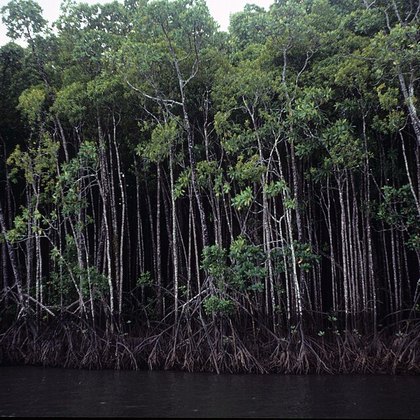
Outside the breeding season strictly a bird of intertidal mud: the broad, soft flats of estuaries and large bays, and within them the edges by mangrove and the channels that drain last. It feeds walking and probing in shallow water, often in company with Common Greenshank, and at high water uses the same sandbars and marsh edges as the rest of the wader flock. Fresh inland water it avoids almost entirely.
Where the bird is most often found, arranged by main group and formation.

Range and movements
Within this map window a vagrant of the outermost edge: there are only a handful of Australian records, nearly all from the northwest and north — the flats around Broome and Roebuck Bay and the Top End coast — and every sighting must be carefully documented. It does not reach New Zealand or Norfolk Island. The normal wintering range lies far further north, in Bangladesh, Thailand, Cambodia, Vietnam and Malaysia; the birds appearing here have overshot it by a great distance.
- Breeding (summer)
- dark = core range, pale = thinly spread
Where and when to look
Assume Common Greenshank until proved otherwise, and prove it on three points: do the legs sit strikingly short under the body, is the bill base thick and yellow against a black tip, and do the toes stay within the tail as the bird flies off? Photograph the foot itself if you possibly can, because the webbing between the front toes is the one mark about which no argument is possible. Search at Broome and Roebuck Bay, where most Australian candidates have appeared.
Conservation
Endangered (EN): a 2023 estimate puts the total at fifteen hundred to two thousand adults. The entire world population breeds in a narrow strip along the southwestern and northern coasts of the Sea of Okhotsk and on Sakhalin, in coastal larch bogs — a breeding range so small that a single oil spill or one large logging operation touches a measurable share of the species. On migration it depends wholly on the intertidal flats of the Yellow Sea, more than half of which have been reclaimed, and on the Southeast Asian wintering grounds shorebirds are still taken in nets. There is as yet no comprehensive international recovery plan; the main measures so far are the protection of individual tidal areas, such as the Inner Gulf of Thailand and the Chinese coastal reserves inscribed as World Heritage since 2019.
Scientific name
Tringa guttifer | (Nordmann, 1835)
Alexander von Nordmann, a Finnish-German zoologist who worked in Odessa and Helsinki, described the species in 1835 as Totanus guttifer, with Okhotsk on the sea of that name as the type locality; because of the move to Tringa, author and year stand in parentheses. The epithet is built from Latin gutta, 'drop, spot', and ferre, 'to bear': the spot-bearer, after the broad black marks of the breeding plumage. For a long time the species stood in its own genus Pseudototanus; DNA work published in 2019 placed it in Tringa, with the Willet as its closest relative. The English and Dutch names honour the describer.